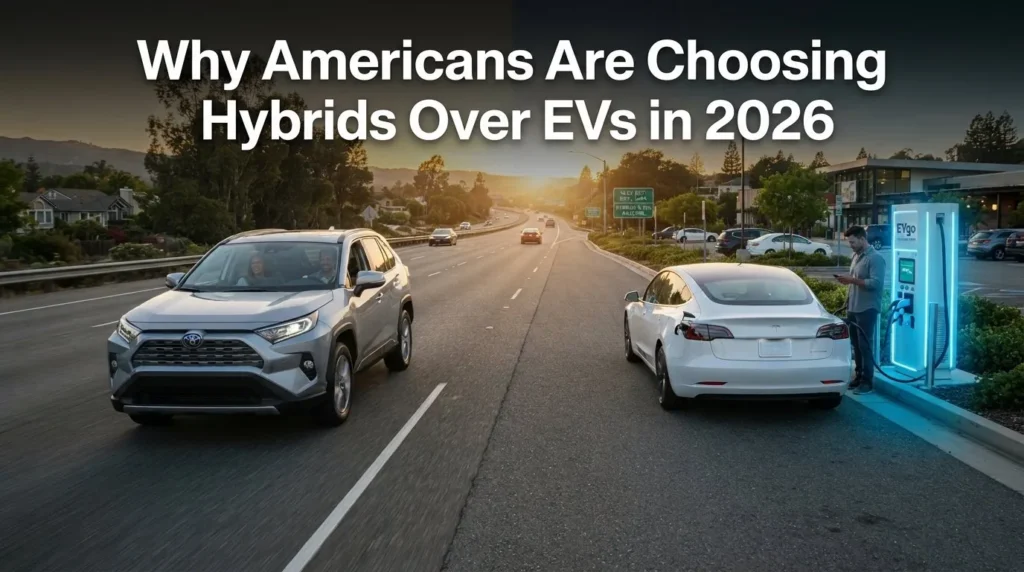

Americans are not giving up on electrified cars. They are skipping the plug. Hybrids hit a record 16.3% of US new-vehicle sales in mid-2026, while pure EVs slid to about 6.5% in the third quarter, down from more than 10% a year earlier. With gas above $4 a gallon for most of the year, buyers wanted lower fuel bills, and most of them chose the car that does not ask them to change their routine.
Autoakhbar Quick Verdict
- Who should buy a hybrid: Drivers without home charging, anyone who tows or drives long highway distances, and buyers who want lower fuel costs without a price jump.
- Who should still consider an EV: Home-charging owners with predictable daily driving, especially where gas is expensive.
- Biggest reason hybrids are winning: Price and convenience, not ideology.
- Biggest caveat: Part of the hybrid surge is simply that automakers are offering more hybrids and fewer gas-only trims.
Table of Contents
The Numbers: Hybrids Up, EVs Down
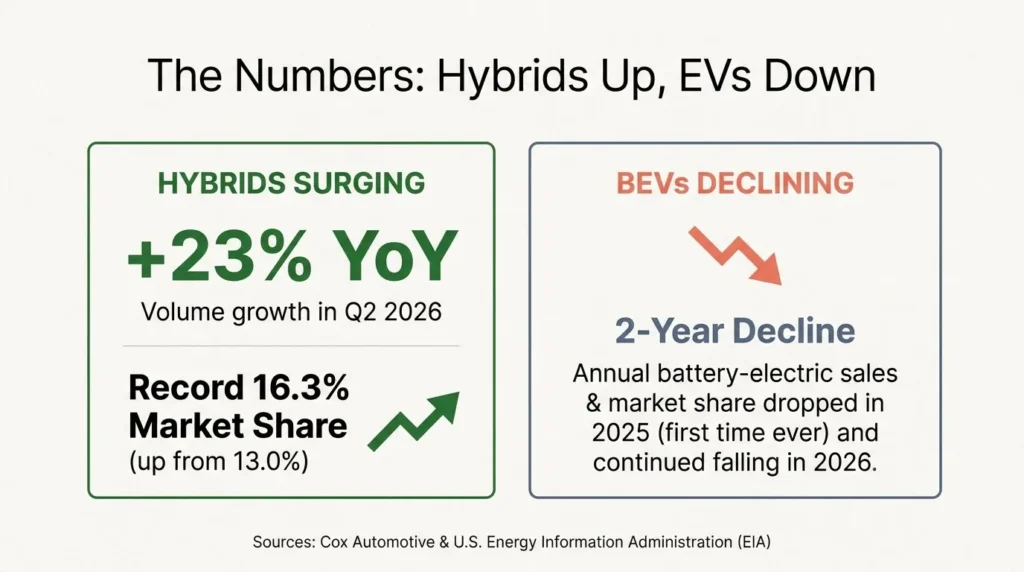
According to Cox Automotive, hybrid volume rose 23% year on year in Q2 2026, lifting share to a record 16.3% from 13.0% a year earlier. The US Energy Information Administration says 2025 was the first year annual battery-electric sales and share declined, and that trend continued in 2026.
| US new-vehicle market | Hybrid (HEV) | Pure EV (BEV) |
|---|---|---|
| Share, mid-2026 / Q3 2026 | 16.3% (record) | About 6.5% |
| Same period 2025 | 13.0% | Above 10% (record, tax-credit rush) |
| Q3 volume | Rising | About 263,000 vs 437,000 a year earlier |
Sources: Cox Automotive via GCN, Cox Automotive Q3 EV report, The Next Web.
Cox’s own Q3 report shows EVs recovered to their best volume in a year, so the picture is “weaker than 2025, improving through 2026,” not a collapse. The gap to hybrids is still large.
Why Americans Are Choosing Hybrids: 6 Reasons
1. Price
Kelley Blue Book data shows Americans paid $56,126 on average for a new EV in July, about $6,200 more than the average new car. In the same survey, higher purchase prices were holding back two in five EV buyers.
2. The tax credit is gone
Q3 2025 was the best EV quarter ever because buyers rushed to use expiring federal incentives. Once the $7,500 credit ended, the cheapest path to an EV got more expensive overnight, while hybrids never depended on a subsidy.
3. Gas above $4
The national average has sat above $4 a gallon, per AAA. Hybrid sales have jumped 37% since late February, against 15% for the overall market, according to Motor Intelligence data. A Cars.com survey found 44% of shoppers likely to consider a hybrid.
4. No range or charging worries
An AAA survey in March 2026 found more than a third of US adults likely to buy a hybrid next, and those who preferred hybrids over EVs most often cited fewer concerns about range and charging access.
5. Strong used-car demand
iSeeCars reports used hybrid demand was up 41.8% year on year in Q1 2026. Its analyst said many people assumed high gas prices would revive EV demand, but hybrids were the real winner.
6. More hybrids on dealer lots
Cox Automotive’s analysis notes that Toyota dropped the gas-only RAV4 for the 2027 model year, so every RAV4 buyer is now a hybrid buyer. Honda said 56% of April CR-V buyers chose the hybrid when both were available. In other words, some of the surge is choice and some is supply.
Which Brands Are Winning and Losing
Toyota is the clearest winner: its electrified sales rose 28.5% in Q3 and now make up 57.4% of its US volume, while GM’s EV sales fell about 62%. Hyundai says hybrids reached a record 29% of brand sales in August, helping the group edge ahead of Ford in the Q3 forecast.
The bigger story is Detroit. Cox forecast that the Detroit Three would fall to about 36% market share in Q3, and one report noted that Ford only offers the hybrid Maverick pickup after discontinuing its hybrid Escape. Asian brands, which built hybrid lineups years ago, are collecting the demand.
The $70 Billion Reset
Automakers have admitted they misjudged the pace of EV adoption. Roland Berger estimates Ford, GM, Stellantis, Honda and Volkswagen have written down roughly $73 billion in EV investment and shifted to hybrids and extended-range EVs. The largest are Stellantis at about $26 billion, Ford at $19.5 billion and GM at $6 billion.
- Ford: Dropped the all-electric F-150 Lightning for a range-extender F-150.
- Stellantis: Cancelled the all-electric Ram 1500 REV for a range-extending version and brought back the Hemi V8.
- Honda: Cancelled three US EV models and says next-generation hybrids from 2027 will be a core product group.
- GM: Staying with EVs, including a relaunched Bolt under $30,000, a bet that costs it near-term volume.
Looking ahead, Roland Berger expects hybrid models built in North America to more than double by 2033, to 71 plug-in or range-extender models and 69 full or mild hybrids.
The Deal-Breakers: What Hybrid Fans Skip
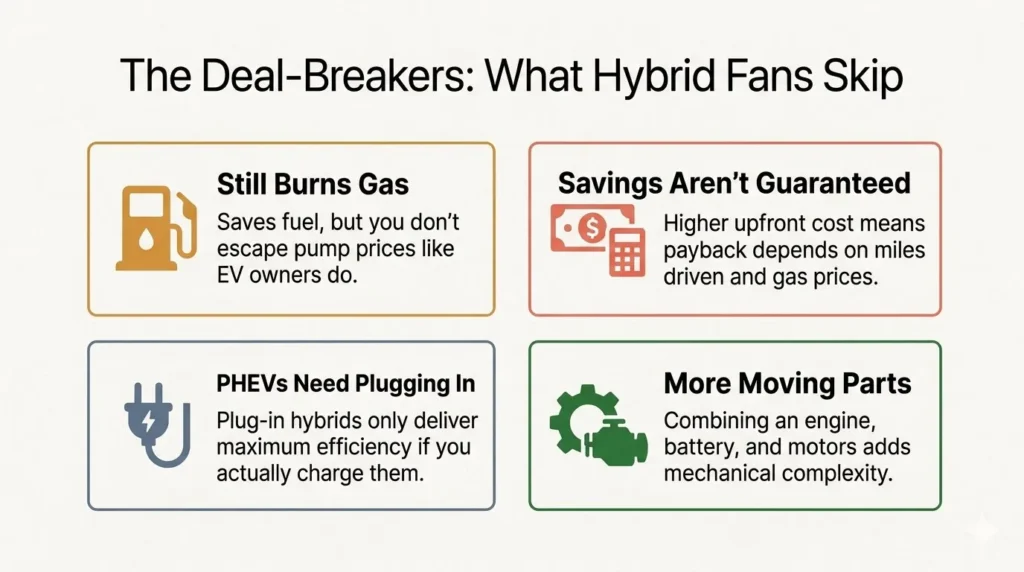
- Hybrids still burn gas. You save fuel, but you do not escape pump prices the way an EV owner largely can.
- Savings are not guaranteed. Hybrids usually cost more than the gas version, so your payback depends on how much you drive and what gas costs.
- Plug-in hybrids only deliver if you plug in.
- More moving parts. An engine plus battery and motors is more complex than either a simple gas car or an EV.
What Should Happen Next
- Detroit needs real hybrid lineups, not one model, built in North America where demand is.
- Cheaper EVs. Affordability is the barrier. Sub-$30,000 models like the relaunched Bolt are the test of whether EV demand returns.
- Stable policy. Automakers whiplashed between incentives and cuts are the ones writing down billions. Predictable rules help both buyers and manufacturers.
- Better charging and plug-in hybrid design so that buyers who do want to plug in have an easy path.
Also Read : CATL Explores Lithium-Air Battery With a Theoretical 1,243-Mile EV Range: Here Is the Catch
The Other Side: Why EVs Aren’t Finished
- Fuel costs favor EVs. Morgan Stanley estimated that at $4 gas, annual fuel costs run about $1,700 for a gas car against $700 for an EV.
- Interest is rising. A Cars.com survey found 52% of shoppers said gas prices made them consider a full EV or plug-in hybrid, though Edmunds data shows the rise in consideration so far is modest.
- Owners are loyal. A HERE Technologies and SBD survey found 77% of EV owners would likely buy another EV.
- Global trend continues. The IEA expects about 23 million electric cars worldwide in 2026, close to 30% of sales, even though the US has slowed.
The fair reading: in the US, hybrids are the best answer to today’s prices, and EVs are waiting for cheaper models and steadier policy.
Autoakhbar Bottom Line
Americans are not anti-electric. They are anti-expensive and anti-inconvenient. Hybrids deliver most of the fuel savings with none of the charging homework, and that is why carmakers are rushing to build them. The automaker that sells a cheap, good EV and a good hybrid will be the one that wins the next five years.
FAQ Hybrids Over EVs
Are Americans really rejecting EVs?
Not entirely. EV share fell to about 6.5% in Q3 2026 from above 10% in Q3 2025, but sales have recovered through 2026. Hybrids are simply growing faster.
What percentage of US car sales are hybrids in 2026?
About 16%. Cox Automotive reported a record 16.3% share at the midpoint of 2026.
Why did EV sales drop in the US?
The federal tax credit ended after a record Q3 2025 rush, EV prices are high, and gas price spikes pushed many shoppers toward hybrids instead.
Which brand sells the most hybrids in the US?
Toyota leads. Electrified vehicles make up 57.4% of its US volume, and Hyundai and Honda are growing fast too.
Are hybrids cheaper to own than EVs?
Hybrids usually cost less to buy, while EVs can cost less to fuel. The better choice depends on your mileage, gas and electricity prices, and whether you can charge at home.
Disclosure: Figures come from the sources linked above and were checked in November 2026. Market data changes monthly.