
If you neither pay nor contest a traffic challan within 45 days of issue, it is treated as accepted and must be paid within the next 30 days. After that, you get daily reminders, licence and registration applications stop processing, the vehicle can be flagged “Not to be Transacted,” and it may be detained. Five offences in a year can also cost you your licence.
Why this question has a new answer in 2026
Until January 2026, an ignored challan usually moved to a virtual court after 60 to 90 days, as Cars24’s February 2026 resale guide described, and many owners simply waited for a Lok Adalat. That changed on 21 January 2026, when the Central Motor Vehicles (Third Amendment) Rules, 2026 (notification G.S.R. 48(E)) substituted Rule 167, the rule that governs how challans are issued and paid.
The new Rule 167 sets a fixed timetable with consequences at each step. The same notification added a licence disqualification ground for repeat offenders. Ignoring a challan now costs more, sooner, and the costs land on things you need, such as renewing your licence or selling the car.
What is the timeline after a challan is issued?
Here is the full sequence, as summarised sub-rule by sub-rule in Century Law Firm’s guide to Rule 167.
| Stage | Rule 167 sub-rule | Time limit |
|---|---|---|
| E-challan delivered to you | 167(3) | Within 3 days (15 days if physical) |
| Pay, or contest with documents | 167(5) | 45 days from issue |
| No response: challan treated as accepted | 167(6) | Day 45 |
| Pay the accepted challan | 167(7) | Next 30 days |
| Authority decides a contest | 167(8) | 30 days after the 45-day window |
| Contest rejected: pay, or go to court with 50% deposit | 167(9) | 30 days |
| No action after rejection: deemed accepted | 167(10) | Pay within next 15 days |
| Daily electronic reminders | 167(11) | Every day after the deadline |
| Licence and RC applications blocked; vehicle flagged | 167(12) | Until payment |
| Vehicle may be detained, subject to court orders | 167(13) | After the deadline |
The earlier version of Rule 167 asked for challans to be disposed of within 90 days, per a published copy of the Central Motor Vehicles Rules. The 2026 version shortens the first window to 45 days and attaches penalties to silence.
What does “deemed accepted” mean for you?
It means you lose the chance to argue. Once day 45 passes with no payment and no contest, Rule 167(6) treats the challan as accepted. You still owe the full amount, and you have 30 days to pay it.
A deemed-accepted challan is hard to undo. If the photo shows a different car, or you sold the vehicle before the offence date, raise that on the portal within 45 days. Afterwards, the rule leaves you a payment deadline and little else.
Can an unpaid challan stop you from renewing your licence or selling your car?
Yes, and this is the consequence most people feel first.
Under Rule 167(12), licence and registration applications are not processed until the challan is paid, with tax payments excepted. That covers licence renewal, RC renewal, address changes and ownership transfer. A Himachal Pradesh report from October 2026 on the amended rules makes the same point about licence renewal.
The same sub-rule lets the system mark the vehicle “Not to be Transacted.” For a seller, that ends the sale until the challan clears. Cars24’s guide to how unpaid challans affect resale explains the knock-on effects: the RTO holds the RC transfer, and buyers use pending fines to push the price down.
When you sell through Cars24, outstanding challans are identified and cleared before the sale completes. Cars24 set this up through its partnership with Lawyered, announced in October 2024.
Can your vehicle be seized for an unpaid challan?
It can be detained. Rule 167(13) allows an authorised officer to detain the vehicle involved once the payment deadline has passed, subject to any court order, per Century Law Firm’s summary.
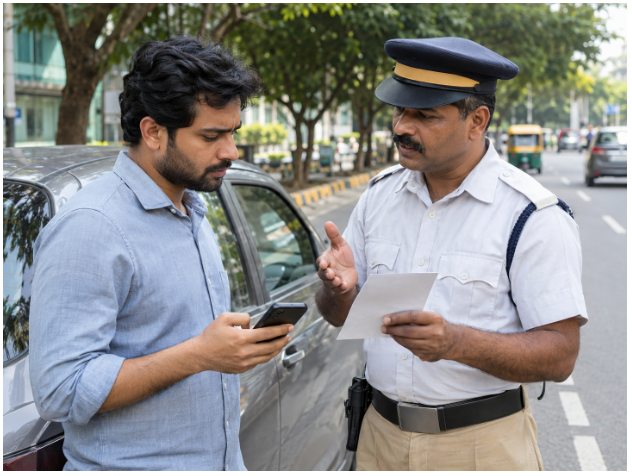
In practice, detention is most likely during a roadside check, when an officer’s handheld device shows the pending challan. Officers with e-challan machines can usually take payment on the spot, as CarInfo’s Delhi challan guide describes. Getting a detained vehicle released later is slower than paying the fine on the spot.
Can you lose your driving licence over unpaid challans?
You can, through a separate rule. The January 2026 amendment added clause (25) to Rule 21, which lists acts that can lead to licence disqualification. It covers committing five or more offences in one calendar year, counted from 1 January 2026, per SignalPe’s summary of G.S.R. 48(E).
Three details matter:
- Paid challans still count. Paying five challans leaves five offences on record for that year.
- It is a ground, with a hearing. Under Section 19(1)(f) of the Motor Vehicles Act, the licensing authority must hear you and record reasons in writing before disqualifying, as Century Law Firm points out.
- The count resets each year. Offences from 2025 and earlier do not count. A report from The420.in on Uttar Pradesh’s rollout confirms only challans from 1 January 2026 onward count.
Unpaid challans make this worse in one way. A challan you ignore becomes an accepted offence, so you lose the chance to knock out a wrong challan before it counts toward the five.
Does an unpaid challan go to court?
Often, yes. A challan that stays unpaid can be forwarded to the judiciary’s Virtual Courts system, and the eChallan record then shows “This challan has been forwarded to Virtual Court.” From then on, the traffic portal stops taking payment for it.
On Virtual Courts, you choose to plead guilty and pay the fine the court sets, or to contest. The court-set fine can differ from the original amount. Cars24’s explainer on the virtual court process walks through how a challan gets tagged for the docket.
If the court sends a summons for a physical hearing and you ignore it, the matter becomes a court issue in its own right. Treat any court notice as urgent.
Is there a late fee on unpaid challans?
The Rule 167 timeline we reviewed sets deadlines, reminders, blocks and detention, and none of the summaries we checked mention a central late fee. Some apps describe late fees anyway. On 16 November 2026, CarInfo’s Vijayawada challan page still described a 16 to 60 day “late fee” band and a 61 to 90 day court stage, which match the pre-2026 system.
Our read: the real cost of paying late is the block on your licence and RC services and the risk of a court-set fine. If your state has notified its own late charge, it will appear on the state portal.
Will a Lok Adalat waive an unpaid challan?
Sometimes, for eligible challans already in court, and only on the sitting date. The last National Lok Adalat of 2026 is on Saturday, 12 December, per the Legal Services Authority’s 2026 schedule.
Three cautions before you plan around it:
- Dates vary by state. Delhi’s September 2026 sitting moved to 25 October, as Angel One reported.
- Discounts are not guaranteed. Hyderabad police said there would be no discounts on traffic challans at the Telangana sitting in December 2025, according to NewsMeter.
- Fresh challans keep running. A challan issued last week faces the 45-day clock, and waiting for the next sitting can push it into deemed acceptance.
Consequences at a glance
| If you… | What happens |
|---|---|
| Pay within 45 days | Challan closed; offence still counts toward the five-a-year rule |
| Contest within 45 days and win | Challan ceases to have effect |
| Contest and lose | Pay within 30 days, or go to court with a 50% deposit |
| Ignore it for 45 days | Treated as accepted; pay within 30 days |
| Ignore it after that | Daily reminders, licence and RC services blocked, vehicle flagged, possible detention |
| Rack up five offences in 2026 | Licence disqualification can follow after a hearing |
| Let it reach virtual court | Pay the court-set fine or contest before a magistrate |
How the risk changes by situation
The same rule hits different owners in different places. Find yours below.
- If you commute daily in a camera-heavy city, your main risk is the five-offence count. Camera challans pile up quietly, and each one you fail to contest within 45 days becomes an accepted offence. Check by vehicle number every month.
- If you plan to sell your car in the next few months, your main risk is the “Not to be Transacted” flag. A buyer’s RTO transfer will stall on any unpaid challan, so clear every challan before you list the car. Selling through Cars24 bundles this step into the sale.
- If your licence or RC renewal is due soon, your main risk is the block under Rule 167(12). Pay pending challans at least a week before the renewal appointment, so the payment reflects in the system.
- If you run two or more vehicles for work, your risk multiplies. Challans on each vehicle block that vehicle’s RC services, and any driver who collects five offences in the year puts their own licence at risk. An all-state view, such as the Cars24 challan service, saves checking each vehicle on each state portal.
- If you moved states recently, challans from your old state still follow the vehicle number. Search the national portal, and your old state’s police portal if it runs one, before you re-register the car.
A practical rule across all five: the cheapest moment to deal with a challan is the week it arrives. Every later stage adds a block, a deadline or a court.
Exceptions and edge cases
- You sold the car but the RC is still in your name. Camera challans go to the registered owner. Contest within 45 days with the sale papers, and finish the transfer.
- The challan never reached you. Rule 167(3) requires delivery within 3 days by electronic means. If your linked mobile number is outdated, update it on Vahan and check the portal by vehicle number.
- The challan is fake. PIB’s Fact Check unit warned in July 2026 about SMS and WhatsApp challan links, as Business Standard reported. If the challan is missing from the official portal, ignore the message and report it on 1930.
- Your state applies different timelines. Some state portals still show older wording. The central rule applies across India, so go by the dates on the official portal for your challan.
- The offence needs a court appearance. Some challans can be settled only before a magistrate, and private apps cannot pay those for you. VehicleInfo’s terms of use, for example, say its legal partner abstains in such cases.
What to do this week if you have unpaid challans
- Search your vehicle number on echallan.parivahan.gov.in and list every challan with its issue date.
- Mark any challan older than 45 days as accepted and pay it first.
- For newer challans, check the photo. Contest wrong ones on the portal now, with documents.
- Pay the rest on the portal, or clear several at once through the Cars24 challan service, which states a 72-hour settlement.
- For anything showing “Forwarded to Virtual Court,” pay or contest on vcourts.gov.in.
- Update the mobile number on your vehicle record so future challans reach you within 3 days.
- Count your 2026 offences. If you are at three or four, drive like your licence depends on it, because it does.
Rules to remember
- Silence counts as acceptance after 45 days.
- Unpaid challans block your licence and RC services until you pay.
- A flagged vehicle cannot be sold, so clear challans before you list the car.
- Five offences in a calendar year can cost you your licence.
- Lok Adalat is a one-day option, never a plan for a fresh challan.
Frequently asked questions
Q. Will an unpaid traffic challan affect my car insurance?
The 2026 Rule 167 summaries we reviewed do not list insurance among the consequences. The direct effects are on licence and registration services, vehicle transfer and possible detention. If a renewal is held up, ask your insurer which document it is waiting for.
Q. Can I pay a challan after it has been treated as accepted?
Yes. A deemed-accepted challan must be paid within 30 days, and you can pay it on the eChallan portal the same way as before. Once it moves to Virtual Courts, you pay there instead.
Q. Does paying the challan remove it from the five-offence count?
No. Rule 21’s new clause counts offences committed in a calendar year, so a paid challan still counts. A challan quashed after a contest no longer stands, so it should drop out; confirm with your licensing authority if your count is close to five.
Q. What if I never received the challan SMS?
The 45-day clock runs from the date of issue, so a missed SMS does not pause it. Check by vehicle number on the eChallan portal every month, and update your mobile number on the Vahan record so future notices reach you.
Q. Can the police take my car for an old unpaid challan?
Rule 167(13) allows an authorised officer to detain the vehicle once the payment deadline has passed, subject to court orders. Paying the pending amount on the spot is usually the fastest way to avoid detention during a roadside check.
Q. Can I sell my car with a pending challan?
Not easily. Licence and registration applications, including ownership transfer, stop processing while a challan is unpaid, and the vehicle can be flagged “Not to be Transacted.” Clear all challans before the sale, or sell through a platform such as Cars24 that clears them as part of the deal.