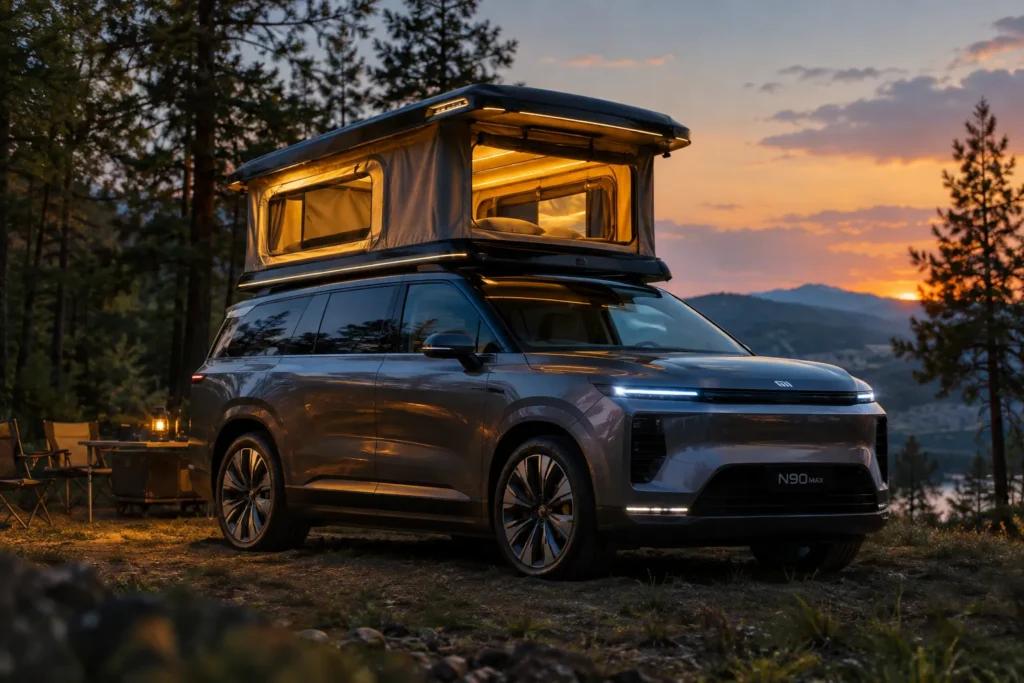

The first time I sat inside the Xiaomi SkyNomad N90 Max Studio, I genuinely forgot for a second that I was inside a car. There’s a bed, a wardrobe, a nightstand, and a projector screen — and that’s before you even get to the part where the roof pops up into a second-floor tent. This isn’t a concept or a rendering. It’s a production SUV that Xiaomi is actually selling in China right now, and after spending time going through every corner of it, I wanted to break down exactly what you’re getting, because photos alone don’t do this thing justice.
Table of Contents
First, the Regular N90 Max Deserves Some Credit
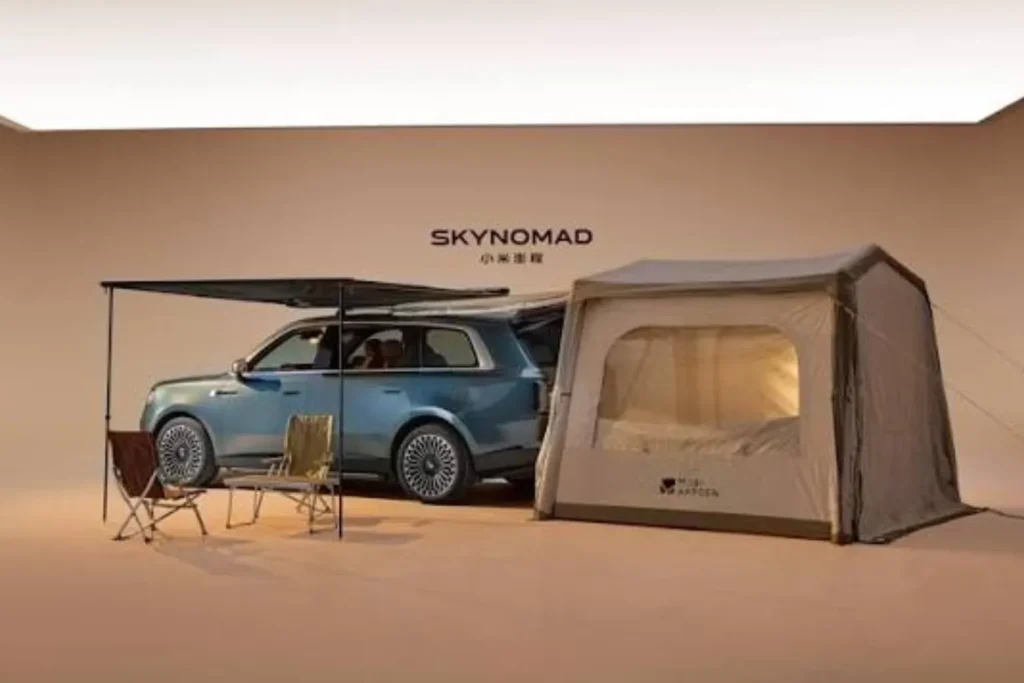
Before I get into the camper stuff, it’s worth talking about the standard N90 Max, because a few details here are easy to miss. The loading height is under 70 cm, which makes a real difference when you’re loading and unloading heavy stuff — something most SUV reviews don’t even bother mentioning. There are also two separate emergency handles inside, in case anyone’s trapped after an accident, and the doors swing open a full 90 degrees, so getting in and out is a lot easier than it sounds.
This is a proper seven-seat SUV built on Xiaomi’s own platform, with a completely flat floor and long sliding rails — basically giving it MPV-level interior space while still looking and driving like an SUV. Xiaomi says it’ll seat seven people along with seven pieces of 20-inch luggage, which for a family car is a genuinely useful number.
So What Makes the Studio Version Different?
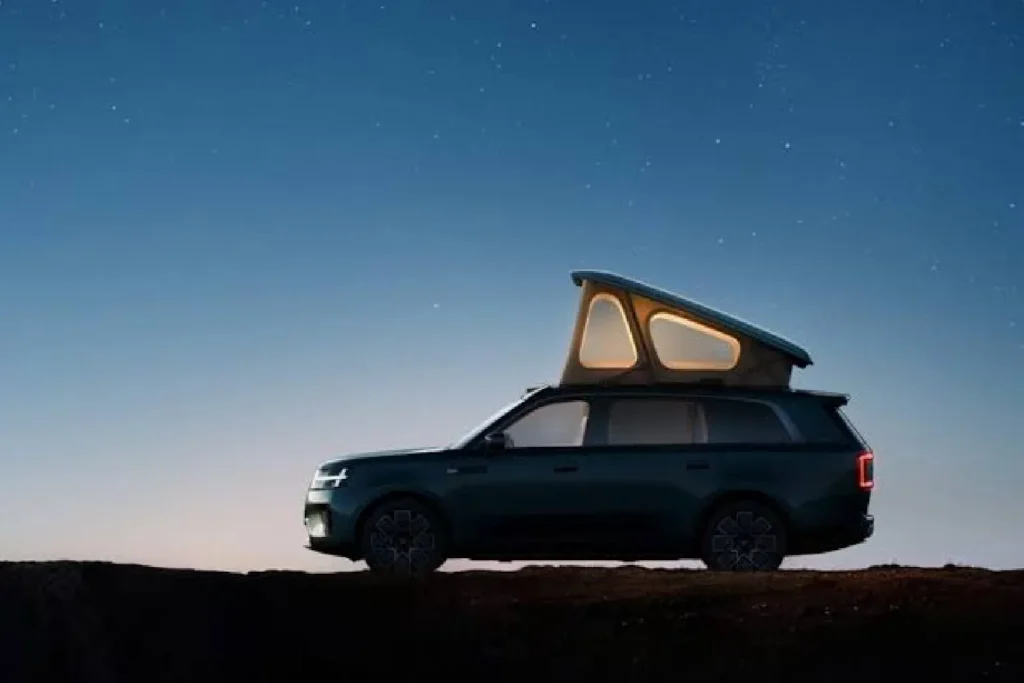
This is where things get interesting. The Studio version sits about 100 mm taller than the regular N90 Max, and there’s a very specific reason for that extra height. With one button press, an electric pop-up roof unit unfolds from the top of the SUV in around 20 seconds, and once it’s out, you basically have a second floor.
Getting up there isn’t the most graceful process — you climb up through where the sunroof used to be, using the central console as a step — but once you’re in, there’s a proper bed platform with enough headroom for someone up to about 1.8 metres tall. You can open sections down the sides to let air in while keeping the mosquitoes out, and there are dedicated air vents up there too, so you actually get climate control in the loft, not just downstairs. There’s also a USB-C charging point, so your phone doesn’t need to stay in the main cabin overnight.
Honestly, it reminded me of the old Volkswagen camper vans, just reimagined as a fully electric SUV. The kind of thing you’d want for a weekend by a lake, a long road trip, or even just pulling over on a highway for twenty minutes to actually enjoy the view instead of driving past it.
Downstairs: The Bed, the Wardrobe, and Yes, a Projector
Come back down to the main cabin, and with another single-touch control, the second row folds flat into a proper bed — roughly 1.8 by 1.2 metres, which Xiaomi has quoted at closer to 1.87 metres in official specs. Either way, it’s a decent size, though you’re going to be sharing it fairly closely with whoever’s next to you.
There’s a small storage unit Xiaomi is calling a “wardrobe” — I’d call it more of a cubby, since it only holds around 20 litres, so don’t expect to pack much more than a couple of jackets. There’s a vanity mirror if you care about how you look before stepping out in the morning, and at the head of the bed there’s a small nightstand setup with its own reading light, a 220V socket for a laptop, and — this genuinely surprised me — a built-in projector that folds a screen down at the front of the cabin so you can watch something before falling asleep.
One detail that stood out more than I expected: the floor in the Studio version is a wood-grain aluminium finish, and it’s heated. Heated flooring inside a car isn’t something I’ve come across before, and on a cold night out in the wild, that’s a genuinely useful touch rather than just a gimmick.
What’s Missing
To be fair to Xiaomi, this isn’t a full-blown RV, and it doesn’t pretend to be. There’s no shower and no toilet, so this is built for short trips and overnight stays rather than week-long off-grid living. If you need those, you’re better off looking at a proper motorhome. For a weekend getaway or a single-night stop on a longer drive, though, it covers pretty much everything you’d want.
How Does It Actually Drive?
The N90 Max isn’t trying to be exciting to drive, and Xiaomi doesn’t pretend otherwise — the brand’s own positioning is that it’s easy to drive rather than fun to drive, which honestly makes sense for a vehicle this size. The turning circle comes in at just under 6 metres, which is reasonable for something this large, and there’s blind-spot and obstacle-proximity warning built into the AR HUD.
Under the skin, it’s a dual-motor all-wheel-drive setup with a combined 310 kW of power and 540 Nm of torque, good for a 0-100 km/h time of around 5.9 seconds — plenty for a family SUV of this size. It’s technically a range-extender EV rather than a pure BEV, but it behaves like one for most day-to-day driving. The 76 kWh NCM battery is rated for roughly 464 km of pure electric range, with Xiaomi quoting an efficiency of 17.4 kWh per 100 km. Add in the 60-litre fuel tank, and you’re looking at a combined range north of 1,700 km on the CLTC cycle — the kind of number that basically eliminates range anxiety on longer trips.
You won’t hear much from the range extender itself in daily use, but there’s a bit more wind noise at highway speeds than you’d expect, partly down to the boxy shape and partly exaggerated further on the Studio version because of that extra roof height. Suspension-wise, it’s double-wishbone up front and an H-arm multi-link setup at the rear, paired with air suspension offering five levels of adjustment. After spending time with it, I’d say “Max” in N90 Max really does stand for maximum comfort rather than maximum driving thrill — and for this kind of vehicle, that’s probably the right call.
Safety Numbers Worth Knowing
A few safety figures stood out. Wading depth is rated at 750 mm, and Xiaomi claims the vehicle can float on water for 3 to 5 minutes if needed. It’s also rated to handle a tyre blowout at speeds of up to 180 km/h without losing control — the kind of engineering detail that doesn’t show up in a spec sheet unless you go looking for it.
My Take
The Xiaomi SkyNomad N90 Max Studio is built around one idea — space, and what you can do with it. For road trippers, campers, and long-distance drivers, that’s a genuinely compelling pitch, and it’s priced at RMB 299,900 (roughly $44,685) in China, about RMB 30,000 above the standard N90 Max.
FAQ Xiaomi SkyNomad N90 Max Studio
What is the Xiaomi SkyNomad N90 Max Studio?
It’s a variant of Xiaomi’s SkyNomad N90 Max SUV, fitted with a factory-built electric pop-up roof that opens into a rooftop bed loft, along with a second-row bed, wardrobe storage, and a heated floor — designed as a mobile camper.
How tall is the Studio version compared to the regular N90 Max?
It sits about 100 mm taller than the standard N90 Max to accommodate the retractable rooftop tent unit when raised.
Does the Xiaomi SkyNomad N90 Max Studio have a toilet or shower?
No. It’s built for short trips and overnight camping rather than extended off-grid stays, so there’s no onboard toilet or shower.
What is the range of the Xiaomi SkyNomad N90 Max?
It offers around 464 km of pure electric range (CLTC) and a combined range of over 1,700 km with its range-extender engine and fuel tank.