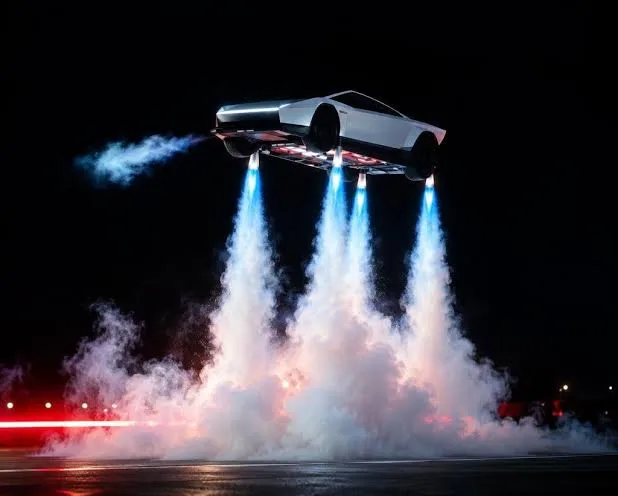

Tesla’s new Roadster did leave the ground at its Oct 15 reveal, but only for a few seconds, at a SpaceX test site in Texas, and reportedly with nobody inside. Tesla still has not announced a price, and Elon Musk says production starts in 2028, nine years after the car was first shown. So is the “flying Roadster” a real product, a legal vehicle, or a very expensive highlight reel? Here is what the evidence supports.
Short answer: the stunt was real, the road-legal claim is thin, and nobody has shown that the flying part is legal for owners in the US.
Table of Contents
Autoakhbar Quick Verdict
- Who should care: Tesla watchers, TSLA investors, and anyone holding a Roadster deposit since 2017.
- Who should not plan around it: Anyone expecting to fly a Roadster to work. Tesla’s own page says the full-thruster Rocket version is not approved for public roads.
- Biggest gap: Tesla has shown a demo, not a price, a delivery date, or any regulatory filing.
- Autoakhbar reality score: 4/10. The engineering stunt is genuine. The ownership promise is not yet backed by anything verifiable. (This is our editorial judgment, not a measured metric.)
What Tesla actually showed on October 15
Tesla unveiled the second-generation Roadster at SpaceX’s McGregor test site near Waco, Texas. According to Yahoo Finance, the car clung to an inverted ramp using a vacuum fan system, launched off upside down and flipped in the air. Tesla lists three versions:
| Version | Seats | 0-60 mph (Tesla claim) | Status |
|---|---|---|---|
| Performance | 2 | Under 1.6 sec | “Road ready,” active aero, suction system |
| Thrust | 2 | Under 0.9 sec | “Race ready,” rear cold-gas thrusters |
| Rocket | 1 | Under 0.59 sec | Invite-only; not approved for public roads |
Source for the version list: Teslarati. Tesla also quotes a top speed above 230 mph and more than 300 miles of range. The Next Web reports reservations of $50,000 or $250,000 depending on the version, with no confirmed price.
2017 promise vs 2026 reveal
| Spec | 2017 claim | Oct 2026 claim |
|---|---|---|
| 0-60 mph | 1.9 sec | Under 1.6 sec (Performance); 0.81 sec shown in a live demo |
| Top speed | 250+ mph | 230+ mph |
| Range | About 620 miles | 300+ miles |
| Production | 2020 | 2028 (Musk) |
| Price | $200,000 base, $250,000 Founders Series | Not announced |
As Electrek pointed out, the range claim is roughly half of what Tesla promised nine years ago. And TradingKey notes the 0.81-second figure comes from an on-site demonstration, not a full production performance test.
Also Read : Tesla Roadster No-Fly Zone: FAA Restricts Airspace Over SpaceX McGregor Site
Has Tesla done this before? The track record
Yes, Tesla has a long record of announcing products faster than it ships them. This is documented, not just opinion.
| Product | What was promised | What happened |
|---|---|---|
| Roadster 2 | Production in 2020 | Pushed to 2021, 2022, 2023, “hopefully” 2024, 2025, then 2027-28. Electrek counts at least six production slips. |
| Tesla Semi | Production in 2019 | Still not in mass production years later; Autoblog reported pricing roughly doubled from the original quote. |
| Cybertruck | Late 2021, starting at $39,900 | Entered limited production in November 2023 per Wikipedia, at prices well above the unveiling number. |
| Full Self-Driving | Autonomy within three years (said in 2015) | Reuters’ factbox lists the missed deadlines; Musk himself once called himself the “boy who cried FSD.” |
Fairness check: Tesla does eventually ship some products. The Cybertruck is on the road. But “eventually, late, and changed” is the pattern, and the Roadster has now run that pattern for nine years. Thrusters are not new either: Musk was already talking about SpaceX rocket thrusters for the Roadster in 2018.
Is this a stunt to prop up a falling stock?
This is the claim many readers make, so let’s test it against the numbers rather than just repeat it.
- The pressure is real. A recent Yahoo Finance analysis put TSLA down about 20% over the past year, with a Q2 earnings miss and a very thin operating margin.
- The reaction was positive. Shares closed at $362.44 on Oct 15 and rose roughly 3-4% in early trading after the event, per Yahoo Finance.
- But reveals do not always lift the stock. Gulf News notes TSLA fell about 6% after the 2019 Cybertruck reveal and 8.3% after the 2024 Cybercab unveiling.
- The Roadster barely moves the business. With estimated volumes near 2,000 cars a year, investingLive says any share move is about sentiment, not earnings.
Our read: Tesla’s stock is under pressure and the event generated enormous attention, but there is no evidence of intent. Calling it a “stock stunt” is an opinion. What we can say with facts is that a demo with no price and no date is a weak basis for valuing a car company.
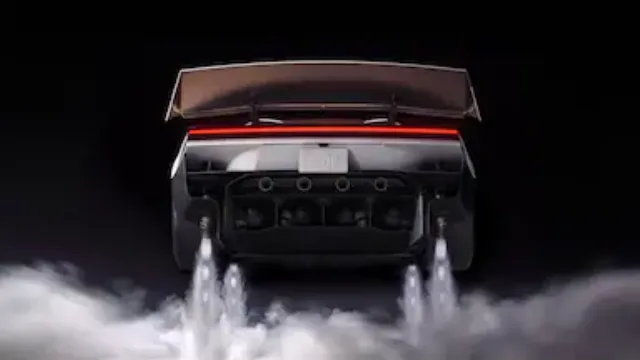
The tech: how does the Roadster “fly”?
It does not fly like an aircraft. It uses cold-gas thrusters built with SpaceX engineers: stored compressed air is released through nozzles to push the car up and rotate it. There is no combustion and no rocket fuel (Silicon Review). Reports describe roughly ten nozzles fed by a large compressed-air tank (ExplainX), though Tesla has not published official specs.
- Multi-mode suction system: Fans pull the car toward the road surface, adding downforce for grip. This is what let it stick to the inverted ramp.
- Active aerodynamics: Moving aero surfaces on the Performance version.
- Steer-by-wire: Reported by TradingKey; no mechanical link between steering wheel and wheels.
Still unpublished: thrust figures, tank pressure, how many seconds of thrust one tank provides, refill time, and repeatability. Without these, “flying” really means “a short, controlled hop,” and it was shown once, by a prototype, under controlled conditions.
Is it actually useful?
For daily driving, no. Electrek’s critique is blunt: a cold-gas thruster gets a few bursts per tank, does nothing on a normal drive, and adds weight and cost. A road-legal sports car is a poor base for repeated thrust events.
Where it could make sense: track days, closed-course stunt shows and brand marketing. Where it does not: commuting, highway use, or anywhere a stray burst of compressed gas near other people is a liability. Even Musk acknowledged the Rocket version is not necessarily “safety-optimized,” per Silicon Review.
The fast-acceleration part is useful in a different sense: it is a real engineering showcase, and Tesla says it will be its only manually driven car going forward, which makes it a halo product rather than a volume seller.
Is the flying Roadster legal in the US?
This is an explainer, not legal advice. Rules change and vary by state. A car that also leaves the ground has to satisfy two separate federal regimes.
| Question | Who decides | Where the Roadster stands |
|---|---|---|
| Can it be driven on public roads? | NHTSA (Federal Motor Vehicle Safety Standards) plus each state’s DMV | US automakers self-certify that vehicles meet FMVSS. Tesla lists Performance as road ready and Rocket as not approved for public roads. Asked if it is street legal, Musk reportedly said “depends on your street.” |
| Can it legally fly? | FAA | No FAA certification or filing for the Roadster has been publicly reported. The FAA reportedly restricted airspace around the test site before the event. |
| What would the closest precedent look like? | FAA + NHTSA together | Alef’s flying car got an FAA special airworthiness certificate limited to exhibition and research, and still needed separate NHTSA approval for road use. |
| Is there a shortcut for low volume? | NHTSA Part 555 exemption | It allows up to 2,500 non-compliant vehicles per year if the maker shows equivalent safety and public benefit. Tesla has not announced applying for one. |
What this means: Nothing in public records shows a legal path for an owner to use thrusters on a public road or to fly a Roadster. The most realistic outcome is a road-legal Performance car, with thruster versions limited to closed-course or exhibition use. That is our reading of the available evidence, not a regulator’s ruling.
Autoakhbar bottom line
The October 15 demo was a genuine engineering stunt. It was not a product launch. Until Tesla publishes a price, a build date, thruster specs and a regulatory plan, treat the “flying car” label as marketing and the 2028 date as a target, not a promise. If you hold a deposit, ask what exactly you are getting. If you are an investor, remember that the stock has not always rewarded Tesla reveals. And if you simply love cars, enjoy the footage, but do not clear space in the garage yet.
Frequently asked questions
Can the Tesla Roadster really fly?
It can make short, thruster-assisted hops and flips using compressed air. It does not fly like an aircraft, and no regulator has approved it for flight.
Is the Tesla Roadster street legal in the US?
Tesla calls the Performance version road ready but says the Rocket version is not approved for public roads. Final US road legality depends on federal safety compliance and state registration, and Tesla has not shown either yet.
How much does the new Tesla Roadster cost?
Tesla has not announced a price. Reservations are reported at $50,000 and $250,000 depending on the version.
When will the Tesla Roadster be released?
Musk says production begins in 2028 at Giga Texas. The car was originally promised for 2020.
Was the Roadster reveal done to boost Tesla stock?
There is no evidence of motive. Tesla shares rose after the event, but they fell after earlier reveals like the Cybertruck and Cybercab.
Sources
- Electrek: Tesla unveils new Roadster that can kickflip
- Electrek: Every Roadster delay so far
- CNBC: Tesla reveals next-generation Roadster
- The Next Web: Tesla unveils thruster-equipped Roadster
- Yahoo Finance: Roadster with compressed air thrusters
- Reuters factbox: Musk’s late and unfulfilled Tesla promises
- US DOT: Part 555 exemption process
- NHTSA: Part 555 FAQ and FMVSS self-certification
Editorial note: figures are Tesla claims or media reports as of October 16, 2026 and may change as Tesla publishes more data. This article is not legal or investment advice.