
A diesel Silverado 3500 dually is rated to pull roughly 13,000 pounds more than the single-rear-wheel version on a gooseneck, but you pay for that capability every day, even when the trailer is parked at home. Six tires, a body roughly a foot wider and a long list of small daily hassles are the real price of going dual. Here is what the extra rear wheels cost, and how to tell whether you actually need them.
Autoakhbar Quick Verdict
- Who should buy a dually: Anyone who regularly tows a heavy fifth-wheel or gooseneck trailer close to or above what a single-rear-wheel truck is rated for.
- Who should skip it: Daily commuters and weekend towers with light trailers. A single-rear-wheel one-ton does the job with less hassle.
- The biggest compromise: Width. The truck is hard to park, hard to wash and awkward in tight streets.
- Value for daily use: 4/10. Value for heavy towing: 9/10.
Table of Contents
Why a dually costs more before you drive it
The sticker is the smallest part, but it is where it starts. In its 2025 breakdown, Jalopnik notes that GMC charges $1,400 more for its Sierra HD Pro trim just to go from single to dual rear wheels. Dual rear wheels also add weight, and the U.S. Department of Energy says fuel economy can fall by up to 2% for every extra 100 pounds (DOE fuel economy fact sheet).
Published numbers for insurance and real-world fuel penalties are thin. We did not find reliable figures, so get an insurance quote for both configurations before you sign anything.
The six-tire problem
A dually has six tires on the road instead of four, so every tire job is 50% bigger. Tire retailer Discount Tire points out that a complete dually rotation means dismounting, remounting and rebalancing all six wheels (Discount Tire). Jalopnik adds that some experts recommend replacing all six together because mismatched tire sizes hurt handling and safety.
One owner’s account on Hagerty shows how it adds up: a set of six Michelin tires came to about $1,600, with about $30 per wheel to mount and balance and $50 to $60 if a stuck inner wheel had to be pulled. At that price, the same tire works out to roughly $267 each, so a four-tire set would be about $1,067. That is an extra $533 per set of tires, for this one example. Your truck, tire brand and region will change the number.
Width is the daily cost nobody mentions
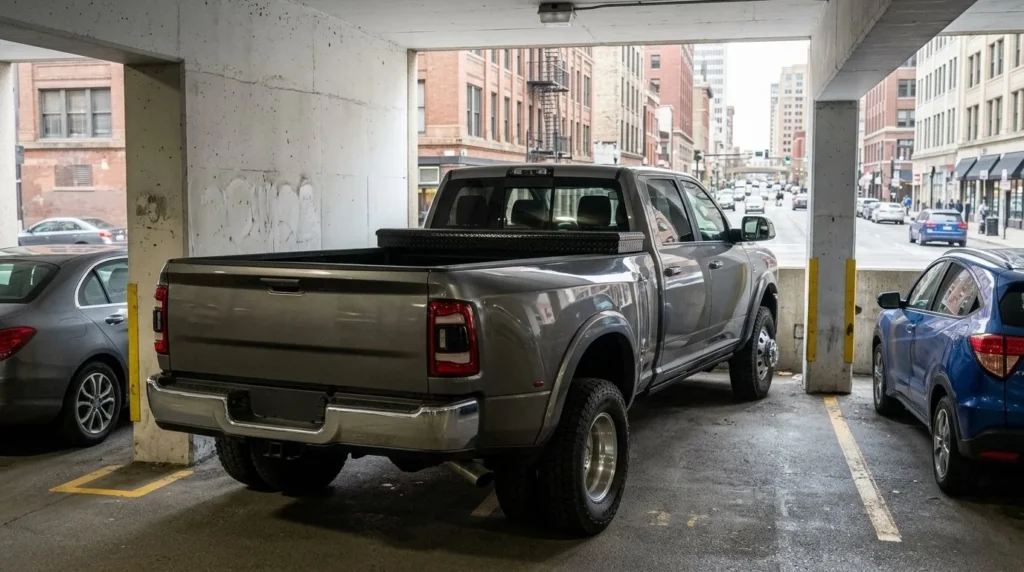
This is where a dually becomes a pain as a daily driver. Using the 2025 Ram 3500 as an example, Jalopnik lists the dually at about 96.5 inches wide against 83.5 inches for the single-rear-wheel version. A typical U.S. parking space is 102 to 108 inches wide, which leaves you with roughly 5.5 to 11.5 inches of total room to open doors and walk around the truck. Jalopnik says it may not fit some spots at all.
Owners also raise car-wash access, snow traction and insurance as common complaints (owner discussion on Bob Is The Oil Guy). Tolls can be another surprise: MotorBiscuit notes that in rare cases a dually pays a higher “commercial” toll, and a few parkways restrict such trucks.
What you actually get: the towing gap
| Spec | Single rear wheel | Dual rear wheel |
|---|---|---|
| Silverado 3500 diesel, gross combined weight rating | 30,000 lb | 43,500 lb |
| Silverado 3500 diesel, gooseneck / fifth-wheel tow rating | 22,420 lb | 35,500 lb |
| Ford F-350 diesel, tow rating | 18,000 lb | 21,000 lb |
| Ram 3500 body width | 83.5 in | 96.5 in |
Sources: Jalopnik (Silverado and Ram figures) and MotorBiscuit (F-350). Ratings vary by configuration, so check your exact truck’s door-jamb sticker.
The gap is largest for gooseneck and fifth-wheel trailers, which is exactly where the extra tires and traction matter. For conventional trailers the difference is much smaller, and Jalopnik notes that some single-rear-wheel 3500 trucks reach the same 20,000-pound maximum conventional tow rating as dually versions.
The deal-breakers sales reps rarely mention
- Tire shops charge more. Some owners report upcharges for dually tire work, and mounting is slower.
- Parking and garage fit. At 96.5 inches wide, many home garages and drive-throughs are a squeeze.
- Light-duty reality. If you only tow a few times a year, you carry the width and tire costs for 50 weeks of non-towing.
How to decide: SRW or DRW
Do not guess. Take the real weight of your trailer, the hitch (pin) weight and the load in the bed, and compare them against the ratings on your truck’s door-jamb sticker. If you are comfortably under the single-rear-wheel limits, you do not need a dually. If you are regularly near or over them, especially with a fifth-wheel, the dually’s stability and rating make it the right tool. RealTruck’s SRW vs DRW comparison and the TFL Truck comparison are good places to cross-check numbers.
Autoakhbar Bottom Line
A dually is a tool, not an upgrade. If your trailer needs it, nothing else matches it. If it does not, you are paying for extra tires, extra width and extra hassle to carry capability you never use. A single-rear-wheel one-ton is the smarter buy for most people who tow only now and then.
Related reading on Autoakhbar: Rok Trucks and the Base Rok pickup | Reo Runabout truck update
FAQ dually vs single rear wheel
Can a dually be a daily driver?
Yes, but expect harder parking and tighter manoeuvring. MotorBiscuit says dually trucks are easy to drive once you account for the extra width, but more challenging to park.
How much more do dually tires cost?
You buy six tires instead of four, so a full set costs about 50% more tires. One owner reported about $1,600 for six tires, but prices depend on brand, size and region.
Does a dually use more fuel?
Usually yes. The extra weight and rolling resistance lower fuel economy, and the DOE says up to 2% per 100 pounds of added weight. Exact numbers depend on the truck and load.
Do I need a dually for a fifth-wheel trailer?
Not always. A single-rear-wheel one-ton can handle many fifth-wheels, but heavier trailers near or over its rating call for a dually. Check your trailer and truck ratings first.