
Quick Answer:
- You cannot buy a new BYD Han (or Han L) from any US dealership in 2026. It isn’t a supply issue — it’s blocked by law.
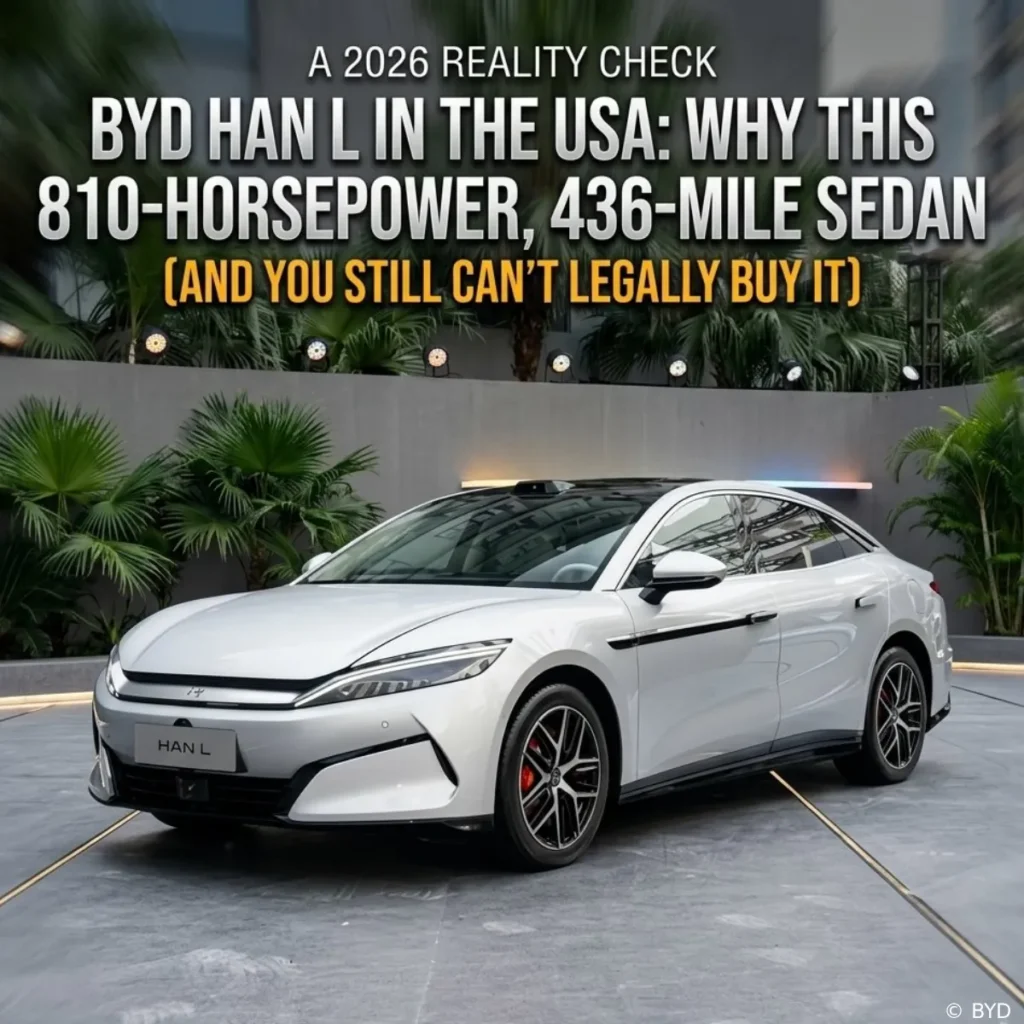
- The 2026 BYD Han L starts around $27,400 in China and delivers up to 436 miles (701 km CLTC) of range with 810 kW (1,086 hp) in dual-motor form, 0–62 mph in 2.7 seconds.
- Two federal barriers keep it out: a 100%+ tariff on Chinese-built EVs, and a Commerce Department rule banning Chinese connected-vehicle software (2027 models) and hardware (2029–2030 models).
- Even if it arrived tomorrow, it wouldn’t qualify for a federal tax credit — that credit ended entirely for all EVs on September 30, 2025.
New Delhi: Type “BYD Han price USA” into Google and you’ll get thousands of searches a month and almost no honest answers. That’s because the question itself contains a false premise: there’s no US price, because there’s no US Han. In our research into why American EV shoppers keep circling back to this car, the real story turned out to be less about the sedan and more about the wall Washington has built around it.
Table of Contents
So, Can Americans Actually Buy a BYD Han?
No. As of 2026, there are zero Chinese-branded passenger vehicles for sale through any authorized US dealer — not a BYD, not a NIO, not a Geely. This isn’t about product quality or demand; it’s policy. BYD’s only confirmed US footprint is electric buses for transit agencies (which are exempt because they’re classified as heavy-duty, over 10,000 lbs) plus its forklift and battery-storage businesses. Passenger cars are a different story entirely.
Privately importing one is technically possible but rarely practical — federalization, EPA/DOT compliance testing, and crash certification for a car never sold here add cost and risk that usually erase any price advantage over buying something already on a US lot.
Why the Han Is Blocked: Tariffs and the Connected-Vehicle Ban
Two separate federal actions do the blocking, and they stack:
- Tariffs: Section 301 tariffs on Chinese-built EVs, layered with additional duties, push the effective import tax on a Chinese-assembled EV well past 100%. A Han L that costs roughly $27,400–$37,200 in China would functionally double in landed cost before it ever reached a dealer lot.
- Connected-vehicle rule: The Commerce Department’s final rule prohibits the sale or import of vehicles using Chinese-linked connected-vehicle software, citing national-security concerns over remote access and data collection. The software ban applies starting with 2027 model-year vehicles; a hardware ban follows for 2029–2030 models. The rule also covers Chinese autonomous-vehicle testing on US roads.
Read the official rule here: US Department of Commerce.
BYD hasn’t rolled over quietly — in February 2026, four of its US subsidiaries filed suit challenging the tariff structure, and CEO-level statements from BYD Americas have repeatedly pushed back on being called “very protective” market. But industry timelines have slipped: early 2025 chatter about a 2025–2026 US entry has given way to realistic estimates of 2028–2030, contingent on how trade policy evolves.
Also Read: Latest EV News on AutoAkhbar
Meanwhile, Next Door: Mexico and Canada Get the Han
The wall isn’t global — it’s specifically American. BYD is already the top-selling EV/PHEV brand in Mexico, holding roughly 70% of that segment. In Canada, a 6.1% tariff-quota arrangement (versus 100%+ south of the border) is letting BYD open around 20 dealerships, with retail sales beginning in provinces like Quebec and British Columbia later in 2026. That gap — a car sold an hour’s drive from the US border but functionally illegal to bring across — is the actual story most coverage misses.
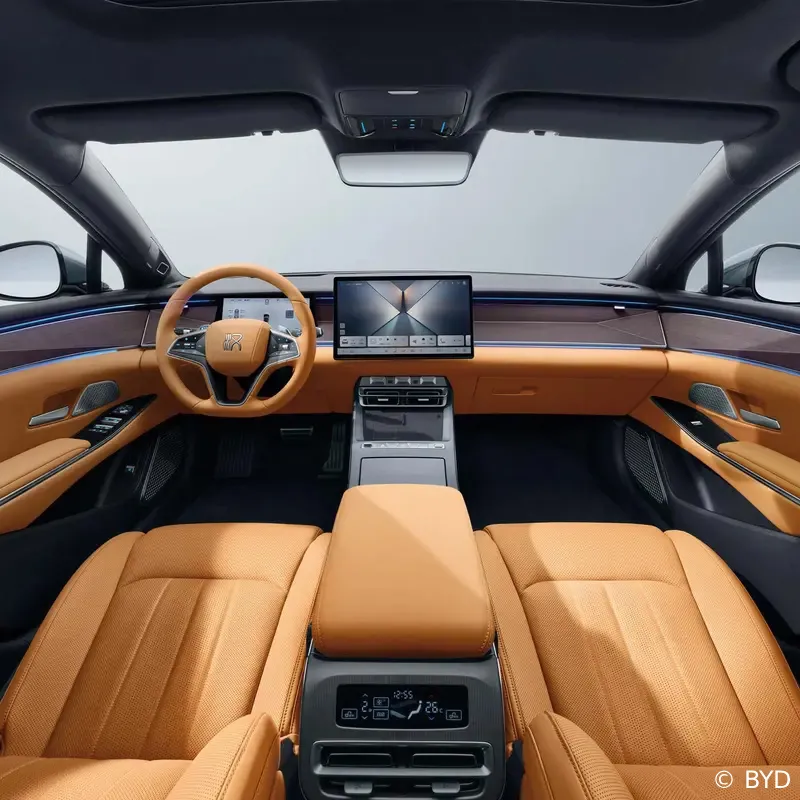
Technical Breakdown: What the 2026 Han L Actually Offers
BYD unveiled the redesigned Han L at the 2025 Guangzhou Auto Show as a replacement generation with fresh styling, hidden door handles, and a roof-mounted LiDAR unit suggesting more advanced driver-assist ambitions.
- Battery: 83.2 kWh LFP pack built for BYD’s “Super e-Platform” 1,000-volt architecture, paired with the brand’s Flash Charging network (targeting up to 1,500 kW peak output, with the Han L among the first vehicles engineered to use the full rate).
- Powertrain options: A PHEV variant (1.5T engine, dual 200 kW motors, ~124 miles pure-EV range, 0–62 mph in 3.9s) and a pure-EV variant in single- or dual-motor form, topping out at a combined 810 kW (about 1,086 hp) and 0–62 mph in 2.7 seconds.
- Range: Up to 701 km CLTC (roughly 436 miles) on the long-range EV trim — CLTC figures typically run more optimistic than EPA testing would show, so real-world US-cycle range would likely land meaningfully lower.
- Top speed: 305 km/h (~190 mph) on the flagship EV trim.
BYD has since pushed the platform further with the Da Han (also marketed as “Great Han”), a full-size flagship with up to 1,008 km of claimed range, air suspension, and rear-wheel steering — a sign the Han nameplate is being stretched upward rather than staying a single model.
Specs vs. the Car Americans Can Actually Buy
| Spec | 2026 BYD Han L (EV, dual-motor) | 2026 Tesla Model 3 Long Range AWD |
|---|---|---|
| Starting Price | ~$37,200 (China, post-subsidy, top trim) | $48,880 (US MSRP) |
| Claimed/EPA Range | ~436 mi (CLTC) | 346 mi (EPA) |
| 0–60 mph | 2.7 sec | 4.2 sec |
| Peak Power | 810 kW (~1,086 hp) | ~324 kW (441 hp) |
| Fast-Charge Architecture | 1,000V, up to 1,500 kW network target | Up to 250 kW Supercharger |
| US Availability | None — not legal to sell | Nationwide, factory-direct |
On paper, the Han L undercuts the Model 3 on price while beating it on claimed range, power, and charging architecture — the exact combination that has US automakers watching BYD’s Mexico expansion nervously, even without a single Han on American roads.
The Money Reality: No Tax Credit Would Apply Anyway
Even setting aside legality, a common assumption in older EV-buying content is worth correcting: the federal $7,500 clean-vehicle credit (Section 30D) ended for all new EV purchases after September 30, 2025, under the One Big Beautiful Bill Act. So no 2026-model EV — American, Korean, or Chinese — arrives with that credit attached anymore. Some state-level incentives (California, Colorado) remain, and a smaller auto-loan-interest deduction replaced the old credit for US-assembled vehicles, but the Han wouldn’t qualify for that either since it isn’t built in North America.
Official credit status: fueleconomy.gov.
Pros and Cons
Pros (on the specs it offers globally): Aggressive pricing relative to output, genuinely quick 1,000-volt charging architecture, strong power-to-price ratio, rapidly expanding global service footprint (Mexico, Canada, Europe, Southeast Asia).
Cons: Zero US service network, zero crash-test data under US NHTSA protocols, unresolved long-term parts/software support questions if imported privately, CLTC range figures don’t reliably translate to EPA-equivalent real-world numbers, and no legal path to ownership without private import risk.
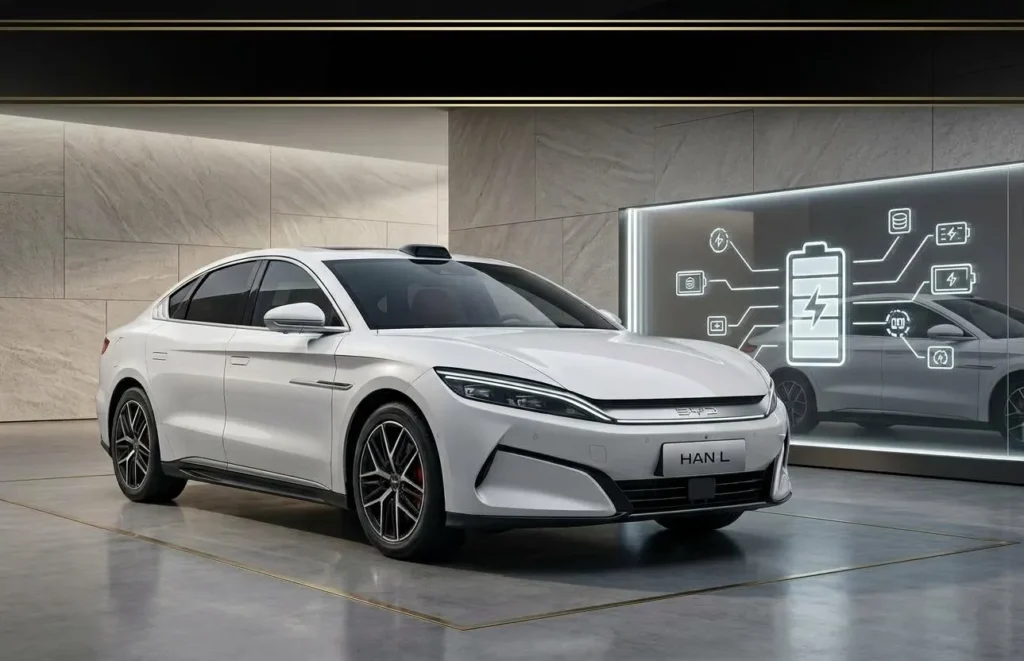
AutoAkhbar Verdict: Should US Buyers Even Wait for It?
If you’re a US shopper who stumbled onto Han specs and got excited, the honest verdict is: don’t hold your breath, and don’t chase a private import. Realistic industry estimates put genuine US market entry at 2028–2030 at the earliest, and that assumes tariff policy or the connected-vehicle rule shifts meaningfully — neither looks imminent as of late 2026. For now, the Han’s real relevance to Americans is as a preview of the pricing and charging-speed pressure Tesla, Hyundai, and GM will face once — or if — that wall ever comes down.
FAQ
Is BYD banned in the US?
Passenger cars, yes, effectively — through tariffs and the connected-vehicle rule. BYD buses and forklifts are exempt and already operate in the US.
Can I import a BYD Han myself?
Technically yes, but federalization and compliance testing make it impractical for most buyers, and the connected-vehicle software rule adds a further legal complication from the 2027 model year onward.
When will BYD sell cars in the US?
No confirmed date. Analyst estimates cluster around 2028–2030, contingent on trade policy.