
By Anshu Uday Sabharwal, Editor, AutoAkhbar.com | Fact-checked and updated: September 21, 2026
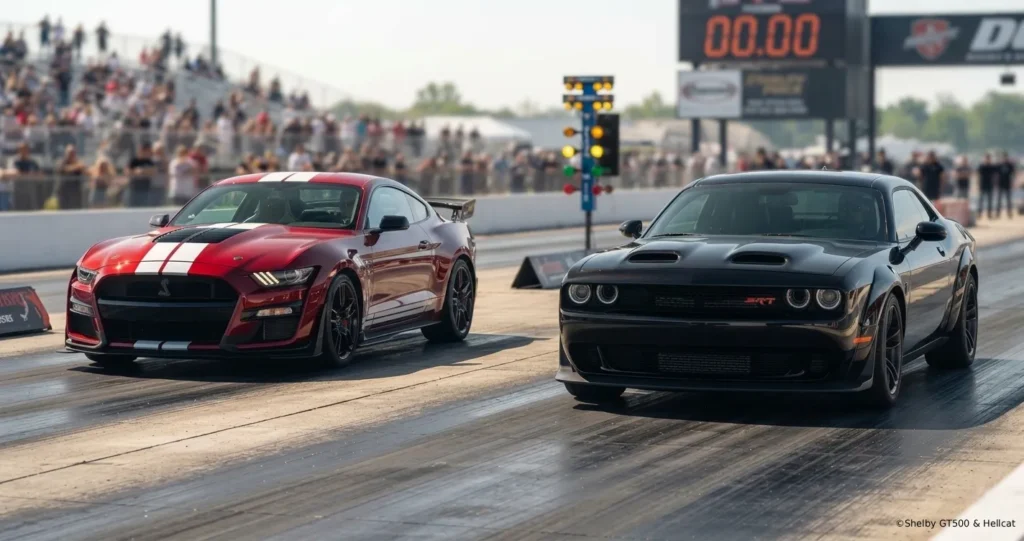
September 2026: Ford’s Shelby GT500 and Dodge’s Hellcat spent a decade trying to out-shout each other, and both supercharged V8 coupes are now out of production. That changes the question. It is no longer “which one wins on paper” but “which one is the smarter used buy in 2026.” Here is how they compare on power, price, and the problems owners actually report.
Key Takeaways
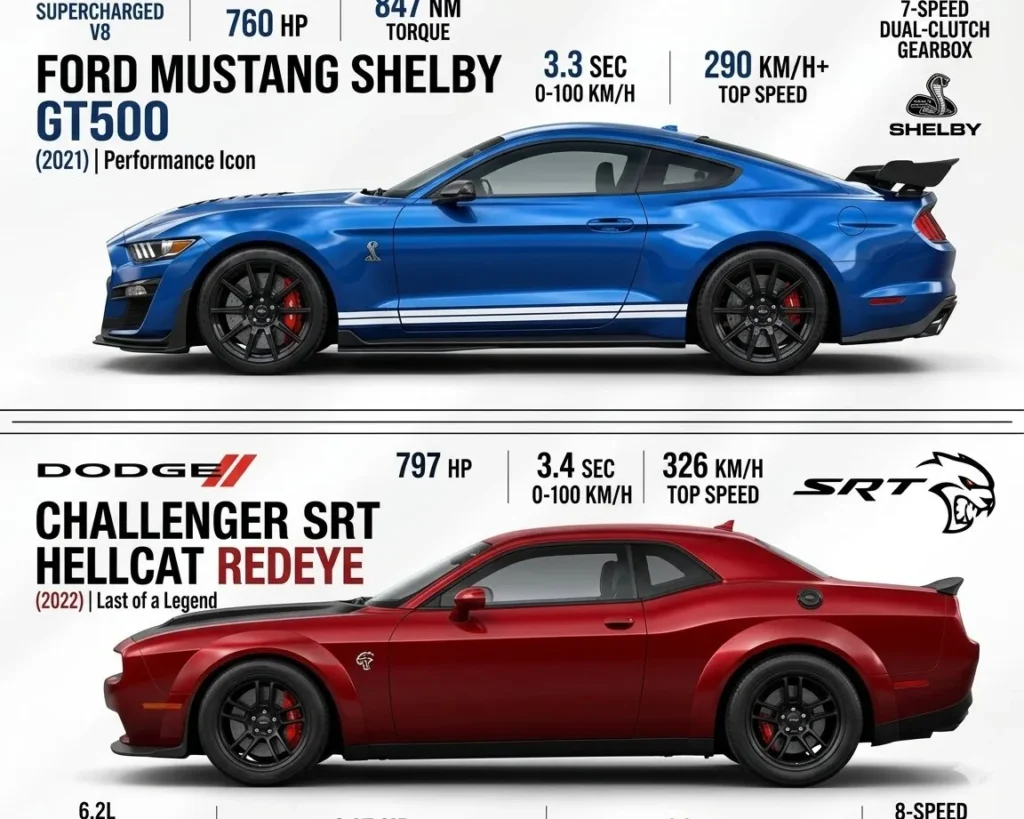
- Power depends on the year you compare: the 2013 GT500 made 662 hp against the 2015 Hellcat’s 707 hp, but the 2020 GT500 (760 hp) out-muscles the standard Hellcat (717 hp) and trails the Redeye (797 hp).
- Straight-line speed is closer than the spec sheets suggest. Tires, launch technique, and model year matter more than the horsepower gap.
- Used prices: low-mileage 2020 GT500s were listed around $80,000 to $100,000 and comparable Hellcats around $65,000 to $75,000 in mid-2025 data. Check current listings before you budget.
- Owner consensus: the GT500 is the sharper handler, the Hellcat is the easier daily and road-trip car.
How we researched this: AutoAkhbar did not test these cars. This comparison is built from manufacturer figures, published road tests, listing data, recall records, and owner-forum reports, all linked in the text and in the sources list at the end. Forum posts are owner opinion, not lab data, and we label them that way.
Table of Contents
Also Read: Is the 2027 Silverado EV 4WT Worth It? The $53,200 Work Truck vs 2LT and Up
How the GT500 Pushed Dodge to Build the Hellcat
The Hellcat exists partly because of a rumor. According to Jalopnik’s reporting, Dodge was working toward a 600-horsepower Challenger until word of the 662-horsepower 2013 Shelby GT500 spread. Fiat Chrysler powertrain executive Chris Cowland used that number to win approval for roughly 675 hp, then gave his team a target above 700. The result was the 2015 Challenger SRT Hellcat at 707 hp.
Ford had not built a slouch. The 2013-2014 GT500 used a 5.8-liter supercharged V8 with far better cooling than the 5.4 it replaced, boost of up to 14 psi, and a one-piece carbon-fiber driveshaft. For two model years it was the horsepower king of American muscle. Then the Hellcat arrived, and the numbers moved on. Ford answered with a 760-hp GT500 for 2020, but by then Dodge had passed 800 hp with the Demon.
Both V8 coupes are now gone. Dodge’s V8 Challengers ended with the 2023 model year, and the 2022 GT500 was the last of its kind, which is a big part of why used prices have held up.
Specs Compared: GT500 vs Hellcat, Generation by Generation
Comparing “the GT500” with “the Hellcat” is misleading because each car changed a lot over its run. The fair way to compare them is by era.
| Model | Engine | Power / Torque | Transmission | Notes |
|---|---|---|---|---|
| 2013-2014 Shelby GT500 | 5.8L supercharged V8 | 662 hp / 631 lb-ft | 6-speed manual | Up to 14 psi boost, carbon-fiber driveshaft |
| 2015 Challenger SRT Hellcat | 6.2L supercharged HEMI V8 | 707 hp / 650 lb-ft | 6-speed manual or 8-speed automatic | Bumped to 717 hp / 656 lb-ft for 2019 |
| 2020-2022 Shelby GT500 | 5.2L supercharged V8 (2.65L supercharger) | 760 hp / 625 lb-ft | 7-speed dual-clutch only | About 4,225 lb; $73,995 starting price for 2020 |
| 2019-2023 Challenger SRT Hellcat Redeye | 6.2L supercharged HEMI V8 | 797 hp / 707 lb-ft | 8-speed automatic | 2023 Redeye RWD: about 4,430 lb, from $68,600, 13/22 mpg |

Sources: MotorBiscuit (2013 vs 2015), Fox News Autos (2020 GT500 power, price), Motor Authority (GT500 curb weight), and Motor Matchup (2023 Redeye). The Super Stock model went further, at 807 hp and 707 lb-ft, per autoevolution.
Who Has the Power Advantage?
- 2013 GT500 vs 2015 Hellcat: the Hellcat has 45 more hp and 19 more lb-ft.
- 2020 GT500 vs a 2019 standard Hellcat (717 hp): the GT500 has 43 more hp.
- 2020 GT500 vs Redeye (797 hp): the Hellcat has 37 more hp, and 47 more against the Super Stock.
The engineering philosophies differ, too. Dodge took the 6.4-liter HEMI, shrank the stroke to 6.2 liters, and bolted on a supercharger of roughly 2.4 liters, a blower that alone soaks up around 80 hp to drive, according to Jalopnik. Ford’s 2020 engine is a smaller 5.2-liter V8 with a 2.65-liter supercharger and a stronger, higher-revving character, and it needs a dual-clutch gearbox to survive the torque. The Hellcat is bigger and heavier, and easier on the driver. The GT500 is lighter and more demanding.
Real-World Performance: Spec Sheet vs Stopwatch
Ford claimed 0-60 mph in 3.3 seconds and a 10.7-second quarter mile for the 2020 GT500 on its best day, which Fox News reported as a tenth of a second quicker than Dodge’s own Redeye claims. Independent numbers were more modest. Car and Driver’s test, as reported in an owner-forum thread, recorded 3.6 seconds to 60 mph and 11.4 seconds at 132 mph in the quarter mile. Ford also stressed the car’s 0-100-0 mph time of 10.6 seconds, which owes a lot to its large Brembo brakes.
Head-to-head drag videos rarely settle it. In one recent race between a Hellcat Super Stock and a GT500, autoevolution concluded that the Dodge’s power edge was slight and the two offered similar straight-line performance. Tires, drivers, and hidden modifications decide these races more than badges do.
Where they separate is character. On the HellCat.org forum, one driver who had owned both a Hellcat and a Redeye called the Shelby fun but smaller and less comfortable on road trips, with the Dodges better in all-weather driving. Another owner who moved from a 2019 Hellcat to a 2020 GT500 said the Ford handles far better and feels better built. Those are opinions from individual owners, not measurements, but they line up with the hardware: the GT500 has adaptive dampers, huge brakes, and about 200 fewer pounds to manage.
What They Cost: Purchase and Running Costs
Used prices. Cars.com, using mid-2025 data, put low-mileage 2020 GT500s at roughly $68,000 to $85,000, citing one with 6,530 miles listed at $92,200 and another with 21,425 miles at $77,995. The same report put used 2020 Hellcats at about $65,000 to $75,000. Cars.com’s national average across all GT500 listings was $79,226 when we checked. For the older 2013-2014 cars, MotorBiscuit noted in 2022 that low-mileage examples were reaching $70,000 while fair-market values sat closer to $40,000. Prices move fast in this segment, and some owners on a 2024 forum thread said low-mileage Redeyes were dropping faster than Shelbys, so treat every number here as a starting point.
Fuel. The GT500 is rated at 12 mpg city and 18 mpg highway, per Cars.com. The Redeye is rated at 13 city and 22 highway. Neither is an economy car, but the Hellcat is a little kinder on the highway.
Insurance and tires. We did not find reliable published figures for these two cars, so get insurance quotes for your specific VIN and age before you sign anything. Wide performance tires on 700-plus-hp cars are not cheap, and traction-limited launches wear them quickly.
Reliability and Known Issues
2020-2022 Shelby GT500
- Recall 22E08: 2020 and 2021 GT500s needed a powertrain and transmission control module reflash, per owner discussion of the recall. It did not affect the 2022 model.
- Timing chain tensioner program (21B26): Ford placed a hold on new sales and offered a customer satisfaction program for 2020 GT500 and GT350 cars built at Flat Rock between December 2, 2019 and December 16, 2020, after technicians may not have activated a secondary tensioner, per MustangForums. The program expired in April 2022.
- Dual-clutch complaints: owners on the GT500 forum report limp mode and a “wrench” warning on cars including a 2022, with one blaming low transmission fluid from the factory. Other members said failures are not common and that their own cars have run trouble-free. Another thread reported a replacement wait of about three months in 2023. This is anecdotal evidence, so weigh it accordingly.
Challenger SRT Hellcat and Redeye
- 2017 oil cooler hose recall: Dodge replaced hoses that could fail and spray oil on 2017 Challenger Hellcats, according to a Fast Car buyer’s guide.
- Supercharger bearing and pulley wear: an owner-report aggregator, Au7o, lists supercharger bearing failure as a serious issue, typically announced by a rising whine from the front of the engine, with repairs estimated at $3,000 to $12,000. That is not official data, but it tells you where to listen during a test drive.
Neither car has a clean bill of health. What we could not find is a rigorous, apples-to-apples failure-rate study, so nobody can honestly say one is “more reliable” than the other. A pre-purchase inspection matters more than the badge.
US Buyer’s Checklist
- Run the VIN on the NHTSA recall lookup and confirm every open recall was completed.
- GT500 (2020-2021): ask for proof of the 22E08 reflash and, for 2020 cars, the timing chain tensioner service.
- GT500 transmission: ask for dual-clutch fluid service history and watch for lurching at low speed.
- Hellcat: listen for supercharger whine that rises with rpm, check the cooling system, and look for signs of hard launches such as worn rear tires and driveline noise.
- Check for modifications. Tunes and drag-strip use are common on both, and can affect coverage.
- Confirm remaining warranty. Most examples are now five or more years old, so factory coverage may have ended unless a certified plan applies.
- Get a pre-purchase inspection from a shop that works on supercharged Fords or Mopars.
Pros and Cons
Shelby GT500 (2020-2022)
- Pros: 760 hp, sharper handling, adaptive dampers and big brakes, lighter than the Challenger, and the last of its kind.
- Cons: automatic-only, dual-clutch service concerns, more expensive on the used market, and less comfortable on long trips according to owners.
Challenger SRT Hellcat / Redeye
- Pros: more power at the top of the range, roomier and more comfortable, strong all-weather drivability, lower used prices, and a manual option on early cars.
- Cons: heavy, less precise handling than the GT500 according to owners, and supercharger and oil cooler issues to check.
AutoAkhbar Verdict: Who Should Buy Which?
- Buy the GT500 (2020-2022) if you want a track-capable car with modern hardware and can afford the premium and the possible dual-clutch bills.
- Buy the Hellcat or Redeye if you want the loudest straight-line car for the money, need real comfort for daily use or road trips, or want to keep your budget under about $75,000.
- Buy a 2013-2014 GT500 or an early manual Hellcat if you want a three-pedal car. The 2020 GT500 does not offer a manual.
The rivalry is not over, even if this chapter is. Ram is bringing the Hellcat V8 back in the 2027 1500 TRX SRT, and a report from Mopar Insiders, covered by Autoblog, says a Hellcat Charger could follow for 2028. Dodge has not confirmed the Charger. Until it does, the used market is the only place to buy either of these cars.
FAQ Shelby GT500 vs Hellcat
Which is faster, the Shelby GT500 or the Hellcat?
It depends on the model year. The 2015 Hellcat (707 hp) has more power than the 2013 GT500 (662 hp). The 2020 GT500 (760 hp) beats the standard Hellcat (717 hp) but trails the Redeye (797 hp). In real-world races the difference is small and often decided by tires and driver.
How much does a used Shelby GT500 cost?
In mid-2025 data, low-mileage 2020 GT500s were listed at roughly $80,000 to $100,000, and Cars.com showed a national average listing price of $79,226 across all model years. Older 2013-2014 cars cost much less. Always check current listings.
Is the GT500 reliable?
Mixed. The 2020-2021 cars had a control-module recall, early 2020 cars had a timing chain tensioner program, and some owners report dual-clutch problems, although others report none. A pre-purchase inspection is essential.
Will the Hellcat V8 come back?
It is returning in the 2027 Ram 1500 TRX SRT with 777 hp. A Hellcat Charger for 2028 has been reported but not confirmed by Dodge.
Sources and Further Reading
- Jalopnik: 2013 Shelby GT500 vs the Hellcat
- Fox News Autos: 2020 GT500 test drive
- Motor Authority: 2020 GT500 deep dive
- HotCars: used GT500 values
- Cars.com: Shelby GT500 listings
- autoevolution: Hellcat Super Stock vs GT500
- NHTSA: check recalls by VIN
Pricing and specifications are drawn from the sources above and change often. Verify current figures with a dealer or the manufacturer before buying.