
No licence. No registration. No insurance.” That’s the pitch on almost every Dacus scooter listing you’ll find online — and for most of the lineup, it’s true. But dig into the fine print of one popular Dacus variant, and that same promise quietly falls apart. Before you book one on the strength of that pitch, here’s what the listings aren’t telling you.
Key Takeaways
- Dacus is manufactured by Futuretech Rides Private Limited, based in Jind, Haryana — a regional EV maker, not a pan-India OEM like Ola or Ather.
- Prices range roughly ₹40,000–₹64,999 depending on model (BRD, Austra, Austra Pro, Austra Pro Plus, Gold, Elite).
- Most Dacus models fall in the low-speed, no-registration category (≤25 km/h, ≤250W) — but not all. This is the one detail most buyers miss, and we break it down below.
- Claimed range: 60–80 km per charge; claimed top speed varies 25–50 km/h across variants.
- No PM E-Drive subsidy applies to low-speed scooters — factor that into your real “on-road” cost comparison.
Table of Contents
Who Is Dacus, Actually?
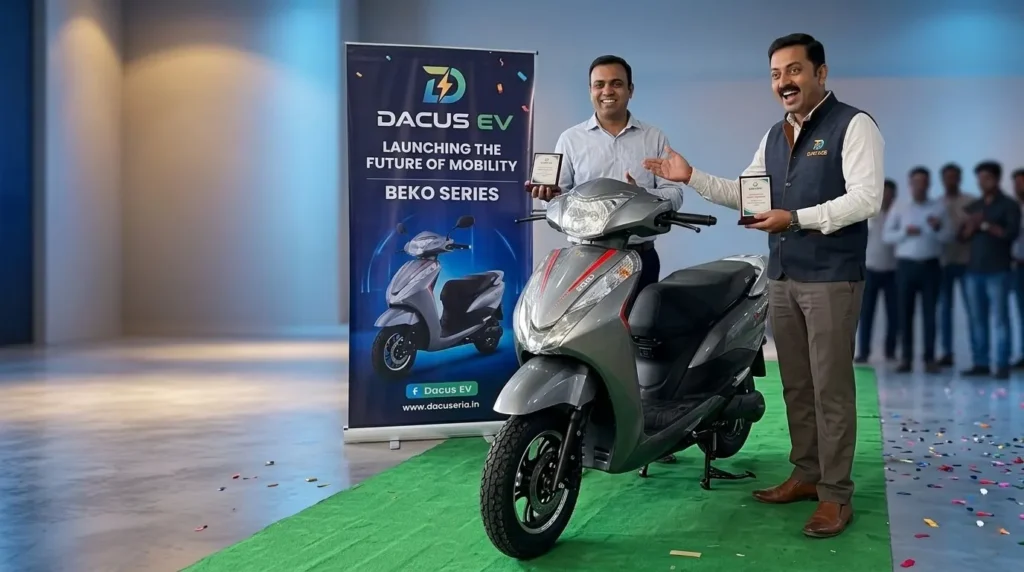
Before diving into specs, it’s worth being upfront about something most listicles skip: Dacus isn’t a mainstream, nationally-distributed EV brand. It’s manufactured by Futuretech Rides Private Limited, a company registered in 2022, headquartered on Bhiwani Road in Jind, Haryana. Its retail footprint is mostly visible through B2B platforms like IndiaMART, and its social presence (Facebook page “Dacus EV”) is modest and locally focused.
This matters for how you should read everything that follows. Dacus scooters are positioned as budget, no-frills, utility EVs — the kind bought by small-town commuters, students, and delivery riders in Haryana, Punjab, and neighbouring states who want a cheap, tax-free, license-free ride. They are not competing with Ola S1, Ather 450, or TVS iQube on tech, service network, or brand trust. Comparing them on that basis would be misleading.
The One Thing Most Buyers Get Wrong: Check the Top Speed Before You Buy
Here’s the detail that genuinely changes buying decisions, and it’s specific to Dacus’s own product line — not a generic EV disclaimer.
Under Indian Central Motor Vehicle Rules, an electric two-wheeler is exempt from registration, driving licence, and road tax only if it stays within two limits: top speed ≤25 km/h and motor power ≤250W. Marketing material for several Dacus models (Austra, BRD) leans heavily on “NO Registration, NO Licence, NO Insurance, NO Age Limit” — which is accurate only for the variants that actually stay under 25 km/h.
The catch: listings for the Dacus Austra Pro Plus advertise a top speed of 50 km/h. A scooter with a 50 km/h top speed does not qualify for the no-registration exemption, regardless of what the dealer or listing implies. If you buy that variant expecting to ride it unregistered, you’d technically be non-compliant.
Practical takeaway: before booking any Dacus model, ask the dealer to confirm the exact top speed and motor wattage in writing for that specific variant, and cross-check it against the 25 km/h / 250W threshold yourself. Don’t rely on generic “no registration” messaging that may have been written for a different model in the same lineup.
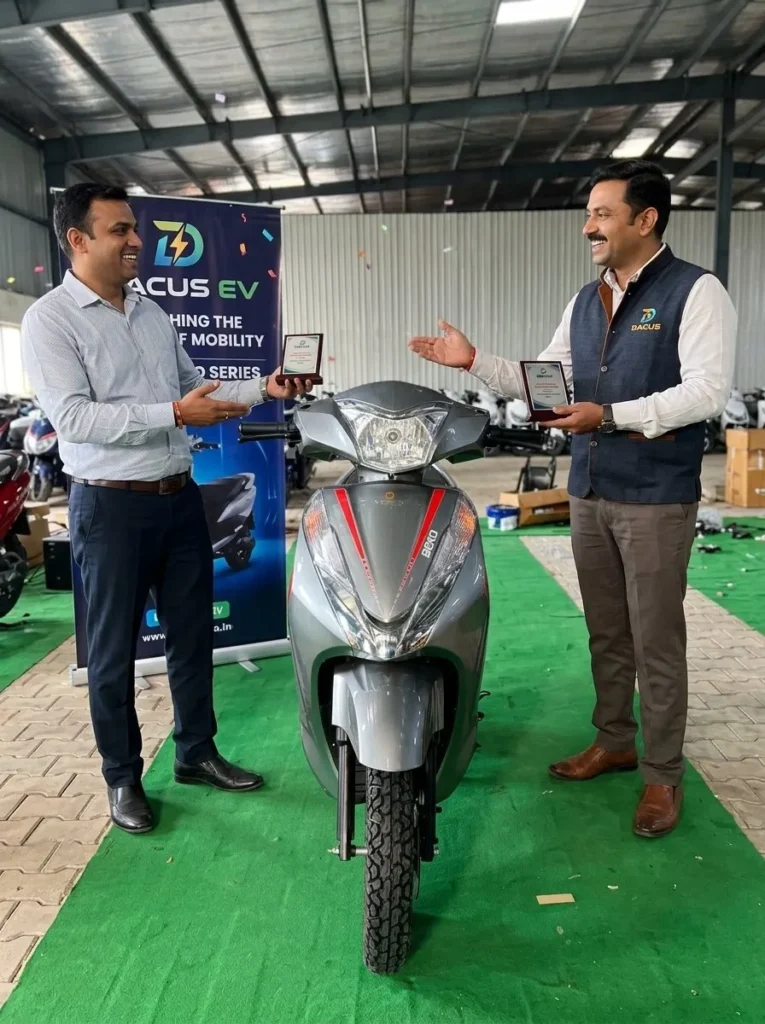
Technical Breakdown
Based on manufacturer listings across the current Dacus range (Austra, Austra Pro, Beko, BRD, Gold, Elite):
- Motor: 250W BLDC hub motor, waterproof, on the base low-speed variants
- Battery options: Lead-acid or Lithium-ion, 60V/72V, roughly 26–33.4Ah depending on variant
- Charging time: 4–5 hours for a full charge
- Brakes: Front disc, rear drum (varies by model — some list disc/disc)
- Suspension: Hydraulic front and rear
- Tyres: Tubeless, 10″–12″ depending on variant
- Loading capacity: Up to 180 kg
- Extras on higher trims: LED lights, DRLs, reverse mode, digital LCD speedometer, central lock, alloy rims
Lead-acid variants are the budget entry point but degrade faster (typically 12–18 months of usable life under regular use) and add noticeable weight. If you can stretch the budget, the lithium-ion option is the more sensible long-term buy — lighter, longer battery life, and better resale.
Also Read : Rosen Electric Bike 2025 Launch – The Next Big Business Trend
Real-World Range & Performance: What to Actually Expect
Manufacturer claims put range at 60–80 km per charge. As with virtually every budget EV scooter in India, treat this as a lab/ideal-condition figure. Realistic factors that will cut this down:
- Rider weight and load — carrying a pillion or bags reduces range meaningfully on small-battery low-speed EVs
- Terrain — Haryana’s flat plains are favourable; hilly routes will hurt range more than on higher-powered scooters
- Lead-acid vs lithium — lead-acid packs lose usable range faster as the battery ages
- Riding style — low-speed scooters have little power reserve, so frequent full-throttle starts drain the pack faster relative to their small capacity
A realistic day-to-day expectation for most riders is 45–65 km on a full charge, rather than the upper end of the claimed range — consistent with what owners of comparable low-speed EVs (Ampere, Okaya, Komaki) typically report.
Specifications & Competitor Comparison
| Feature | Dacus BRD / Austra (base) | Okinawa R35 | Ampere Reo Plus Li |
|---|---|---|---|
| Price (ex-showroom) | ₹40,000 – ₹45,000 | ₹60,000 | ₹58,990 |
| Category | Low-speed (no RTO)* | Low-speed (no RTO) | Low-speed (no RTO) |
| Battery | Lead-acid / Li-ion, 60–72V | Li-ion | Li-ion |
| Claimed range | 60–80 km | 60 km | 65 km |
| Top speed | 25–35 km/h* | 25 km/h | 25 km/h |
| Charging time | 4–5 hrs | 4–5 hrs | 4–5 hrs |
| Brakes | Front disc / rear drum | Disc/Drum | Disc/Drum |
| Dealer network | Regional (Haryana-focused) | Pan-India | Pan-India |
*Verify the exact top speed for your chosen Dacus variant — see the section above. The Austra Pro Plus variant (50 km/h) is not a no-RTO scooter.
Where Dacus wins: upfront price. It’s meaningfully cheaper than Okinawa or Ampere at the entry level, and loading capacity (180 kg) is competitive.
Where it loses: dealer/service network. Okinawa and Ampere have pan-India presence and spare-parts availability; Dacus service support is concentrated around Jind and nearby Haryana towns. If you’re outside that belt, factor in higher effective cost of ownership from service travel or part delays.
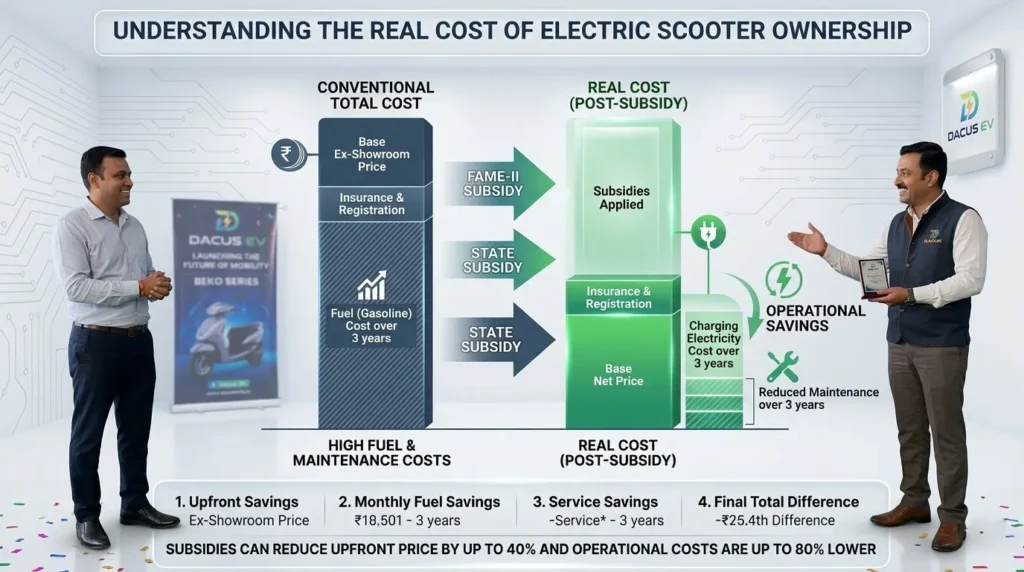
Pricing, Subsidies & the Real Cost of Ownership
One common myth worth correcting: low-speed EV scooters, Dacus included, are not eligible for the central PM E-Drive purchase incentive, which applies only to registered high-speed e-2Ws priced up to ₹1.5 lakh. So the ₹40,000–₹65,000 Dacus price tags you see are already the final on-road price in most cases — no registration means no road tax either, which is the genuine saving versus a comparable high-speed scooter.
Running cost is where low-speed EVs like Dacus shine regardless of brand: charging cost per 100 km typically works out to roughly ₹15–25 depending on local electricity tariffs, versus ₹250–350 for an equivalent petrol scooter at current fuel prices.
Pros & Cons
Pros:
- Among the cheapest entry points into EV two-wheelers in North India
- No registration, licence, or insurance hassle on qualifying (≤25 km/h) variants
- Decent 180 kg loading capacity for a budget scooter
- Lithium variants available for better long-term battery life
Cons:
- Limited dealer and after-sales network outside Haryana
- Top-speed labelling inconsistency across the lineup needs buyer verification
- Lead-acid variants have a shorter usable battery life
- Not a nationally established brand — fewer independent reviews or long-term ownership data available
Final Verdict: Who Should Buy the Dacus EV Scooter?
If you live in or near Jind, Haryana (or anywhere with an accessible Dacus service point), want the cheapest possible license-free commute for short, local trips, and are comfortable buying from a regional manufacturer rather than a national brand — the Dacus BRD or Austra (confirmed ≤25 km/h variant) is a genuinely sensible, low-risk purchase.
If you need highway-capable speed, a wide service network across states, or plan to resell in a few years, the ₹15,000–₹20,000 extra for an Okinawa, Ampere, or similar pan-India low-speed brand is the safer bet.
Before you buy any Dacus model: get the exact top speed and motor wattage confirmed in writing for that specific variant, so you know for certain whether it qualifies for the no-registration exemption.
FAQ
Does the Dacus EV scooter need registration in India?
Only variants with a top speed of 25 km/h or less and a motor of 250W or less qualify for the no-registration exemption. Some Dacus models, like the Austra Pro Plus, claim a 50 km/h top speed and would require registration.
What is the price of the Dacus EV scooter?
Dacus models range from roughly ₹40,000 to ₹64,999 ex-showroom, depending on the variant and battery type (lead-acid vs lithium-ion).
Is Dacus EV scooter eligible for the PM E-Drive subsidy?
No. PM E-Drive incentives apply only to registered high-speed electric two-wheelers, not to low-speed no-registration models like Dacus.
What is the real-world range of a Dacus scooter?
Manufacturer claims 60–80 km per charge; realistic day-to-day range is closer to 45–65 km depending on load, terrain, and battery type.