
By Shubham Sharma, Founder & Editor, AutoAkhbar.com | Fact-checked and updated: September 16, 2026
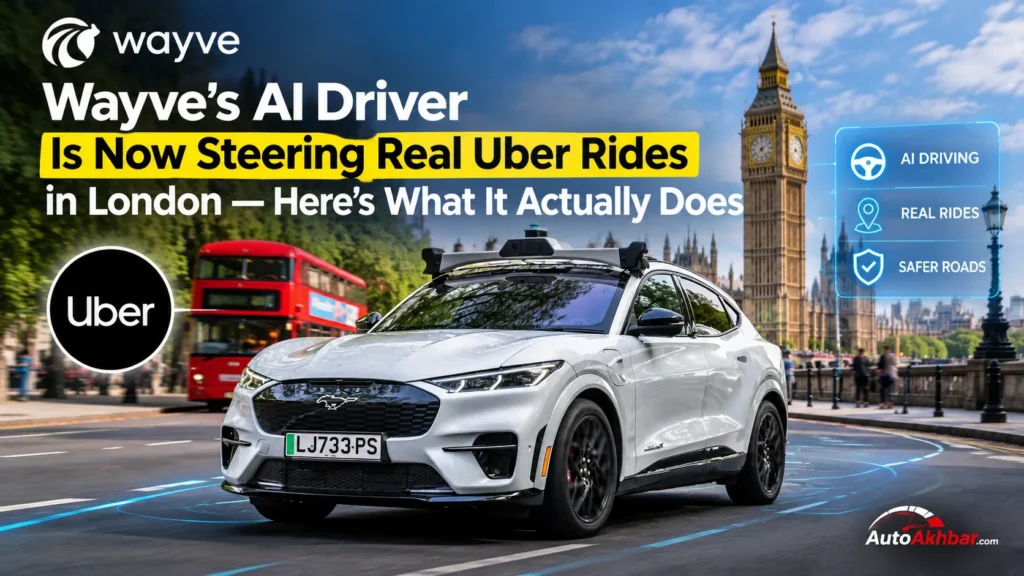
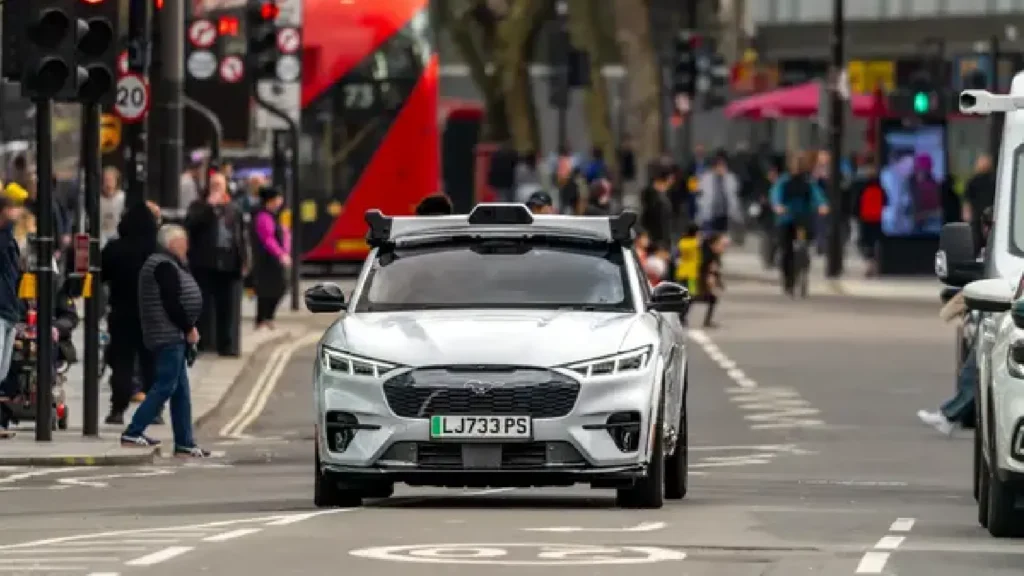
New Delhi: On September 3, 2026, something quietly historic happened on the streets of London. A regular Uber user, requesting an UberX or Uber Comfort, could suddenly be matched with an all-electric Ford Mustang Mach-E that was, for all practical purposes, driving itself — using an AI system called the Wayve AI Driver. There was still a trained safety operator up front, hands hovering near the wheel, but the car itself was reading the road, the roundabouts, and the double-decker buses with its own neural network, not a pre-loaded 3D map.
Table of Contents
Who Is Wayve, and Why Is Everyone Suddenly Talking About It?
Wayve isn’t a new name — it’s a London startup founded in 2017 by Cambridge researchers Alex Kendall and Amar Shah — but 2026 is the year it stopped being a “promising AI lab” and started being an actual product on actual roads. The company has now raised roughly $2.8 billion across four funding rounds, with its most recent Series D in February 2026 pulling in $1.2 billion and pushing its valuation to $8.6 billion. The investor list alone tells you how seriously the industry is taking this: Microsoft, Nvidia, Uber, Mercedes-Benz, Nissan, and SoftBank’s Vision Fund are all in.
What makes Wayve different from the self-driving names you already know — Waymo, Tesla FSD, Baidu’s Apollo Go — is how it drives. Most autonomous systems lean heavily on pre-built HD maps and hard-coded rules for every intersection, roundabout and sign. Wayve’s “AV 2.0” approach instead trains an end-to-end neural network on millions of kilometres of real driving footage, so the car learns to drive the way a human does — by experience and pattern recognition, not a script.
CEO Alex Kendall has been candid that this doesn’t mean cameras-only by ideology; in a 2024 interview on The Road to Autonomy podcast, he clarified the sensor stack is chosen for “safety, scalability and economics,” not dogma. In practice, that means Wayve vehicles run on cameras and radar, and — unlike Tesla’s pure vision-only setup — it doesn’t rule out adding more sensor redundancy as it scales.
One clarification worth making explicitly: Wayve’s own public positioning (and most primary reporting on its Series D) describes its current production stack as camera-and-radar-based, deliberately skipping lidar and HD maps to keep costs down and scale faster — so treat any claim that it already runs full lidar arrays like Waymo’s with some caution unless Wayve itself confirms it.
What Actually Happened on Launch Day — The Part Most Headlines Skipped
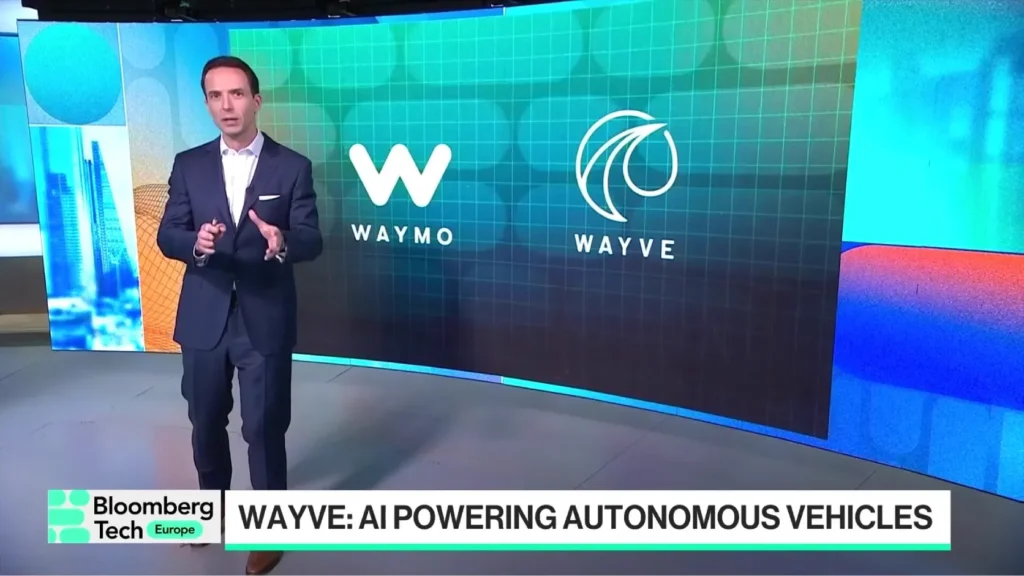
Most coverage of the London launch stuck to the press-release version: 15-odd Wayve-powered Mach-Es, safety drivers on board, more than 140,000 Londoners already opted in through the Uber app to try one. That’s real and it’s a big deal — London is now only the second European city with public robotaxis, after Zagreb (which uses Chinese firm Pony.ai’s tech via a company called Verne).
But the more useful story for anyone trying to judge this tech honestly came from a live demo run for AFP journalists on the eve of launch. The car handled a protest outside Parliament, roadworks, and a mini roundabout cleanly — it even correctly read a cyclist waving it forward. Then, on a narrow side street, the rear doors of a parked van swung open unexpectedly.
The AI braked hard and triggered an internal alarm, and the safety driver took over. Wayve’s own team later said the takeover was the driver’s judgement call and that they believe the system would have handled it — but that’s exactly the kind of edge case that separates a controlled demo from a genuinely finished product, and it’s worth knowing about before you take the marketing copy at face value.
It also matters that the UK’s original goal — fully driverless taxis in London by the end of 2026 — has already slipped. The Department for Transport is now only targeting a regulatory framework for driverless cars sometime in 2027, with no firm date. Waymo, meanwhile, is racing to get its own fully driverless service (no human on board at all) running in the US before London even gets there.
How Wayve Stacks Up Against the Other Big Self-Driving Bets
| Company | Core Approach | Current Public Status (Sept 2026) | Backers / Funding |
|---|---|---|---|
| Wayve | End-to-end deep learning (“AI Driver”), no HD-map dependency, camera-led + supporting sensors | Supervised public rides via Uber in London & Zagreb; consumer L2+ cars targeted for 2027 | ~$2.8B raised; $8.6B valuation (Microsoft, Nvidia, Uber, Mercedes-Benz, Nissan) |
| Waymo | Sensor-heavy (lidar + radar + camera) with detailed HD maps | Fully driverless rides (no human) already live in multiple US cities; London launch targeted for 2026 | Alphabet-backed |
| Tesla FSD | Camera-only, no lidar, deployed at consumer scale worldwide | Driver-supervised in personal cars; robotaxi service expanding in select US cities | Tesla, self-funded |
| Baidu Apollo Go / Pony.ai | Sensor-heavy, China-first deployment, partnering internationally (e.g. Lyft, Verne in Zagreb) | Large-scale robotaxi operations in China; early European entry via partners | Baidu; Chinese state and private capital |
The Question Nobody in London Is Asking (But We Are): Would This Survive Indian Roads?
Alex Kendall likes to call London “one of the most complex driving environments in the world” — narrow medieval streets, aggressive cyclists, unpredictable pedestrians. Fair enough. But anyone who has driven in Old Delhi, Mumbai’s link roads during monsoon, or a Bengaluru signal-free corridor at rush hour knows London’s chaos is a controlled classroom compared to India’s real-world exam. No fixed lane discipline, cattle and handcarts sharing carriageways, hand signals that vary by state, and monsoon flooding that changes the “road” itself week to week.
This is actually where Wayve’s pitch is more interesting than Waymo’s. A system that learns from driving data rather than depending on painstakingly pre-mapped roads should, in theory, generalise faster to messy, unmapped environments — Wayve has publicly claimed its cars have driven “zero-shot” (no prior training on that specific city) in over 500 cities across Europe, North America and Japan in a single year.
Whether that generalisation holds up against Indian traffic density and informal road behaviour is a genuinely open question, and it’s one none of Wayve’s current markets — London, Zagreb, and planned launches in about 12 markets globally — actually test. For now, this remains a UK/EU/Japan/North America story; there’s no indication India is anywhere close to Wayve’s near-term roadmap, and any Indian deployment would first need to clear the kind of regulatory groundwork that’s still holding things up even in London.
Worth noting too: Wayve isn’t chasing a “we’ll build our own robotaxi fleet” model like Waymo. Its actual business plan is to license the AI Driver software to automakers — Nissan and Stellantis are already on board — so the more realistic path into markets like India, if it ever happens, would be through a car brand quietly shipping Wayve’s software inside an existing model, not a dedicated Wayve-branded taxi fleet.
Also Read: Tesla’s Cybercab Just Hit Austin Streets With No Steering Wheel — Here’s What Changes for Riders
Inside Wayve: What Insiders Are Saying
Away from the press releases, employee reviews on Glassdoor (aggregated via workplace-culture trackers) paint a fairly consistent picture: a genuinely collaborative, low-ego engineering culture with a world-class ML research team, but real burnout risk given how aggressively the company is trying to solve full autonomy, and career-progression frameworks that are still catching up with its rapid scale-up from research lab to 850-plus-employee company. It’s also worth remembering that this is a company that, by its own CEO’s account, was once dismissed outright — Kendall has recounted that Elon Musk personally told him years ago that Wayve’s approach “would never work.” Whatever you think of the current tech, that specific bet looks a lot less certain today.
AutoAkhbar Verdict: Should You Care About Wayve?
If you’re not in London or Zagreb, you can’t ride in a Wayve-powered car yet, and there’s no confirmed India timeline — so this isn’t a “buy” or “book a ride” story today. But it matters for three real reasons: Wayve represents the most credible non-Waymo, non-Tesla approach to full autonomy, it’s now backed by nearly every major AI and automotive player at once, and its software-licensing model (rather than building its own robotaxi fleet) means it could end up inside a car you actually buy years before any robotaxi reaches Indian streets.
The honest read: impressive engineering, a launch-day stumble that shows the tech isn’t finished, and a business model that’s realistically 2-3 years from being relevant to Indian roads at all — worth watching closely, not worth holding your breath for.
Sources & Further Reading: Reuters — Uber, Wayve launch London’s first robotaxi service, on-the-ground account of the launch-day van-door incident, Wayve’s official Series D funding announcement, and TIME’s deep dive on Wayve’s strategy vs Waymo.
Also Read: Zoox Recalls 105 Robotaxis After One Drove Into An Active Fire Scene