
Buying a used car involves a checklist that most buyers have thought about at least a little. Service history, accident record, tyre condition, engine health. What almost nobody thinks to add to that list is pending traffic challans. And that oversight, quiet and easy to miss, can cost you a significant amount of money shortly after you have driven away.
Challans do not disappear when a car changes hands. They stay, and they become your problem the moment the registration number is linked to your name.
Table of Contents
Challans Follow the Car, Not the Owner
This is the part that surprises most used car buyers. A traffic challan is issued against a vehicle’s registration number, not against the person who was driving it at the time. When ownership of that vehicle transfers to you, the pending challans attached to that registration number do not get cleared automatically. They carry over.
In practice, this means that a previous owner who racked up fines across three cities, never paid any of them, and then decided to sell the car has effectively passed that liability to you. You did not commit those violations. You may never have driven the car before the day you bought it. None of that matters to the traffic authority whose records show your registration number with outstanding dues.
The law does not distinguish between the person who incurred the fine and the current registered owner. What the database shows is what the system acts on.
What the Previous Owner May Not Have Told You
Most used car sellers are not deliberately withholding challan information. Many simply do not know what challans are pending on their own vehicle. An e-challan issued by a speed camera in a city the seller visited once, an SMS that went to an old phone number, a notification that was missed during a busy period, these all add up to a situation where the seller genuinely believes the car is clean when it is not.
Some sellers do know and say nothing, counting on the buyer not to check. Either way, the outcome for the buyer is the same: an inherited liability that was not part of the deal and was not reflected in the price.
The only reliable way to know the true challan status of any vehicle is to check it yourself, independently, before you complete the purchase.
How Far Back Does a Challan Record Go
There is no automatic expiry on unpaid challans in India. A fine issued three years ago that was never paid is still in the system, still attached to the registration number, and still fully enforceable. If enough time has passed without payment, it may have escalated from an e-challan to a court-pending status, which makes it significantly more complicated to resolve than a straightforward online payment.
For vehicles with multiple previous owners, the challan history can span years and multiple states. Each owner may have driven the car to different cities, triggered violations in different jurisdictions, and left behind fines that were never cleared. All of it accumulates under the single registration number that you are now considering taking ownership of. The requirement of clearance of any pending challans for ownership transfer is only a recent development.
A comprehensive challan check pulls records from across all Indian states in a single search. What you see is the complete picture, not just the most recent entries.
The RC Transfer Problem Nobody Warns You About
Pending challans can complicate the registration certificate transfer in ways that catch buyers off guard after they have already paid for the car. While unpaid e-challans do not always block an RC transfer at every RTO, challans that have escalated to court-pending status are a different matter entirely.
Some RTOs flag vehicles with unresolved court challans during the transfer process. When that happens, the transfer cannot proceed until the matter is legally resolved. You have already paid for the car. The seller may be difficult to reach. And you are now the one responsible for sorting out a legal dispute that has nothing to do with your own driving history.
Discovering this after the fact is a position no buyer wants to be in. Discovering it before you finalise the deal gives you options: negotiate the price down to account for the liability, ask the seller to clear the challans before transfer, or walk away. This is precisely why platforms like Cars24 run a challan check as part of the used car buying process, so that neither the buyer nor the seller is caught off guard during transfer.
How to Run a Challan Check on Any Vehicle
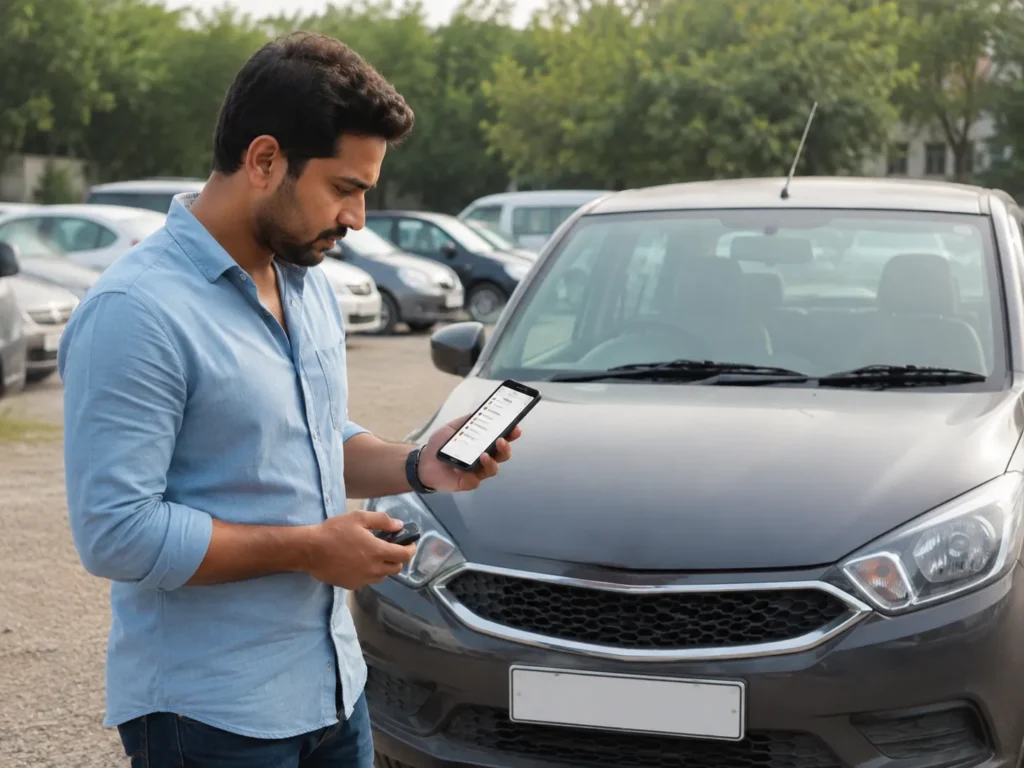
Checking a vehicle’s challan status before buying it is straightforward and takes only a few minutes. All you need is the registration number of the car.
The government’s Parivahan portal allows basic challan lookups by registration number and covers centrally issued challans. For a more complete picture that spans all states and includes both online and court-pending challans, Cars24’s challan portal pulls verified data from across the country’s traffic databases and presents everything in one place. Enter the registration number, and you see every pending fine attached to that vehicle, the violation type, the date, the amount, and the current status.
Do this before you negotiate the final price. Do it again before you sign the transfer papers, because challans can be issued at any time, including in the days between your initial check and the actual transfer. A vehicle that was clean last week may have a new pending fine today.
Drive It Home Clean
A used car purchase already involves enough variables. The mechanical condition, the accident history, the authenticity of the service records, the fairness of the price. Adding an inherited challan liability to that list is entirely avoidable.
Two minutes and a registration number is all it takes to know exactly what you are buying into. Run the check, factor the findings into your decision, and make sure the car you drive home is genuinely yours to enjoy, not yours to settle the previous owner’s dues with.