
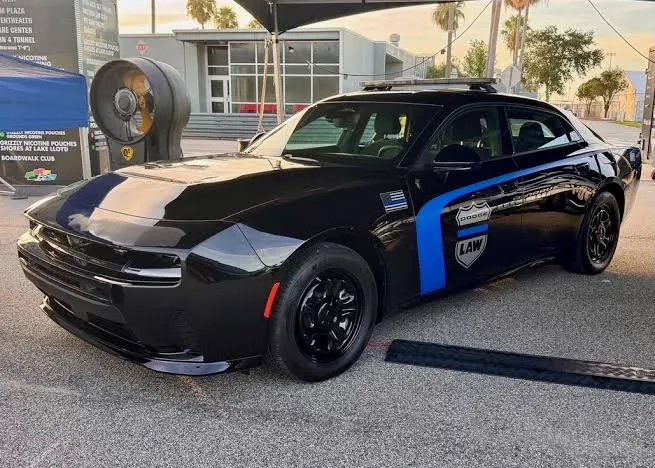
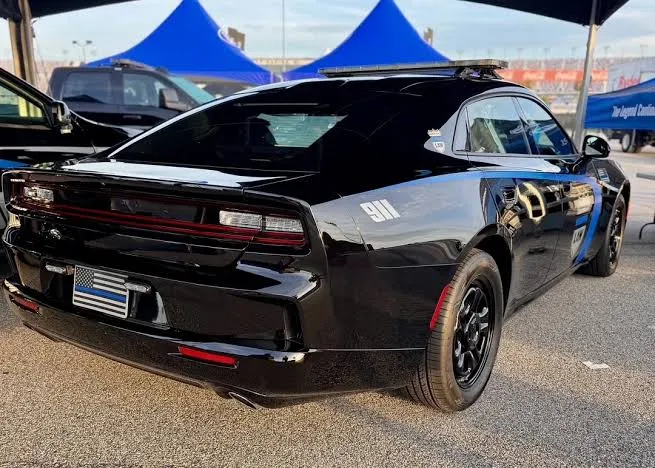
Dodge has shown an early prototype of the next-generation Charger police car — badged Charger PPV — at the Police Fleet Expo 2026 in Daytona. Built on the Charger SIXPACK R/T, the pursuit-ready sedan packs a 420-hp twin-turbo Hurricane inline-six and is expected to arrive with standard all-wheel drive when ordering opens in summer 2027.
Daytona Beach: Dodge has finally answered the question its fans and law enforcement agencies have been asking for nearly two years — yes, the new-generation Charger is coming back to police duty. Dodge Law showcased an early prototype of the Charger PPV (Police Pursuit Vehicle) at the Police Fleet Expo (PFE) 2026, held at Daytona International Speedway, giving departments their first close look at the replacement for the outgoing Charger Pursuit.
Table of Contents
Quick Answer: The Dodge Charger PPV is an early prototype police version of the eighth-generation Charger, built on the SIXPACK R/T platform with a 420-hp twin-turbo Hurricane inline-six engine and expected standard all-wheel drive. It was shown at the Police Fleet Expo 2026 in Daytona, with production orders targeted for summer 2027.
SIXPACK Power, Not the Rumored HEMI V8
Despite online speculation about a HEMI V8-powered police Charger, Dodge chose a different route. The Charger PPV prototype is based on the Charger SIXPACK R/T and uses the standard-output version of Stellantis’ twin-turbocharged 3.0-liter Hurricane inline-six. In its civilian R/T form, this engine produces 420 horsepower and 468 lb-ft of torque, paired with an 880RE 8-speed automatic transmission.
For departments operating across the Midwest, New England, and the Northwest — regions that regularly deal with snow and rough weather — the Charger PPV is expected to arrive with standard all-wheel drive, a notable upgrade over some rear-drive-only pursuit vehicles on the market today.
Direct Answer: The Charger PPV uses the same 420-hp, 468 lb-ft twin-turbo Hurricane SO engine found in the civilian Charger SIXPACK R/T, mated to an 8-speed automatic, with AWD expected as standard equipment.
Built Around Police Equipment
Inside, Dodge has already reworked the cabin for patrol duty. The large production center console is gone, freeing up space for radios, siren controls, in-car computers, and switch panels. Interestingly, engineers kept the Charger’s pistol-grip electronic shifter and push-button start rather than reverting to a column-mounted shifter like the previous Charger Pursuit used.
A police partition separates the front seats from the rear passenger area, though the prototype still runs a standard cloth rear bench — many departments are expected to swap this for a purpose-built, easy-to-clean prisoner seat before deliveries begin. Notably, the rear door panels still retain functional power-window switches and lock buttons, a detail that suggests this particular unit remains an early development vehicle rather than a production-ready car.
Also Read : 2027 Dodge Charger Super Bee Returns With 600 HP and Track-Focused Hardware
Solving the Hatchback Problem
One of the biggest engineering questions around using the new liftback-style Charger for police work was how to separate detained passengers from equipment stored in the large cargo area behind the rear seats. Dodge’s answer: a divider installed behind the rear bench, paired with a large equipment tray that could give departments more usable storage for medical supplies, computers, and emergency gear than the outgoing Charger Pursuit offered.
Gas First, Electric Later
| Variant | Powertrain | Output | Drive |
|---|---|---|---|
| Charger PPV (2027, gas) | 3.0L Twin-Turbo Hurricane I6 (S/O) | 420 hp / 468 lb-ft | AWD (expected) |
| Charger Daytona R/T (electric, evaluated 2024) | Dual Electric Drive Modules | 456 hp / 404 lb-ft | Full-time AWD |
Dodge has also explored an electric police Charger, based on the Daytona R/T, offering over 300 miles of estimated range in earlier concept form. However, for agencies concerned about charging infrastructure, long shifts, and rural patrol coverage, the gasoline Hurricane-powered Charger PPV is expected to be the more practical near-term replacement for the outgoing Charger Pursuit.
AutoAkhbar Verdict / What’s Next
Dodge CEO Matt McAlear has confirmed the brand is actively working with the GSA, California Highway Patrol, and Michigan State Police — agencies that help set national pursuit-vehicle standards — to bring the Charger PPV to production. Final suspension tuning, brake upgrades, cooling systems, equipment packages, pricing, and pursuit certification are still to be announced, but Dodge is targeting summer 2027 for the opening of Charger PPV orders. For a brand built on the phrase “it’s always taken a Charger to catch a Charger,” this marks a serious return to law-enforcement fleets after the previous Charger Pursuit’s production ended.
TAGS
Dodge Charger, Charger PPV, Police Pursuit Vehicle, Dodge Law, Hurricane Engine, Stellantis, Law Enforcement Vehicles, 2027 Dodge Charger, US Auto News, Police Fleet Expo
Source Name: MoparInsiders
Frequently Asked Questions
What is the Dodge Charger PPV?
The Charger PPV (Police Pursuit Vehicle) is Dodge’s next-generation police version of the eighth-generation Charger, built on the SIXPACK R/T platform and shown as a prototype at the Police Fleet Expo 2026.
What engine does the Charger PPV use?
It uses the standard-output 3.0-liter twin-turbo Hurricane inline-six, rated at 420 horsepower and 468 lb-ft of torque in civilian trim, paired with an 8-speed automatic transmission.
Does the Charger PPV have all-wheel drive?
Dodge has not confirmed final specifications, but the Charger PPV is expected to come standard with AWD, which would benefit departments operating in snow-prone regions.
When can departments order the Charger PPV?
Dodge is targeting summer 2027 for the opening of Charger PPV orders, according to information shared at the Police Fleet Expo.
Will there be an electric Dodge police Charger?
Dodge has evaluated an electric Charger Daytona R/T-based police variant with over 300 miles of range, but the gas-powered Hurricane engine is expected to lead production due to charging infrastructure concerns for police fleets.