Shubham Sharma — Founder, AutoAkhbar.com Karnal, Haryana · Digital Marketing Expert · Auto BloggerI've been covering Indian auto news since AutoAkhbar launched, and I'll be honest — most "green mobility" announcements end up being press releases that gather dust. But when I dug into the Tata hydrogen bus story properly, I realised this one is genuinely different. Let me take you through everything I found out, directly from Tata Motors' official sources.
Table of Contents
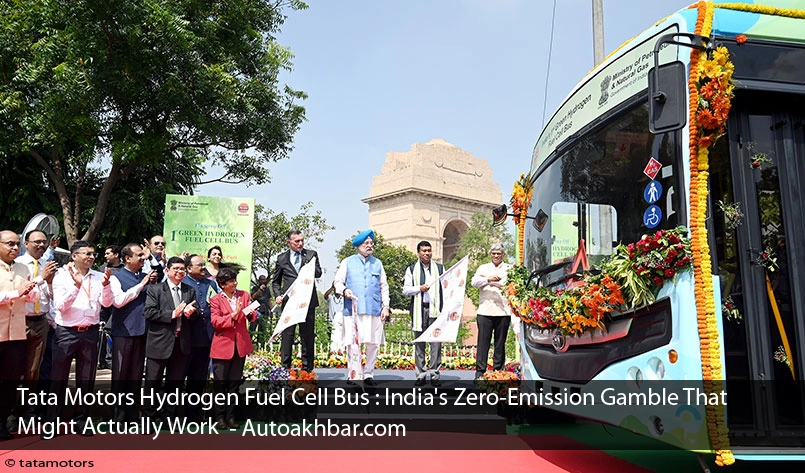
On September 25, 2023, two unremarkable-looking white buses were handed over at a ceremony in Delhi. The handshakes were formal, the ministers were smiling, and the press release used words like "landmark" and "historic." But here's the thing — this time, it actually was.
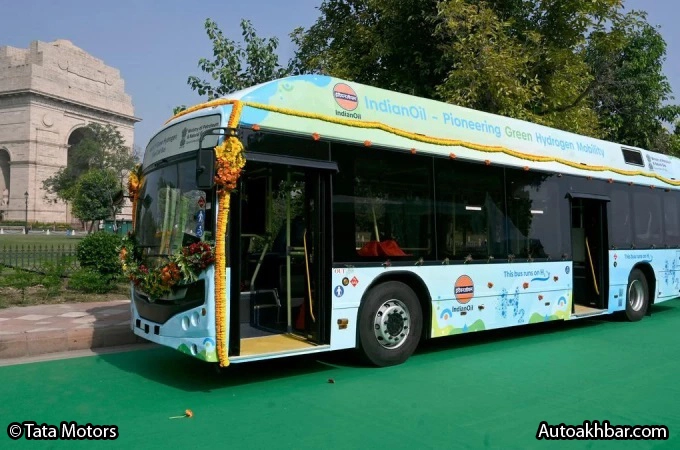
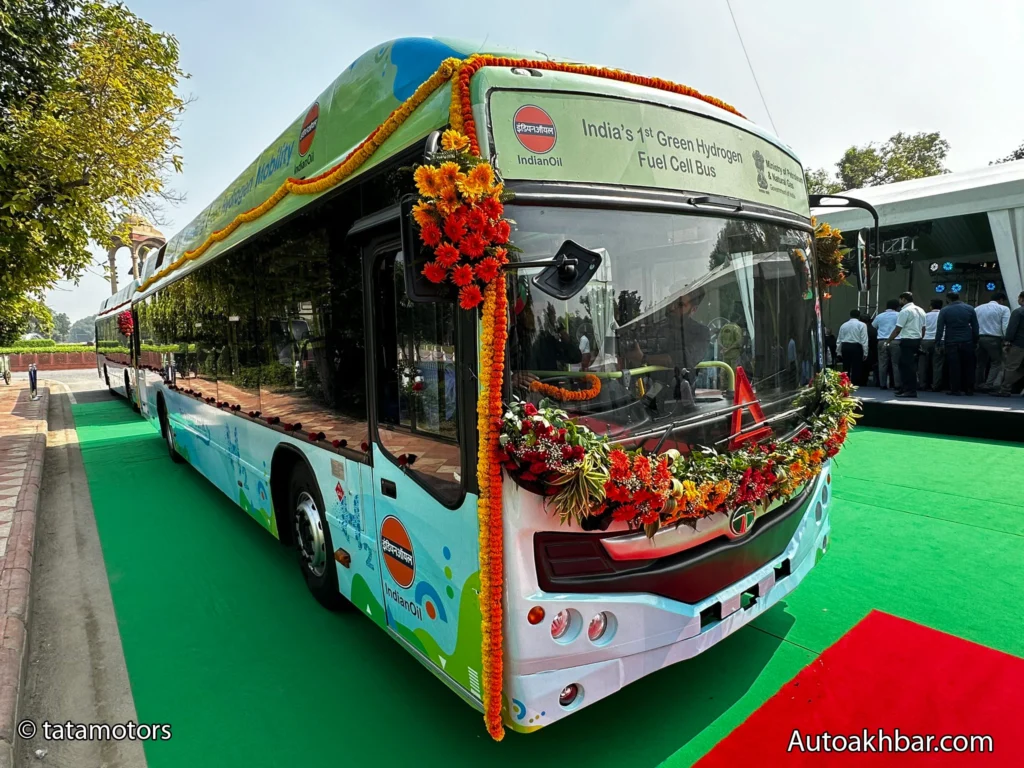
Those two buses were India's first hydrogen fuel cell-powered passenger vehicles. Not a prototype sitting in a Pune lab. Not a motor show concept. Real buses, on real roads, handed over to Indian Oil Corporation Limited (IOCL) — India's largest petroleum company — under a government-backed evaluation program. And they were built, top to bottom, by Tata Motors.
I've been covering the Indian auto industry for years, and I'll be honest: most "green mobility" announcements from domestic manufacturers end up being either imports with new badges or technology that barely makes it past pilot stage. This one feels different. Here's why.
15
FCEV buses ordered by IOCL in 2021 tender
12m
Bus length — full intercity size
70 kW
PEM fuel cell stack output
350 bar
Hydrogen storage pressure
35
Seated passenger capacity
The Technology
How Does a Hydrogen Fuel Cell Bus Actually Work?
Before we get into Tata's specific bus, let's demystify the technology — because there's a lot of confusion between "hydrogen bus" and "hydrogen engine bus," and they are fundamentally different things.
Tata's bus uses what's called a Hydrogen Fuel Cell Electric Vehicle (FCEV) powertrain — not a hydrogen combustion engine. The distinction matters enormously. In a combustion engine, you burn hydrogen the same way you'd burn petrol or diesel. In an FCEV, hydrogen never burns at all. Instead, it goes through an electrochemical reaction in the fuel cell stack, combining with oxygen from the air to produce electricity. That electricity powers the electric motors. The only byproduct? Water vapour.
Proton Exchange Membrane (PEM) Fuel Cell
The heart of the system. Hydrogen molecules are split at the anode — electrons flow through an external circuit (creating electricity), protons pass through the membrane to combine with oxygen at the cathode, forming water.
Buffer Battery Pack
A supplementary battery stores regenerative braking energy and provides peak power during acceleration. The fuel cell handles steady-state load; the battery handles spikes.
350-Bar Compressed Storage
Hydrogen is stored onboard at extremely high pressure — 350 bar. This is the same pressure used in heavy-duty industrial applications, engineered to Indian road and climate conditions by Tata's Pune R&D centre.
Electronic Braking & Stability Control
The bus features full electronic braking system (EBS) and electronic stability control (ESC) — safety systems not commonly seen in Indian public buses at this price point.
"This bus features a 350-bar hydrogen storage system, 70 kW fuel cell stack, electronic braking system and stability control for higher safety, intelligent transport system, new-generation telematics for efficient, user-friendly vehicle maintenance and tracking along with roomy interiors."— Mr. Rajendra Petkar, President & Chief Technology Officer, Tata Motors
The Pune R&D centre where these buses were built is no ordinary garage. Tata Motors collaborated with "renowned industry partners and research institutions" to adapt PEM fuel cell technology — which was originally developed for colder, more temperate climates — to India's extreme heat, dust, and humidity conditions. That's an engineering challenge that often gets glossed over in press coverage, but it's genuinely significant.
Understanding why hydrogen wins for heavy transit requires understanding where battery technology currently stands — and where its limits are. Our Tesla battery deep-dive covers the Al-Ion and solid-state developments that could eventually change this calculus.
Hydrogen vs EV
Why Hydrogen Over Electric? The Real Reason India Is Betting on FCEV for Buses
This is the question I get most from readers whenever I write about hydrogen vehicles, and honestly, it's the right question to ask. India has been pushing electric vehicles aggressively under FAME-II and PM E-Bus Sewa. So why is IOCL — and by extension, the Ministry of Petroleum — investing in a completely different technology for public buses?
The short answer: for intercity and long-distance routes, battery electric simply doesn't scale well enough yet.
Hydrogen Fuel Cell
✔️ Refuelling in 5–10 minutes (like diesel)
✔️ Range of 400–600 km per fill
✔️ No charging infrastructure grid load
✔️ Consistent range in heat & cold
✔️ Only emission is water vapour
✔️ Lighter than equivalent battery pack
*Hydrogen FCEV Better for buses
BEV (Battery Electric)
❌ 2–4 hour fast charging minimum
❌ Typical range 200–300 km/charge
❌ Heavy grid demand at depots
❌ Range degrades in extreme heat (India)
❌ Zero tailpipe, but battery mining impact
❌ Heavy battery pack reduces payload
For an intra-city bus that returns to depot every night, an electric bus makes perfect sense — and Tata sells plenty of those. But for the 400-km Delhi–Jaipur corridor, or the Mumbai–Pune industrial freight route, a 3-hour charging stop mid-journey is operationally impossible. Hydrogen fills that gap.
The refuelling advantage is massive. A hydrogen bus can be refuelled in the same time as a diesel bus — roughly 8–12 minutes at a dedicated dispenser. For fleet operators running 18-hour schedules, this is the difference between viable and impractical. IOCL, which already operates hundreds of fuel retail outlets, is also well-positioned to eventually add hydrogen dispensers to its network.
There's also an energy density argument. Hydrogen stores more energy per kilogram than lithium-ion batteries — significantly more. This means the energy storage system on a hydrogen bus is lighter relative to the range it provides, which matters enormously for payload and ride quality on a full-sized intercity coach.
For the latest developments in India's commercial vehicle market — including government policy, fleet electrification, and alternative fuel deployments — follow our Auto Industry Reports section, updated regularly.
Specifications
Full Specifications & Design Breakdown: Tata FCEV Bus
Let me give you what most articles skip — the actual numbers, laid out clearly. These are sourced directly from Tata Motors' official press documentation.
Tata Motors FCEV Bus — Verified Technical Specifications
Body Length
12 metres (full low-floor intercity format)
Seating Capacity
35 passengers
Fuel Cell Type
Proton Exchange Membrane (PEM)
Fuel Cell Stack Power
70 kW
Hydrogen Storage Pressure
350 bar (compressed gas)
Powertrain Architecture
FCEV + buffer battery hybrid
Floor Design
Low-floor for easy ingress/egress
Braking System
Electronic Braking System (EBS)
Stability System
Electronic Stability Control (ESC)
Telematics
New-generation connected telematics + ITS
Emissions
Zero — water vapour only
Development Centre
Tata Motors R&D, Pune, India
First Delivery
September 25, 2023 (to IOCL)
Total Order
15 buses (IOCL tender, won June 2021)
The Design: What Does This Bus Actually Look Like Inside?
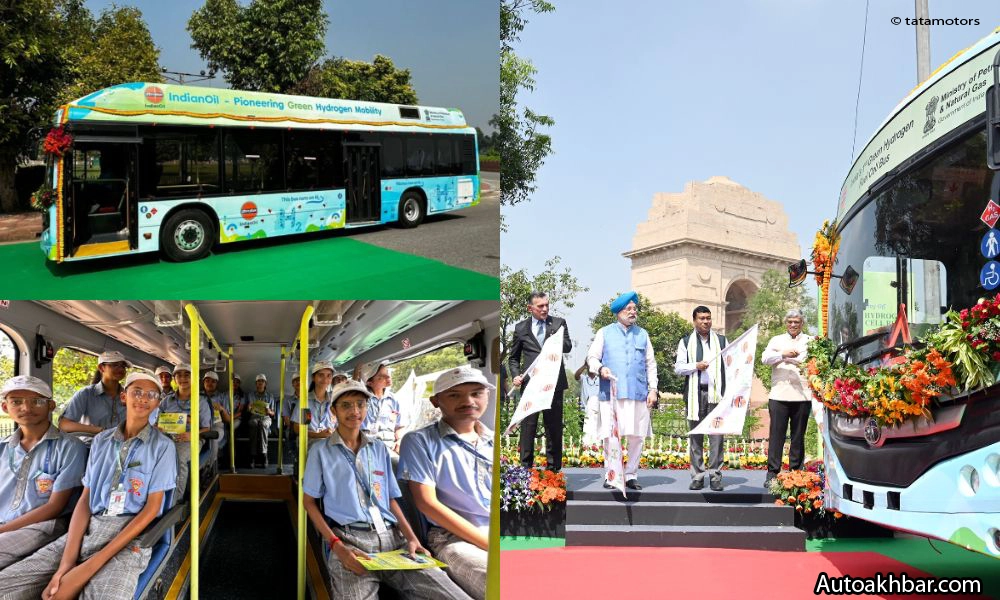
Tata's press materials describe "roomy interiors" — which, in my experience of reviewing commercial vehicles, is a phrase that can mean anything. But the 12-metre low-floor platform is significant. A low-floor design means the floor sits much closer to street level than a conventional step-entry bus, making boarding dramatically easier for elderly passengers, people with disabilities, and anyone carrying luggage.
The bus was designed with inter-city commute in mind — so the 35 seats (versus the 40–50 you'd find in a pure city bus) signal a more spacious, higher-comfort layout. The hydrogen storage tanks are roof-mounted, a common choice for FCEV buses globally because it keeps the high-pressure system away from passenger areas and frees up floor space.
The telematics system deserves a special mention. The "new-generation telematics" and Intelligent Transport System (ITS) integration mean fleet operators can track fuel cell health, hydrogen levels, temperature parameters, and route data in real time. For IOCL's evaluation program, this is critical — they're not just running buses, they're gathering data for a potential national rollout.
From Buses to Trucks: India's Hydrogen Mobility Ambition Is Much Larger
Here's something that most people covering the Tata hydrogen bus story miss entirely: the bus delivery to IOCL in 2023 was just the beginning of a much larger programme.
In March 2025, Tata Motors flagged off India's first-ever hydrogen truck trials — a programme funded by the Ministry of New and Renewable Energy under the National Green Hydrogen Mission. This is a 16-vehicle trial spanning up to 24 months, covering freight corridors around Mumbai, Pune, Delhi-NCR, Surat, Vadodara, Jamshedpur, and Kalinganagar.
"Hydrogen is the fuel of the future with immense potential to transform India's transportation sector by reducing emissions and enhancing energy self-reliance."— Shri Nitin Gadkari, Union Minister of Road Transport and Highways, at the hydrogen truck trial flag-off, March 2025
What makes the truck trial particularly interesting is that it tests both hydrogen technologies side by side: Hydrogen Internal Combustion Engine (H2-ICE) trucks and FCEV trucks. The Tata Prima H.55S is available in both variants; the Tata Prima H.28 uses H2-ICE. With an operational range of 300–500 km, these trucks are designed for the kind of long-haul freight that currently runs almost entirely on diesel in India.
Why this matters for the bus programme: Every kilometre logged by the hydrogen trucks is data that feeds back into Tata's fuel cell engineering. The same 70 kW PEM technology in the bus will need to scale up to heavier truck applications — and the real-world durability data from freight routes is invaluable for that process.
India's green mobility transition is happening on multiple fronts simultaneously. Our EV hub covers the full landscape — from city EVs to charging infrastructure — giving you the context to understand where hydrogen fits in the bigger picture.
Challenges & Outlook
The Honest Assessment: What Still Needs to Work for Hydrogen to Succeed
I'd be doing you a disservice if I wrapped this up as a pure success story. There are real challenges, and they deserve to be named.
The Infrastructure Problem
Hydrogen refuelling stations in India can be counted on one hand. For a technology that refuels like diesel but requires completely different equipment, building out even 50 stations is a multi-year, multi-crore infrastructure project. IOCL is the right partner for this — they already operate the largest fuel retail network in the country — but it won't happen overnight.
The Cost of Green Hydrogen
The environmental promise of hydrogen only fully holds when the hydrogen itself is "green" — produced using renewable energy via electrolysis. Currently, most hydrogen produced in India is "grey" hydrogen, made from natural gas with significant CO2 emissions. The National Green Hydrogen Mission has a target to produce 5 million metric tonnes of green hydrogen annually by 2030, but as of now, green hydrogen is 3–5x more expensive than grey. That's a cost burden that falls on fleet operators.
The Technology Validation Gap
The PEM fuel cell technology in Tata's bus has been proven globally — Toyota, Hyundai, and various European bus manufacturers have all deployed FCEV vehicles at scale. But Tata has specifically adapted this technology to Indian conditions: heat, dust, variable fuel quality, rough roads. The IOCL evaluation programme is precisely meant to validate this adaptation. Until those 15 buses have logged significant kilometres across Indian summers and monsoons, there's still a validation gap.
Scale and the Supply Chain
Fifteen buses is a proof of concept. Fifteen hundred buses is a revolution. The jump from one to the other requires a domestic supply chain for fuel cell stacks, membrane materials, and high-pressure storage components — most of which are currently imported. Tata's ongoing MoU with IOCL specifically includes work on advancing core PEM fuel cell technology domestically, which is the right direction. But it's a long road.
My Takeaway: This Is India's Most Credible Hydrogen Bet Yet
I've followed enough "future of mobility" announcements to be appropriately sceptical. But the Tata Motors hydrogen bus story has elements that most others don't: real deliveries to a credible institutional partner, a government-backed evaluation framework, and a clear technology roadmap that extends from buses to trucks to potentially passenger cars.
The technology itself — 70 kW PEM fuel cell, 350-bar storage, low-floor design, electronic safety systems — isn't science fiction. It's engineering that exists and works. The question has never been whether hydrogen buses can operate in India. The question is whether India can build the hydrogen ecosystem fast enough to make them commercially viable.
My honest view: the bus programme and the truck trials together represent the most serious industrial commitment to hydrogen mobility this country has seen. Whether it succeeds depends as much on IOCL's refuelling rollout and the cost trajectory of green hydrogen as it does on Tata's engineering. But for the first time, I think the pieces are genuinely there.
Hydrogen cars typically deliver 60–100 km per 1 kg of hydrogen, depending on the vehicle and driving conditions. For example, cars like the Toyota Mirai can achieve around 80–90 km/kg in real-world usage. 👉 In short: hydrogen efficiency is काफी strong hoti hai compared to petrol/diesel.
Is there a hydrogen bus in India?
Yes, India already has hydrogen buses. Tata Motors has developed and delivered hydrogen fuel cell buses to Indian Oil Corporation Limited for trials. 👉 These buses are currently running under pilot programs and testing phases, mainly for intercity routes.
What is the price of Tata hydrogen vehicle?
As of now, Tata Motors has not officially revealed the commercial price of its hydrogen vehicles. 👉 But estimates suggest: Hydrogen buses can cost ₹2–3 crore+ per unit This is higher than electric buses due to fuel cell tech Prices are expected to drop once production scales up.
Is hydrogen better than CNG?
It depends on use case 👇 Hydrogen (FCEV): > Zero emissions (only water vapor) > Higher efficiency > Future-ready tech CNG: > Cheaper fuel today > Widely available in India > Still emits CO₂ (not fully clean) 👉 Final verdict: > Short term → CNG practical hai > Long term → Hydrogen ज्यादा clean aur advanced solution hai
Shubham Sharma is the founder of AutoAkhbar, where he focuses on delivering accurate, data-driven automotive news, EV insights, and in-depth car analysis. With expertise in digital marketing and SEO, he specialises in building high-authority automotive content platforms.
He actively tracks global EV trends, emerging technologies, and market shifts to provide readers with reliable and up-to-date insights. His goal is to simplify complex automotive topics and help users make informed decisions.
📍 India | 🚗 EV Trends • Automotive News • SEO Strategy
{
"@context": "https://schema.org",
"@type": "FAQPage",
"mainEntity": [
{
"@type": "Question",
"name": "What is the mileage in a 1 kg hydrogen car?",
"acceptedAnswer": {
"@type": "Answer",
"text": "Hydrogen cars typically deliver around 60–100 km per 1 kg of hydrogen, depending on driving conditions and vehicle efficiency. On average, most hydrogen fuel cell cars offer about 80–90 km per kg."
}
},
{
"@type": "Question",
"name": "Is there a hydrogen bus in India?",
"acceptedAnswer": {
"@type": "Answer",
"text": "Yes, India has hydrogen fuel cell buses developed by Tata Motors in partnership with Indian Oil Corporation. These buses are currently being tested under pilot programs for public transport use."
}
},
{
"@type": "Question",
"name": "What is the price of Tata hydrogen vehicle?",
"acceptedAnswer": {
"@type": "Answer",
"text": "Tata Motors has not officially disclosed the price of its hydrogen vehicles yet. However, estimates suggest hydrogen buses can cost around ₹2–3 crore due to advanced fuel cell technology."
}
},
{
"@type": "Question",
"name": "Is hydrogen better than CNG?",
"acceptedAnswer": {
"@type": "Answer",
"text": "Hydrogen is a cleaner fuel compared to CNG as it produces only water vapor as emission. However, CNG is currently more affordable and widely available in India. Hydrogen is considered a future-ready, zero-emission alternative."
}
}
]
}
{
"@context": "https://schema.org",
"@type": "NewsArticle",
"headline": "Tata Motors Hydrogen Fuel Cell Bus: India's Zero-Emission Gamble That Might Actually Work",
"description": "A deep dive into Tata Motors hydrogen fuel cell bus in India, including specs, 70kW fuel cell, 350-bar storage, and why hydrogen may outperform electric buses for long-distance transport.",
"image": [
"https://autoakhbar.com/wp-content/uploads/2026/04/press-25sep23-01-copy-768x451.webp",
"https://autoakhbar.com/wp-content/uploads/2026/04/Hydrogen_fuel_cell_Bus_4_39bb771e66.webp",
"https://autoakhbar.com/wp-content/uploads/2026/04/47.23.webp",
"https://autoakhbar.com/wp-content/uploads/2026/04/F63_C_Zb_Maw_A_Ah_Lv_F_6a1017cd9f-1024x768.webp"
],
"author": {
"@type": "Person",
"name": "Shubham Sharma",
"url": "https://autoakhbar.com/author/shubhams/"
},
"publisher": {
"@type": "Organization",
"name": "AutoAkhbar",
"logo": {
"@type": "ImageObject",
"url": "https://autoakhbar.com/wp-content/uploads/2025/05/cropped-ChatGPT-Image-May-25-2025-05_56_44-PM-249x52.webp"
}
},
"datePublished": "2026-04-14T08:00:00+05:30",
"dateModified": "2026-04-16T10:00:00+05:30",
"mainEntityOfPage": {
"@type": "WebPage",
"@id": "https://autoakhbar.com/tata-motors-hydrogen-fuel-cell-bus-india-fcev/"
},
"articleSection": "Commercial Vehicles",
"keywords": [
"Tata hydrogen bus India",
"hydrogen fuel cell bus",
"Tata Motors FCEV bus",
"hydrogen vs electric bus India",
"green hydrogen mobility India"
],
"wordCount": "1800"
}
Shubham Sharma — Founder, AutoAkhbar.com Karnal, Haryana · Digital Marketing Expert · Auto BloggerI've been covering Indian auto news since AutoAkhbar launched, and I'll be honest — most "green mobility" announcements end up being press releases that gather dust. But when I dug into the Tata hydrogen bus story properly, I realised this one is genuinely different. Let me take you through everything I found out, directly from Tata Motors' official sources.
Table of Contents
On September 25, 2023, two unremarkable-looking white buses were handed over at a ceremony in Delhi. The handshakes were formal, the ministers were smiling, and the press release used words like "landmark" and "historic." But here's the thing — this time, it actually was.
Those two buses were India's first hydrogen fuel cell-powered passenger vehicles. Not a prototype sitting in a Pune lab. Not a motor show concept. Real buses, on real roads, handed over to Indian Oil Corporation Limited (IOCL) — India's largest petroleum company — under a government-backed evaluation program. And they were built, top to bottom, by Tata Motors.
I've been covering the Indian auto industry for years, and I'll be honest: most "green mobility" announcements from domestic manufacturers end up being either imports with new badges or technology that barely makes it past pilot stage. This one feels different. Here's why.
15
FCEV buses ordered by IOCL in 2021 tender
12m
Bus length — full intercity size
70 kW
PEM fuel cell stack output
350 bar
Hydrogen storage pressure
35
Seated passenger capacity
The Technology
How Does a Hydrogen Fuel Cell Bus Actually Work?
Before we get into Tata's specific bus, let's demystify the technology — because there's a lot of confusion between "hydrogen bus" and "hydrogen engine bus," and they are fundamentally different things.
Tata's bus uses what's called a Hydrogen Fuel Cell Electric Vehicle (FCEV) powertrain — not a hydrogen combustion engine. The distinction matters enormously. In a combustion engine, you burn hydrogen the same way you'd burn petrol or diesel. In an FCEV, hydrogen never burns at all. Instead, it goes through an electrochemical reaction in the fuel cell stack, combining with oxygen from the air to produce electricity. That electricity powers the electric motors. The only byproduct? Water vapour.
Proton Exchange Membrane (PEM) Fuel Cell
The heart of the system. Hydrogen molecules are split at the anode — electrons flow through an external circuit (creating electricity), protons pass through the membrane to combine with oxygen at the cathode, forming water.
Buffer Battery Pack
A supplementary battery stores regenerative braking energy and provides peak power during acceleration. The fuel cell handles steady-state load; the battery handles spikes.
350-Bar Compressed Storage
Hydrogen is stored onboard at extremely high pressure — 350 bar. This is the same pressure used in heavy-duty industrial applications, engineered to Indian road and climate conditions by Tata's Pune R&D centre.
Electronic Braking & Stability Control
The bus features full electronic braking system (EBS) and electronic stability control (ESC) — safety systems not commonly seen in Indian public buses at this price point.
"This bus features a 350-bar hydrogen storage system, 70 kW fuel cell stack, electronic braking system and stability control for higher safety, intelligent transport system, new-generation telematics for efficient, user-friendly vehicle maintenance and tracking along with roomy interiors."— Mr. Rajendra Petkar, President & Chief Technology Officer, Tata Motors
The Pune R&D centre where these buses were built is no ordinary garage. Tata Motors collaborated with "renowned industry partners and research institutions" to adapt PEM fuel cell technology — which was originally developed for colder, more temperate climates — to India's extreme heat, dust, and humidity conditions. That's an engineering challenge that often gets glossed over in press coverage, but it's genuinely significant.
Understanding why hydrogen wins for heavy transit requires understanding where battery technology currently stands — and where its limits are. Our Tesla battery deep-dive covers the Al-Ion and solid-state developments that could eventually change this calculus.
Hydrogen vs EV
Why Hydrogen Over Electric? The Real Reason India Is Betting on FCEV for Buses
This is the question I get most from readers whenever I write about hydrogen vehicles, and honestly, it's the right question to ask. India has been pushing electric vehicles aggressively under FAME-II and PM E-Bus Sewa. So why is IOCL — and by extension, the Ministry of Petroleum — investing in a completely different technology for public buses?
The short answer: for intercity and long-distance routes, battery electric simply doesn't scale well enough yet.
Hydrogen Fuel Cell
✔️ Refuelling in 5–10 minutes (like diesel)
✔️ Range of 400–600 km per fill
✔️ No charging infrastructure grid load
✔️ Consistent range in heat & cold
✔️ Only emission is water vapour
✔️ Lighter than equivalent battery pack
*Hydrogen FCEV Better for buses
BEV (Battery Electric)
❌ 2–4 hour fast charging minimum
❌ Typical range 200–300 km/charge
❌ Heavy grid demand at depots
❌ Range degrades in extreme heat (India)
❌ Zero tailpipe, but battery mining impact
❌ Heavy battery pack reduces payload
For an intra-city bus that returns to depot every night, an electric bus makes perfect sense — and Tata sells plenty of those. But for the 400-km Delhi–Jaipur corridor, or the Mumbai–Pune industrial freight route, a 3-hour charging stop mid-journey is operationally impossible. Hydrogen fills that gap.
The refuelling advantage is massive. A hydrogen bus can be refuelled in the same time as a diesel bus — roughly 8–12 minutes at a dedicated dispenser. For fleet operators running 18-hour schedules, this is the difference between viable and impractical. IOCL, which already operates hundreds of fuel retail outlets, is also well-positioned to eventually add hydrogen dispensers to its network.
There's also an energy density argument. Hydrogen stores more energy per kilogram than lithium-ion batteries — significantly more. This means the energy storage system on a hydrogen bus is lighter relative to the range it provides, which matters enormously for payload and ride quality on a full-sized intercity coach.
For the latest developments in India's commercial vehicle market — including government policy, fleet electrification, and alternative fuel deployments — follow our Auto Industry Reports section, updated regularly.
Specifications
Full Specifications & Design Breakdown: Tata FCEV Bus
Let me give you what most articles skip — the actual numbers, laid out clearly. These are sourced directly from Tata Motors' official press documentation.
Tata Motors FCEV Bus — Verified Technical Specifications
Body Length
12 metres (full low-floor intercity format)
Seating Capacity
35 passengers
Fuel Cell Type
Proton Exchange Membrane (PEM)
Fuel Cell Stack Power
70 kW
Hydrogen Storage Pressure
350 bar (compressed gas)
Powertrain Architecture
FCEV + buffer battery hybrid
Floor Design
Low-floor for easy ingress/egress
Braking System
Electronic Braking System (EBS)
Stability System
Electronic Stability Control (ESC)
Telematics
New-generation connected telematics + ITS
Emissions
Zero — water vapour only
Development Centre
Tata Motors R&D, Pune, India
First Delivery
September 25, 2023 (to IOCL)
Total Order
15 buses (IOCL tender, won June 2021)
The Design: What Does This Bus Actually Look Like Inside?
Tata's press materials describe "roomy interiors" — which, in my experience of reviewing commercial vehicles, is a phrase that can mean anything. But the 12-metre low-floor platform is significant. A low-floor design means the floor sits much closer to street level than a conventional step-entry bus, making boarding dramatically easier for elderly passengers, people with disabilities, and anyone carrying luggage.
The bus was designed with inter-city commute in mind — so the 35 seats (versus the 40–50 you'd find in a pure city bus) signal a more spacious, higher-comfort layout. The hydrogen storage tanks are roof-mounted, a common choice for FCEV buses globally because it keeps the high-pressure system away from passenger areas and frees up floor space.
The telematics system deserves a special mention. The "new-generation telematics" and Intelligent Transport System (ITS) integration mean fleet operators can track fuel cell health, hydrogen levels, temperature parameters, and route data in real time. For IOCL's evaluation program, this is critical — they're not just running buses, they're gathering data for a potential national rollout.
From Buses to Trucks: India's Hydrogen Mobility Ambition Is Much Larger
Here's something that most people covering the Tata hydrogen bus story miss entirely: the bus delivery to IOCL in 2023 was just the beginning of a much larger programme.
In March 2025, Tata Motors flagged off India's first-ever hydrogen truck trials — a programme funded by the Ministry of New and Renewable Energy under the National Green Hydrogen Mission. This is a 16-vehicle trial spanning up to 24 months, covering freight corridors around Mumbai, Pune, Delhi-NCR, Surat, Vadodara, Jamshedpur, and Kalinganagar.
"Hydrogen is the fuel of the future with immense potential to transform India's transportation sector by reducing emissions and enhancing energy self-reliance."— Shri Nitin Gadkari, Union Minister of Road Transport and Highways, at the hydrogen truck trial flag-off, March 2025
What makes the truck trial particularly interesting is that it tests both hydrogen technologies side by side: Hydrogen Internal Combustion Engine (H2-ICE) trucks and FCEV trucks. The Tata Prima H.55S is available in both variants; the Tata Prima H.28 uses H2-ICE. With an operational range of 300–500 km, these trucks are designed for the kind of long-haul freight that currently runs almost entirely on diesel in India.
Why this matters for the bus programme: Every kilometre logged by the hydrogen trucks is data that feeds back into Tata's fuel cell engineering. The same 70 kW PEM technology in the bus will need to scale up to heavier truck applications — and the real-world durability data from freight routes is invaluable for that process.
India's green mobility transition is happening on multiple fronts simultaneously. Our EV hub covers the full landscape — from city EVs to charging infrastructure — giving you the context to understand where hydrogen fits in the bigger picture.
Challenges & Outlook
The Honest Assessment: What Still Needs to Work for Hydrogen to Succeed
I'd be doing you a disservice if I wrapped this up as a pure success story. There are real challenges, and they deserve to be named.
The Infrastructure Problem
Hydrogen refuelling stations in India can be counted on one hand. For a technology that refuels like diesel but requires completely different equipment, building out even 50 stations is a multi-year, multi-crore infrastructure project. IOCL is the right partner for this — they already operate the largest fuel retail network in the country — but it won't happen overnight.
The Cost of Green Hydrogen
The environmental promise of hydrogen only fully holds when the hydrogen itself is "green" — produced using renewable energy via electrolysis. Currently, most hydrogen produced in India is "grey" hydrogen, made from natural gas with significant CO2 emissions. The National Green Hydrogen Mission has a target to produce 5 million metric tonnes of green hydrogen annually by 2030, but as of now, green hydrogen is 3–5x more expensive than grey. That's a cost burden that falls on fleet operators.
The Technology Validation Gap
The PEM fuel cell technology in Tata's bus has been proven globally — Toyota, Hyundai, and various European bus manufacturers have all deployed FCEV vehicles at scale. But Tata has specifically adapted this technology to Indian conditions: heat, dust, variable fuel quality, rough roads. The IOCL evaluation programme is precisely meant to validate this adaptation. Until those 15 buses have logged significant kilometres across Indian summers and monsoons, there's still a validation gap.
Scale and the Supply Chain
Fifteen buses is a proof of concept. Fifteen hundred buses is a revolution. The jump from one to the other requires a domestic supply chain for fuel cell stacks, membrane materials, and high-pressure storage components — most of which are currently imported. Tata's ongoing MoU with IOCL specifically includes work on advancing core PEM fuel cell technology domestically, which is the right direction. But it's a long road.
My Takeaway: This Is India's Most Credible Hydrogen Bet Yet
I've followed enough "future of mobility" announcements to be appropriately sceptical. But the Tata Motors hydrogen bus story has elements that most others don't: real deliveries to a credible institutional partner, a government-backed evaluation framework, and a clear technology roadmap that extends from buses to trucks to potentially passenger cars.
The technology itself — 70 kW PEM fuel cell, 350-bar storage, low-floor design, electronic safety systems — isn't science fiction. It's engineering that exists and works. The question has never been whether hydrogen buses can operate in India. The question is whether India can build the hydrogen ecosystem fast enough to make them commercially viable.
My honest view: the bus programme and the truck trials together represent the most serious industrial commitment to hydrogen mobility this country has seen. Whether it succeeds depends as much on IOCL's refuelling rollout and the cost trajectory of green hydrogen as it does on Tata's engineering. But for the first time, I think the pieces are genuinely there.
Hydrogen cars typically deliver 60–100 km per 1 kg of hydrogen, depending on the vehicle and driving conditions. For example, cars like the Toyota Mirai can achieve around 80–90 km/kg in real-world usage. 👉 In short: hydrogen efficiency is काफी strong hoti hai compared to petrol/diesel.
Is there a hydrogen bus in India?
Yes, India already has hydrogen buses. Tata Motors has developed and delivered hydrogen fuel cell buses to Indian Oil Corporation Limited for trials. 👉 These buses are currently running under pilot programs and testing phases, mainly for intercity routes.
What is the price of Tata hydrogen vehicle?
As of now, Tata Motors has not officially revealed the commercial price of its hydrogen vehicles. 👉 But estimates suggest: Hydrogen buses can cost ₹2–3 crore+ per unit This is higher than electric buses due to fuel cell tech Prices are expected to drop once production scales up.
Is hydrogen better than CNG?
It depends on use case 👇 Hydrogen (FCEV): > Zero emissions (only water vapor) > Higher efficiency > Future-ready tech CNG: > Cheaper fuel today > Widely available in India > Still emits CO₂ (not fully clean) 👉 Final verdict: > Short term → CNG practical hai > Long term → Hydrogen ज्यादा clean aur advanced solution hai
Shubham Sharma is the founder of AutoAkhbar, where he focuses on delivering accurate, data-driven automotive news, EV insights, and in-depth car analysis. With expertise in digital marketing and SEO, he specialises in building high-authority automotive content platforms.
He actively tracks global EV trends, emerging technologies, and market shifts to provide readers with reliable and up-to-date insights. His goal is to simplify complex automotive topics and help users make informed decisions.
📍 India | 🚗 EV Trends • Automotive News • SEO Strategy
{
"@context": "https://schema.org",
"@type": "FAQPage",
"mainEntity": [
{
"@type": "Question",
"name": "What is the mileage in a 1 kg hydrogen car?",
"acceptedAnswer": {
"@type": "Answer",
"text": "Hydrogen cars typically deliver around 60–100 km per 1 kg of hydrogen, depending on driving conditions and vehicle efficiency. On average, most hydrogen fuel cell cars offer about 80–90 km per kg."
}
},
{
"@type": "Question",
"name": "Is there a hydrogen bus in India?",
"acceptedAnswer": {
"@type": "Answer",
"text": "Yes, India has hydrogen fuel cell buses developed by Tata Motors in partnership with Indian Oil Corporation. These buses are currently being tested under pilot programs for public transport use."
}
},
{
"@type": "Question",
"name": "What is the price of Tata hydrogen vehicle?",
"acceptedAnswer": {
"@type": "Answer",
"text": "Tata Motors has not officially disclosed the price of its hydrogen vehicles yet. However, estimates suggest hydrogen buses can cost around ₹2–3 crore due to advanced fuel cell technology."
}
},
{
"@type": "Question",
"name": "Is hydrogen better than CNG?",
"acceptedAnswer": {
"@type": "Answer",
"text": "Hydrogen is a cleaner fuel compared to CNG as it produces only water vapor as emission. However, CNG is currently more affordable and widely available in India. Hydrogen is considered a future-ready, zero-emission alternative."
}
}
]
}
{
"@context": "https://schema.org",
"@type": "NewsArticle",
"headline": "Tata Motors Hydrogen Fuel Cell Bus: India's Zero-Emission Gamble That Might Actually Work",
"description": "A deep dive into Tata Motors hydrogen fuel cell bus in India, including specs, 70kW fuel cell, 350-bar storage, and why hydrogen may outperform electric buses for long-distance transport.",
"image": [
"https://autoakhbar.com/wp-content/uploads/2026/04/press-25sep23-01-copy-768x451.webp",
"https://autoakhbar.com/wp-content/uploads/2026/04/Hydrogen_fuel_cell_Bus_4_39bb771e66.webp",
"https://autoakhbar.com/wp-content/uploads/2026/04/47.23.webp",
"https://autoakhbar.com/wp-content/uploads/2026/04/F63_C_Zb_Maw_A_Ah_Lv_F_6a1017cd9f-1024x768.webp"
],
"author": {
"@type": "Person",
"name": "Shubham Sharma",
"url": "https://autoakhbar.com/author/shubhams/"
},
"publisher": {
"@type": "Organization",
"name": "AutoAkhbar",
"logo": {
"@type": "ImageObject",
"url": "https://autoakhbar.com/wp-content/uploads/2025/05/cropped-ChatGPT-Image-May-25-2025-05_56_44-PM-249x52.webp"
}
},
"datePublished": "2026-04-14T08:00:00+05:30",
"dateModified": "2026-04-16T10:00:00+05:30",
"mainEntityOfPage": {
"@type": "WebPage",
"@id": "https://autoakhbar.com/tata-motors-hydrogen-fuel-cell-bus-india-fcev/"
},
"articleSection": "Commercial Vehicles",
"keywords": [
"Tata hydrogen bus India",
"hydrogen fuel cell bus",
"Tata Motors FCEV bus",
"hydrogen vs electric bus India",
"green hydrogen mobility India"
],
"wordCount": "1800"
}