

India just achieved E20 — and the country is still arguing about it. Now the government wants to jump straight to E85. Here’s everything Indian car owners need to know, explained honestly.
Let me be honest with you — when I first heard that the government was drafting rules for E85 petrol, my first reaction wasn’t excitement. It was a quiet, tired sigh. Because I remembered what happened just last year when E20 was rolled out across India, and how millions of car owners — many of them people just like you and me — suddenly found themselves googling “why is my mileage dropping” and “is E20 destroying my engine.”
And yet, here we are. Today, April 29, 2026, India’s Ministry of Road Transport and Highways has formally issued a draft notification proposing amendments to the Central Motor Vehicles Rules to officially bring E85 and E100 fuels into the regulatory framework. The draft is open for public comments. The clock is ticking.
This is not a small tweak. This is a structural shift in how India fuels its vehicles. And whether you drive a Maruti Alto or a Hyundai Creta, this affects you.
So let’s pull this apart — properly, without the government spin or the doomsday panic. Let’s understand what E85 actually is, why the world uses it, what happened with E20, and most importantly: is India actually ready for this?
85%
Ethanol in E85
85%
India’s crude import dependency
₹22L CR
India’s annual fuel import bill
0
Flex-fuel cars sold in India (2026)
Table of Contents
First, What Even Is E85 Petrol?
The name gives it away if you know the pattern. E20 means 20% ethanol + 80% petrol. E85 means 85% ethanol + 15% petrol. Yes, you read that right — it’s almost entirely ethanol, with just a sliver of conventional petrol.
Ethanol, for those who don’t follow fuel policy, is an alcohol-based biofuel produced from crops — primarily sugarcane and maize in India’s case. It burns cleaner than fossil fuel, produces fewer tailpipe emissions, and most importantly for policymakers: it can be made domestically, reducing dependence on oil imports from politically volatile regions.
📌 Quick Reference: India’s Ethanol Blending Journey
1.5% blending in 2014 → 10% in 2022 (ahead of schedule) → 20% in 2025 (5 years ahead of the 2030 target) → E85 draft rules notified in April 2026. India has been on a fast-forward, and that speed is at the heart of every controversy.
But here’s the catch that the government doesn’t always lead with: E85 is not a drop-in substitute for regular petrol. You cannot simply pour it into your existing car. It requires a specially engineered engine and fuel system — what the industry calls a Flex-Fuel Vehicle (FFV). More on that in a bit.
The E20 Controversy: India’s “Greenlash” Was Very Real
Before we talk about where we’re going, we need to talk about where we just came from. Because the E20 rollout was messy, and pretending otherwise would be doing you a disservice.
In July 2025, India announced it had achieved 20% ethanol blending — five years ahead of the original 2030 target. Normally that’d be cause for national celebration. Instead, it triggered what many observers called a “greenlash” — a consumer backlash against a climate policy that felt rushed and opaque.
Social media filled up with complaints. A popular YouTube channel, Ask CarGuru, published a video highlighting consumer concerns which drew thousands of comments from owners reporting significant mileage drops after switching to E20. RTI requests were filed seeking clarity on actual blend ratios at pumps. A public interest litigation challenging the rollout was even filed in the Supreme Court — though it was ultimately dismissed in 2025.
Nearly 66% of 36,000 vehicle owners surveyed across India in early August 2025 opposed the national rollout of E20 petrol — with 44% demanding withdrawal and 22% calling for more choices at the pump.— Local Circles Survey, August 2025, via Context / Thomson Reuters Foundation
The government’s response was to defend the policy vigorously. The Ministry of Petroleum said critics “lacked technical foundation.” Road Transport Minister Nitin Gadkari challenged critics to prove widespread damage, even suggesting a “petrol lobby” was stoking fears. The ministry’s internal studies found no major engine damage.
But here’s the nuance that got lost in the political back-and-forth. The government itself acknowledged that mileage could drop by 1-2% in newer cars and up to 6% in older ones. Two major motorcycle manufacturers and Shell India had warned that vehicles built before 2023 might need fuel system changes to run on E20 without issues. And for the hundreds of millions of Indians driving older vehicles — that wasn’t a small footnote, that was their reality at every pump visit.
⚠️ What The E20 Controversy Actually Revealed
India’s rapid ethanol blending — from 1.5% to 20% in just 11 years, faster than any other ethanol-adopting nation — exposed a critical gap: the policy moved faster than consumer awareness, infrastructure transparency, and independent testing. People weren’t angry about clean fuel. They were angry about feeling blindsided.
The lesson here matters hugely for E85. Because if E20 at 20% ethanol created this level of friction with existing vehicles, what happens when we’re talking about 85%?
🚨 The government is reportedly set to issue draft rules for E85, a blend containing up to 85% ethanol and 15% petrol. pic.twitter.com/vLGXfVBlUM
— Indian Tech & Infra (@IndianTechGuide) April 22, 2026
Where Is E85 Already Working? The Global Picture
India isn’t inventing this wheel. E85 and flex-fuel vehicles have been working — sometimes brilliantly — in other parts of the world for decades. The evidence is genuinely encouraging. But the way those countries got there matters a lot.
Brazil: The Gold Standard (And the Blueprint India Wants to Follow)
Brazil’s story is the one Indian policymakers keep citing, and for good reason. In 2003, Volkswagen launched the Gol 1.6 Total Flex — the first commercial flex-fuel car capable of running on any blend of gasoline and ethanol. Within two years, flex cars were 73% of new car sales. By 2009, they were 94%. Today, flex-fuel vehicles make up 74.4% of all new light vehicle registrations in Brazil.
Brazil runs E27 (27% ethanol) as its standard pump fuel, while pure ethanol (E100) is available at virtually every station. The ecosystem works because Brazil built it over three decades — starting in the 1970s after the oil crisis, offering tax breaks, ensuring competitive ethanol pricing, and letting car technology evolve in parallel with fuel availability.
India’s ethanol industry body ISMA has explicitly pointed to Brazil’s model as the blueprint. ISMA Director General Deepak Ballani has identified two non-negotiables for success: competitive E100 pricing and eliminating the cost premium on flex-fuel vehicles over regular cars. Without both, the transition stalls.
The United States: 27 Million Flex Vehicles and Counting
The US had 27 million flex-fuel vehicles on the road by end of 2021. American FFVs are optimised to run on any mixture up to E85. You can tell them by the yellow fuel cap. In the Midwest especially, E85 is a genuine consumer choice — often cheaper per gallon than regular petrol, making it cost-competitive despite the lower energy density.
Europe: Sweden Led, Others Followed
E85 is widely used in Sweden, with multiple manufacturers offering FFV models across Audi, Citroën, Ford, Peugeot, Renault, and Volvo. In France, about 30% of petrol stations supply E85. Finland has E85 available from over 120 stations across two major chains. The Nordic countries built this infrastructure gradually and with sustained policy support.
| Country | Current Ethanol Blend Standard | FFV Adoption | Key Success Factor |
|---|---|---|---|
| Brazil | E27 standard / E100 available | 74.4% of new cars (2025) | 50-year ecosystem build |
| USA | E10 standard / E85 at select pumps | 27 million vehicles | Federal subsidies + Midwest ethanol |
| Sweden | E5-E10 standard / E85 widely available | 243,100+ FFVs (2018) | Strong policy + tax incentives |
| India (2026) | E20 mandatory from Apr 2026 | 0 commercial FFVs | Draft rules just issued |
Why India Is Pushing This — And Why Now
Let me give you the real reasons, not just the press release version.
Reason 1: The crude oil import problem is enormous. India currently imports about 85% of its crude oil requirements. The country’s crude import bill hit approximately ₹14 trillion (around $167 billion) in fiscal year 2024-25. West Asia tensions — ongoing since the conflict began — are creating supply disruptions and price volatility that are hitting Indian households directly at the pump. Every percentage point of ethanol blending reduces that dependency.
Reason 2: India has surplus ethanol production capacity. By June 2025, India’s annual ethanol production capacity had reached approximately 18.22 billion litres. The NITI Aayog had earlier projected a need for 15 billion litres to sustain E20. India is producing more than required — and idle capacity is an economic argument for pushing blending higher.
Reason 3: Farmers benefit directly. Higher ethanol offtake means more demand for sugarcane and maize — India’s two primary ethanol feedstocks. This is a significant rural income story, particularly for sugarcane farmers in UP and Maharashtra. Ethanol arrears from sugar mills — a chronic problem — have been cleared under the blending programme.
Reason 4: Climate commitments. India’s National Determined Contributions and net-zero-by-2070 commitment require meaningful fuel transition. The blending programme, according to the government, saved over ₹1.44 lakh crore in foreign exchange and avoided 73.60 million metric tonnes of CO2 between 2014 and mid-2025.
The push to E85 follows directly from geopolitical necessity — driven by a need to cut petroleum import costs compounded by supply disruptions from the ongoing West Asia conflict. This isn’t just green policy. It’s strategic self-reliance.— DriveSpark News, April 2026
The Real Problems India Will Face With E85
Okay, I’ve given you the optimistic case. Now let me be very straight with you about the challenges — because there are serious ones, and anyone telling you otherwise isn’t being honest.
Problem 1: There Are Zero Commercial Flex-Fuel Cars in India Right Now
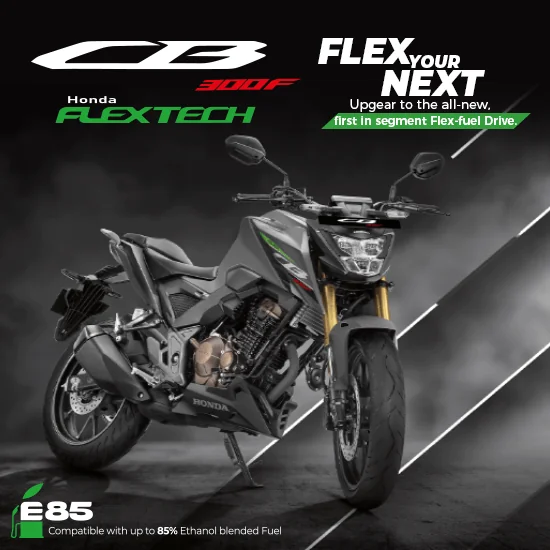
This is the elephant in the room. As of today, not a single automaker sells a commercially available flex-fuel vehicle in India. Maruti Suzuki — India’s largest carmaker with over 40% market share — has announced plans. Hyundai showcased a Creta Flex Fuel prototype. Tata Motors displayed the Punch Flex Fuel at the Bharat Mobility Global Expo 2025. TVS Motor Company is reportedly expected to roll out a flex-fuel motorcycle later in 2026.
But announcements aren’t cars on the road. And E85 only works in flex-fuel vehicles. You cannot put E85 in your existing Maruti Swift, Honda City, or Royal Enfield. Period. The fuel system isn’t compatible, and attempting it would cause serious engine damage.
🚫 DO NOT Try E85 in a Regular Car
E85 requires specially engineered engines with different fuel injectors, materials, compression ratios, and ECU calibration. Putting it in a standard petrol car will not make you eco-friendly — it will make you very expensive repairs. E85 in India will only be for dedicated flex-fuel vehicles, which do not yet exist commercially here.
Problem 2: Infrastructure Doesn’t Exist at Scale
E85 requires separate storage tanks and dedicated dispensing nozzles at every petrol station. This isn’t a minor upgrade — it’s a significant capital expenditure. India’s three major oil marketing companies — Indian Oil, Bharat Petroleum, and Hindustan Petroleum — flagged concerns in a February 2026 meeting about minuscule demand seen in earlier pilot projects, where E93 fuel was supplied at only around 500 outlets in 2024.
If demand for E85 is near-zero (because there are no compatible vehicles) and infrastructure investment is high, you have a chicken-and-egg problem that’s very difficult to solve without either massive subsidies or a mandated vehicle launch timeline.
Problem 3: Mileage Loss is Real and Significant
This is not FUD (Fear, Uncertainty, Doubt). It’s physics. Ethanol has a lower energy density than petrol — about 33% lower heating value compared to gasoline. A litre of E85 contains less energy than a litre of E10. This means your engine needs to burn more fuel to travel the same distance. In vehicles not optimised specifically for ethanol (with higher compression ratios that take advantage of ethanol’s high octane rating of ~100-105), the net result is lower mileage.
We already saw this with E20, where even the government conceded a 1-6% mileage drop. With E85, a non-optimised engine would face even steeper losses. Proper FFV engines are designed to compensate — but only if the entire system is engineered for it from the ground up.
Problem 4: The Price Equation Hasn’t Been Solved
In Brazil, ethanol is genuinely cheaper than petrol at the pump, which is why consumers willingly switched. In India, there is currently no price differentiation between E20 and regular petrol at the pump — one of the major criticisms during the E20 rollout. Oil marketing companies have raised this as a key concern for E85 as well. For consumers to willingly adopt flex-fuel vehicles and pay a potential 5-7% premium on vehicle cost (as estimated by Mahindra), the fuel itself must offer a visible price benefit.
Problem 5: The Timeline Is Ambitious to the Point of Concern
Industry experts are warning that a smooth transition to E85 as a mass-market reality will realistically take until around 2035. The draft rules currently propose initial testing could begin as early as December 2026. That’s testing — not rollout. The gap between “testing begins” and “this works for 300 million vehicle owners” is enormous.
✅ What’s Actually Positive Here
The draft is open for public comments — meaning this isn’t a fait accompli. The regulatory framework is being built correctly, with separate fuel classifications and infrastructure requirements spelled out. And the government has confirmed E20 and E10 will remain available for existing vehicles. This is being positioned as an addition, not a replacement — which is the right approach.
What This Actually Means For You As an Indian Car Buyer
Here’s my honest take, based on everything I’ve read and researched for this piece.
If you are buying a car right now in 2026: E85 is not your problem yet. Your car will run on E20 (the current standard), and it will continue to do so. The E85 rollout is in draft stage and won’t affect your vehicle choice in the near term. That said, if you’re planning a purchase in 2027-2028, keep an eye on flex-fuel variants as they start entering the market — Maruti Suzuki is the most likely to launch first.
If you have an older car (pre-2023): Continue using E20 as you have been. Be vigilant about your mileage and service your fuel system during regular maintenance. E85 will not be available or mandatory for your vehicle.
If you are a motorcycle owner: TVS Motor is reportedly preparing a flex-fuel bike for late 2026. This is actually a significant development because two-wheelers are the backbone of Indian commuting. Watch this space.
If you are planning to invest in the auto sector: The flex-fuel vehicle ecosystem — from ethanol producers to specialized auto parts to FFV-ready ECU suppliers — is about to become a serious growth story in India over the next decade.
🔗 Also Read on AutoAkhbar.com
- Case Study of Maruti Suzuki — India’s First Car Brand & Their Flex-Fuel Plans
- Manual vs AMT vs CVT vs DCT — Which Transmission Works Best With Flex Fuel?
- EV vs Flex Fuel: India’s Two-Track Clean Mobility Debate
- BYD vs Tesla 2025 — How Global Brands Are Watching India’s Fuel Transition
My Final Take — As Someone Who Covers Indian Roads
I’ve been following India’s ethanol blending story since the E10 days, and here’s what I genuinely believe: the destination is right. An India that runs its vehicles on domestically produced biofuel, reducing ₹22 lakh crore in import dependency and supporting millions of farmers, is a better India. That’s not propaganda — that’s a genuinely good policy goal.
But the journey has to be better than what we saw with E20. The mileage-drop controversy, the lack of pump transparency, the consumer confusion — all of that was avoidable with better communication, independent testing, and a price mechanism that actually rewarded consumers for using ethanol.
E85 has to learn from those mistakes. The government has to put flex-fuel vehicles on the road before building E85 dispensers at every pump. It has to price ethanol competitively. It has to invest in independent, transparent fuel quality testing that consumers trust. And it has to stop dismissing legitimate complaints as being orchestrated by a “petrol lobby.”
Brazil took 30 years. India wants to do it in 10. That ambition is admirable. But ambition without execution is just a press release. The public comment period on the E85 draft rules is open right now — and the auto industry, not just the government, needs to engage with it seriously.
I’ll keep tracking this story for you here on AutoAkhbar. Because this isn’t just a fuel story. It’s a story about what kind of automotive future India is building — and whether Indian car owners will be passengers or participants in that journey.
Sources: DriveSpark News (Apr 29, 2026) · Business Standard (Apr 22, 2026; Mar 27, 2026) · India.com / Economic Times (Apr 2026) · Outlook Money (Aug 17, 2025) · India Business & Trade (Mar 4, 2026) · Context / Thomson Reuters Foundation (Aug 20, 2025) · Mongabay India (Sep 2025) · BusinessToday (Apr 22, 2026) · Outlook Business (Apr 2026) · Wikipedia — E85, Flexible-fuel vehicles, Ethanol in Brazil · carhp.in Flex Fuel Guide (Feb 2026) · NITI Aayog 2021 Biofuels Report
People Also Ask — E85 Petrol in India
What is E85 petrol and can I use it in my current car?
E85 is a fuel blend containing 85% ethanol and 15% petrol. You cannot use it in a standard petrol car. It requires a specially engineered Flex-Fuel Vehicle (FFV) with compatible engines, fuel injectors, and ECU calibration. Using E85 in a regular car would damage your engine and void your warranty. As of 2026, no commercial FFVs are sold in India, though launches are expected from Maruti Suzuki and others in the near future.
Is E85 petrol available in India right now?
Not yet for mass market use. The Ministry of Road Transport and Highways issued a draft notification in April 2026 proposing the regulatory framework for E85 and E100 fuels. The draft is open for public comments. A limited pilot with E93 fuel was tested at around 500 outlets in 2024. Broad commercial availability is expected to begin testing from late 2026 at the earliest.
Will E85 reduce mileage in flex-fuel vehicles?
Ethanol has a lower energy density than petrol — roughly 33% lower heating value per litre. However, a well-engineered flex-fuel vehicle takes advantage of ethanol’s very high octane rating (100-105) to run at higher compression ratios, recovering much of that efficiency. The net effect depends on engine calibration. In the US and Brazil, FFV owners typically experience 15-25% lower fuel economy on E85, but often offset this with lower E85 prices at the pump.
Which Indian cars will support E85 in the future?
Maruti Suzuki is widely expected to be the first major manufacturer with a commercial FFV in India, likely based on the Brezza platform. Hyundai showcased the Creta Flex Fuel with a 1.0-litre turbo engine. Tata Motors displayed the Punch Flex Fuel (capable of 100% ethanol) at Bharat Mobility 2025. TVS Motor Company is reportedly preparing India’s first flex-fuel motorcycle for late 2026. Renault, which sells FFVs in Brazil and Colombia, has also indicated interest if Indian policy becomes clear.
How does E85 compare to EV (electric vehicles) for India?
They’re not competing solutions — they address different segments and challenges. EVs are best for urban commuting with predictable ranges and available charging. Flex-fuel vehicles running on E85 address long-distance and rural use cases where EV charging infrastructure is absent. India’s government is pursuing both simultaneously. Ethanol-based flex-fuel also has a major advantage for India specifically: it uses existing engine technology, existing fuel retail infrastructure (with modifications), and generates demand for domestic agricultural produce. It’s essentially a “bridge fuel” while India builds its EV ecosystem.
What happened with E20 petrol controversy in India?
When India achieved 20% ethanol blending in mid-2025 — five years ahead of the 2030 target — it triggered significant consumer backlash. A Local Circles survey found 66% of 36,000 vehicle owners opposed the rollout. Complaints centered on mileage drops (the government acknowledged 1-6% drops depending on vehicle age), concerns about engine wear in pre-2023 vehicles, lack of non-blended fuel options, and opacity about blend ratios at pumps. A PIL was filed in the Supreme Court (dismissed in 2025). The government defended the policy, and mandatory E20 came into effect across India from April 1, 2026.
Does E85 petrol damage engines?
In a properly designed flex-fuel vehicle — no. Manufacturers engineer FFVs with ethanol-resistant fuel lines, stainless steel fuel tanks, wider fuel injection pulse ranges, and ECUs that automatically detect the fuel blend and adjust combustion. In a standard petrol car not designed for high ethanol blends — yes, E85 can corrode rubber components, damage fuel pumps, and cause engine performance issues. This is why E85 is strictly for FFVs only.

Jyoti Sharma
Co-Founder & Automotive Content Strategist | AutoAkhbar
Jyoti covers India’s fuel policy, EV transition, and everyday car ownership experience for AutoAkhbar. She believes the best auto journalism explains how policy decisions land in people’s driveways — not just in government press releases. Based in North India, she’s been tracking the ethanol blending story since the E10 days.
📍 India | 🚗 EV Trends • Automotive News • SEO Strategy






Pingback: India's E85 Revolution Has Officially Begun — Complete Guide
Pingback: How To Install A Flex Fuel E85 Conversion Kit (DIY)
Pingback: Yamaha FZ Blue Flex Launched: Price, Specs & Mileage 2026