
Imagine this: You spent ₹8 lakh on an electric car. The company promised a 15-year battery warranty. One day, your car lightly grazes a speed breaker. The next morning, the service center calls — “Sir, your warranty is void.” The insurance company says the same thing. Your car sits untouched at the service center for three months. And the bill to fix it? ₹6–10 lakh. This isn’t a hypothetical. This is the lived reality of thousands of Indian EV owners in 2026 — and the companies selling these cars never told them it could happen.
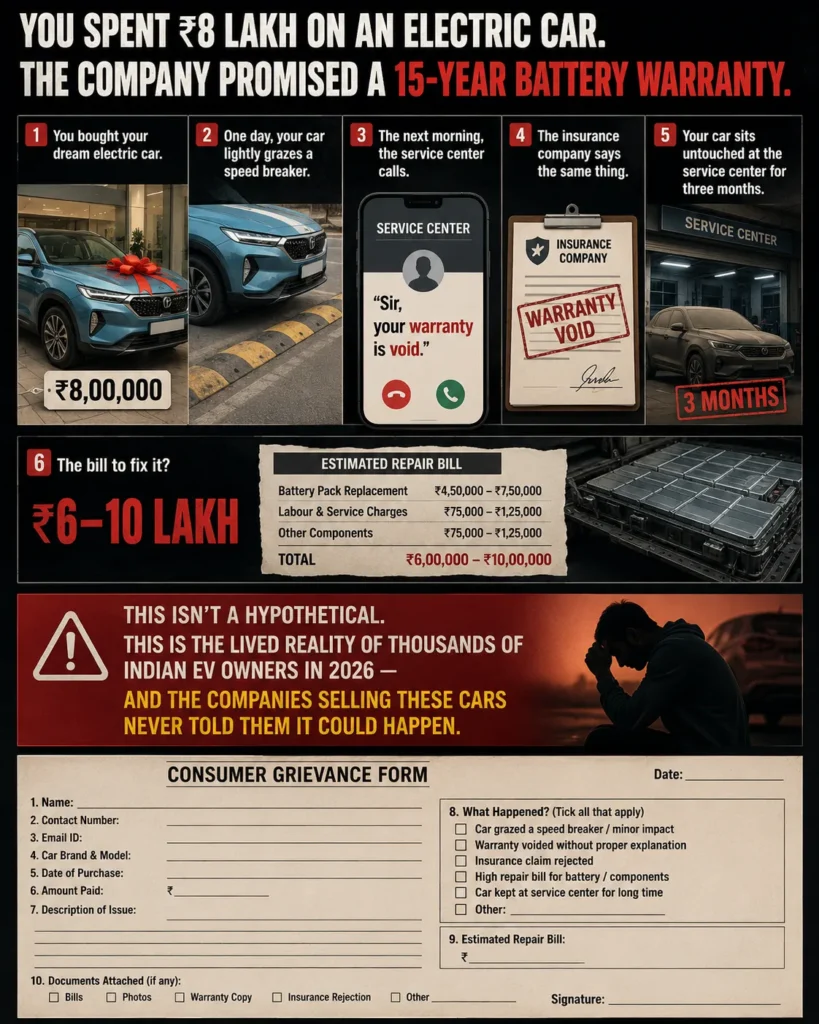
Table of Contents
The Tata Tiago EV Case That Started It All
A Tata Tiago EV owner noticed something alarming — his car’s range was dropping sharply after the battery hit 40% charge. He drove to his nearest authorized service center, expecting a straightforward warranty repair.
The technician lifted the car and inspected the underbody. Minor scratches. Nothing dramatic. Nothing that looked like an accident.
The service center’s response: “Sir, this is physical damage. Battery warranty does not apply. Please speak to your insurance company.”
The owner then went to his insurer. The insurer’s response: “There’s no registered accident claim on this vehicle. We cannot cover this.”
Result? The car has been sitting at the service center for over three months. The battery replacement will cost somewhere between ₹6 lakh and ₹10 lakh — roughly 30 to 40% of what the car originally cost. And this is not an isolated case.
Similar complaints have been reported by Tata Harrier EV owners, Mahindra XUV400 owners, and others. The pattern is the same: minor underbody damage, warranty denied, insurance denied, owner stranded.
The Hidden Loophole Inside That “15-Year Warranty”
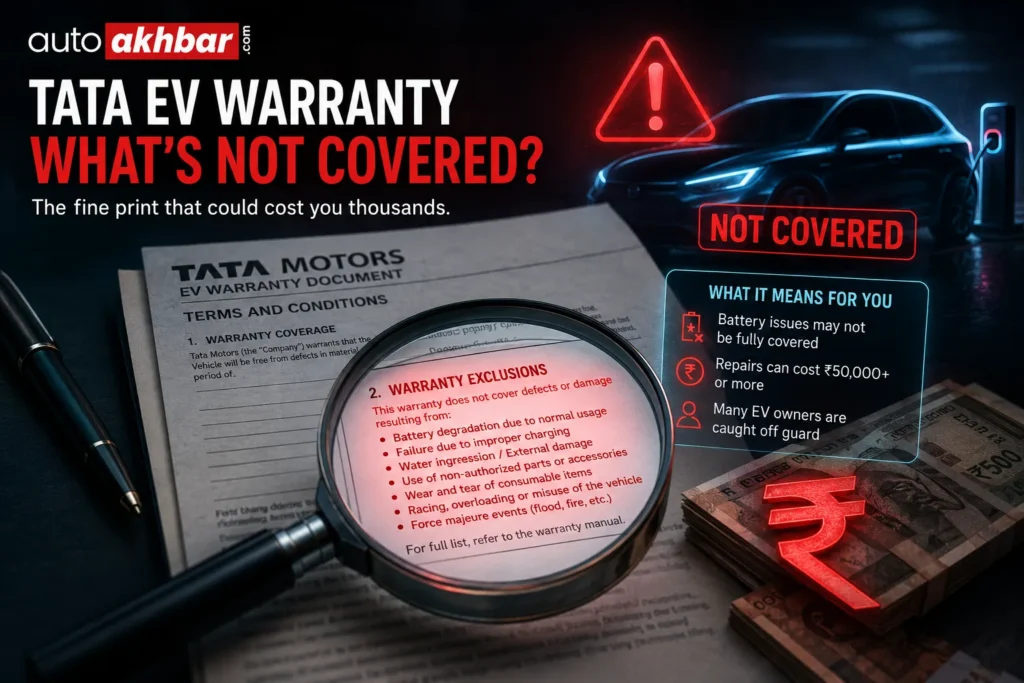
In 2026, Tata Motors announced a Lifetime / 15-Year Battery Warranty across several of its EVs — a move that made headlines. But buried inside the official warranty terms is a clause that dealerships almost never mention at the time of sale:
- Any physical damage to the battery pack or its casing — even minor scratches — voids the warranty entirely.
- Any unauthorized service at a non-authorized center voids the warranty.
- Missing even one scheduled annual service can void the warranty.
- Flood or external water damage is excluded — a BYD Seal owner in Noida was handed an ₹18.35 lakh battery replacement bill just two months after purchase, with both the manufacturer warranty and insurer refusing to cover flood damage.
The core problem is not that these clauses exist. Every warranty has exclusions. The problem is that they are never disclosed at the point of sale. The salesperson says “15-year warranty” and moves on. The fine print? That’s your job to find.
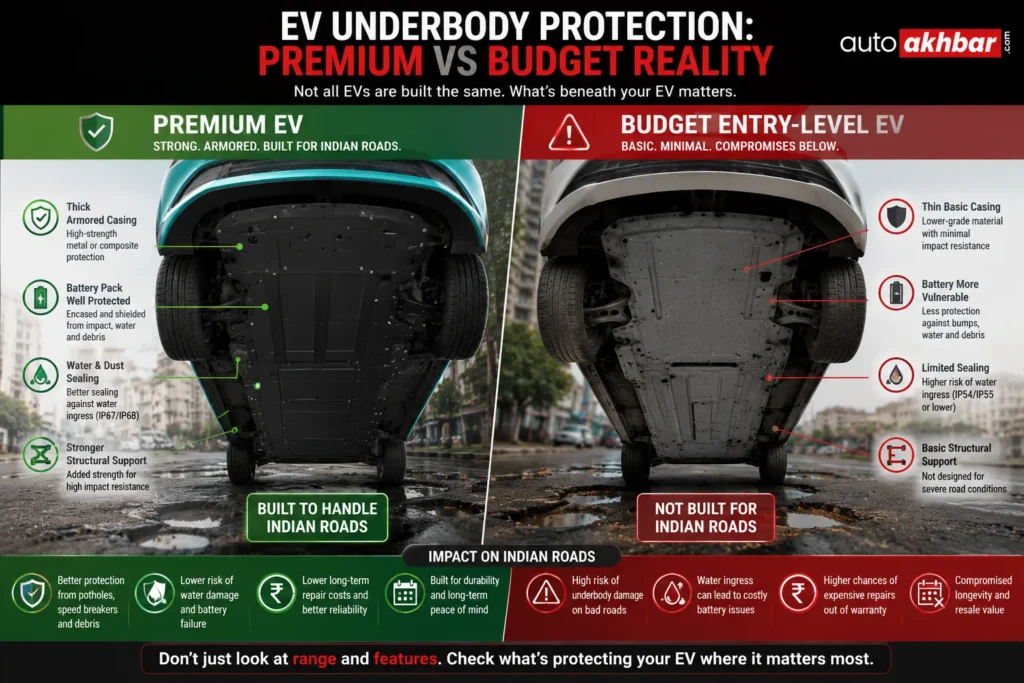
Entry-Level EV vs Premium EV — The Underbody Truth
Here is where it gets deeply unfair. Not all EVs carry this risk equally.
| EV Category | Examples | Underbody Casing | Risk Level |
|---|---|---|---|
| Premium EVs (₹40L+) | BYD Atto 3, Kia EV6, Hyundai Ioniq 5 | Heavy armored casing, reinforced skid protection | 🟢 Low |
| Mid-Range EVs (₹20–35L) | Tata Nexon EV, Mahindra XUV400 | Medium-strength casing + decent ground clearance | 🟡 Moderate |
| Entry-Level EVs (Under ₹15L) | Tata Tiago EV, MG Comet | Basic thin casing, low ground clearance | 🔴 High |
The cruel irony: the buyers who can least afford a ₹8 lakh battery repair are the ones facing the highest risk of losing their warranty. Entry-level EV buyers are the most exposed — and the least informed.
Indian Roads + Entry-Level EVs = A Problem Waiting to Happen
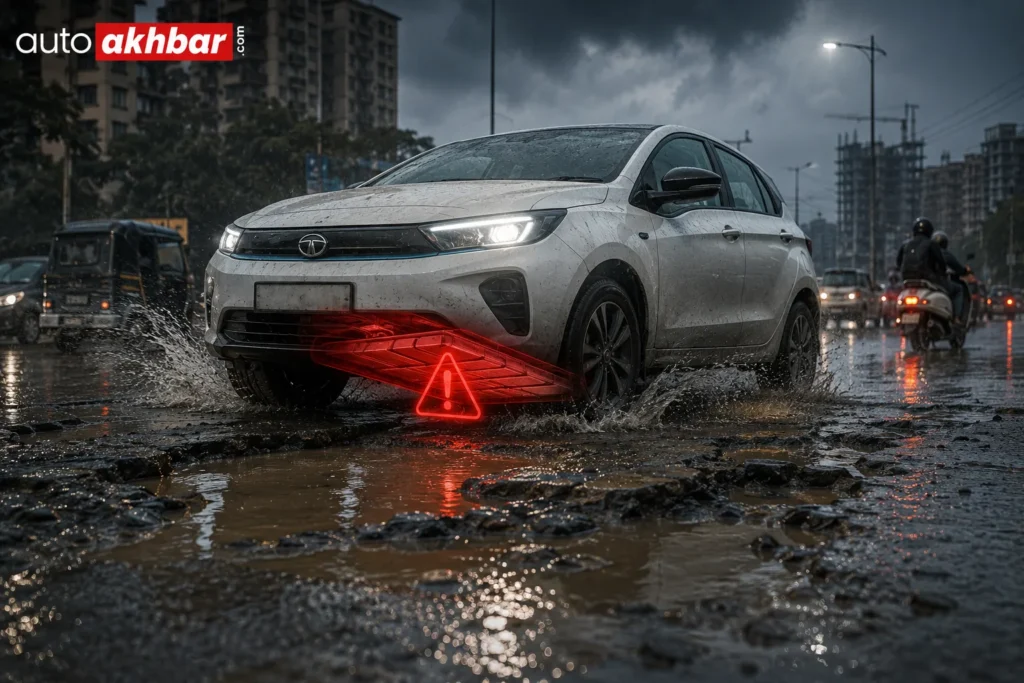
- Potholes — in every city, every colony, every highway patch
- Unmarked or oversized speed breakers
- Monsoon flooding where you can’t see the road surface at all
- Construction debris — loose gravel, broken bricks, road scrap
When the same problem hit petrol and diesel cars years ago — underbody engine damage — the industry responded with engine skid plates. Today, skid plate protection is standard on almost every ICE vehicle. Engines are well-protected.
EV battery packs, sitting flat along the floor of the car, face the same threat. But most entry-level EVs still don’t come with robust underbody battery protection as standard. Companies can build this. The cost is not prohibitive. The willingness, apparently, is.
Now EV owners are carrying two anxieties on every drive: Where’s the next charging station? And — is this road safe enough for my battery’s warranty to survive?
Insurance Won’t Save You Either — 40% of EV Claims Get Rejected
Many buyers assume that even if the manufacturer warranty fails, their comprehensive car insurance will cover a battery failure. That assumption is expensive.
According to a 2026 insurance industry report, nearly 40% of EV battery insurance claims are flagged for battery negligence and rejected. Why?
- In many policies, the battery is treated as a separate component — not always covered under standard comprehensive cover
- Without a Zero Depreciation Add-On, the claim payout on a battery is drastically reduced
- Flood damage and external impact are explicitly excluded in many policies
- If there’s no registered accident claim, the insurer has grounds to reject physical damage claims
Also read: EV in India — What You Must Know Before Buying | AutoAkhbar
So Should You Avoid EVs Altogether? (The Honest Answer)
A lot of people reading this will ask: if EVs carry this risk, why buy one at all? It’s a fair question. But the alternatives aren’t exactly rosy either.
Petrol: India’s Transport Minister is actively planning an E85 ethanol blend rollout — far beyond the E30 most people expected. Running costs on petrol are only going one direction.
Diesel: The diesel passenger car market is already shrinking. Isobutanol blending regulations are incoming.
CNG: Infrastructure is still city-specific and limited.
No matter which way you turn, EVs are still the direction of travel. The answer is not to avoid EVs. The answer is to buy one with your eyes open.
5 Things Every Indian EV Buyer Must Do in 2026
- Read the warranty terms yourself — every clause. Do not rely on what the salesperson tells you. Ask specifically about what constitutes “physical damage” and whether underbody scratches void the battery warranty.
- Get a Battery Protection Insurance Add-On. Also add Zero Depreciation cover. These are not optional luxuries — they are financial self-defense.
- Fit an aftermarket underbody skid plate. A quality underbody guard costs ₹3,000–₹8,000 and gives your battery pack meaningful protection against Indian road realities.
- Never miss a scheduled service. One missed annual inspection can silently void your entire battery warranty. Set calendar reminders.
- If your budget allows, go mid-range or above. The underbody casing quality and ground clearance of mid-range EVs significantly reduces the physical damage risk that plagues entry-level models.
Also read: गर्मियों में EV की देखभाल कैसे करें? 2026 की Complete Guide (Summer EV Care Tips in Hindi)
What Indian EV Companies Need to Do — Right Now
This is not just a consumer problem. It is an industry credibility problem. Every rejected warranty claim is a buyer who will warn ten others not to buy an EV. Here is what needs to change:
- Mandatory underbody armoring on entry-level EVs. If premium EVs can have it, there is no engineering reason budget EVs cannot.
- Transparent warranty disclosure at point of sale. A simple one-page checklist of all warranty exclusions, signed by the buyer, should be compulsory.
- India-specific battery design. Some international battery manufacturers are already designing cells specifically for Indian heat, humidity and road conditions. Indian OEMs must demand the same from their supply chains.
- Government regulation. FAME-III guidelines or BIS certification standards should include mandatory battery pack physical protection standards — just as crash safety standards exist for the car body.
Also read: How to Set Up EV Charging at Home in India — 2026 Complete Guide | AutoAkhbar
Final Word — Don’t Fear EVs. Fear Buying One Uninformed.
Indian EV companies are not running an outright scam. But what they don’t tell you is just as damaging as a lie. A 15-year warranty headline with a warranty-voiding underbody scratch clause buried in the fine print — and never disclosed at the showroom — is a serious failure of consumer transparency.
Until the industry cleans up its act and government regulation catches up, the responsibility falls on you, the buyer, to ask the hard questions before signing.
Buy the EV. Just buy it with your eyes wide open.
Found this useful? Share it with anyone who’s considering an EV in 2026 — they need to read this before they walk into a showroom. Drop your own EV experience in the comments below.