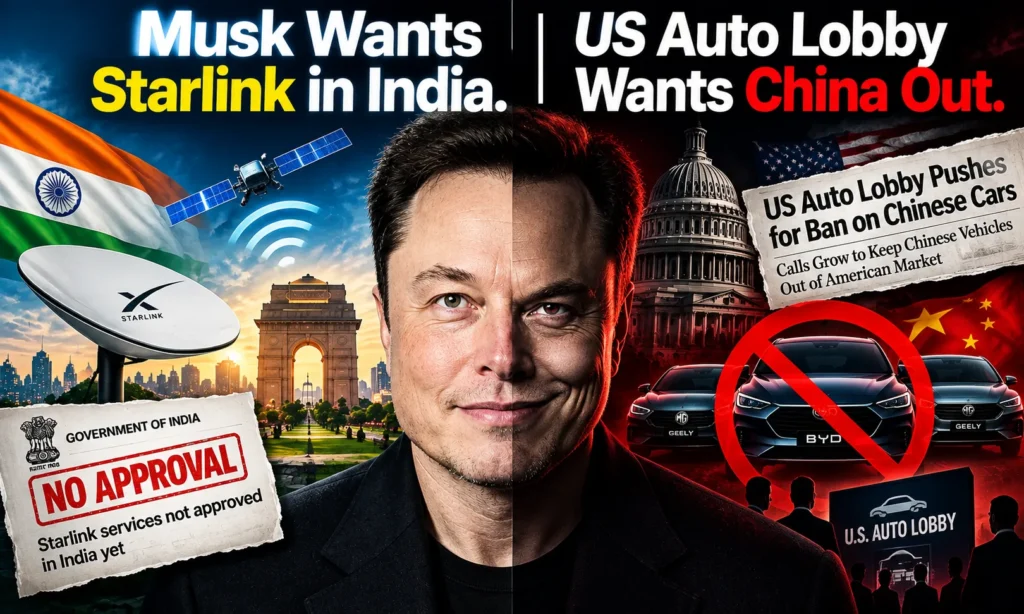

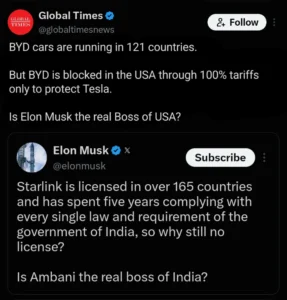
Not a single Chinese-brand car is sold in the US today, yet Washington is arguing as if BYD already has a showroom in every state. CBT News notes that Trump is open to Chinese automakers building cars in America, while US auto groups are begging him not to. Add Elon Musk, loudly demanding open doors in India, and you get the best hypocrisy story of the year.
Table of Contents
Autoakhbar Verdict Card
- Who Should Care: Anyone who buys, sells or builds cars in America, which means every US car buyer paying record prices.
- Who Can Skip: Readers who only want spec sheets.
- The Biggest Unknown: Whether Trump’s talk becomes policy. I could not confirm any final decision at the time of writing.
- Consistency Rating: Detroit 6/10, Trump 5/10, Musk 3/10.
Who Wants What: The Door Policy Table
| Player | Public Position | The Awkward Detail |
|---|---|---|
| Trump | Would accept Chinese automakers building cars in the US (The Hill) | His own predecessor’s 2025 rule effectively bans them, and 100%+ tariffs on Chinese EVs remain |
| US auto lobbies | Keep the door “firmly shut” (CNBC) | Reuters says the groups represent GM, Toyota, VW, Ford, Hyundai, Stellantis and Tesla, among others |
| US consumers | A Cox Automotive survey found nearly 40% would consider a Chinese brand (via The Edge) | They have never been allowed to try |
| Elon Musk | Anti-tariff, pro-competition, at least when the competition is in India | See the next section |
The Fight Behind the Fight
The Biden-era rule effectively blocked Chinese automakers from selling or building passenger vehicles in the US over fears that connected cars could send sensitive driver data to China. That rule, plus tariffs above 100% on Chinese EVs, built the wall. Then Trump told Fox News he would accept Chinese carmakers building in America, and Detroit panicked.
The industry’s argument is simple: state-subsidized rivals with low prices and EV scale could crush domestic producers. The consumer’s argument is simpler: new cars are expensive. Senator Elissa Slotkin said that if BYD showed up in Washington with Xi, it would suggest deals were afoot. Xi was due at the White House on September 24, according to autoevolution. Before that, Trump called Slotkin’s talk of a bigger deal a “total phony rumor” and said he would not accept finished Chinese imports or cars routed through Mexico (GM Authority). I found no report of a final decision after the visit.
Also Read : NHTSA to Rewrite US Headlight Rules: Will Glare End?
The Musk Double Standard: “Let Starlink Compete,” Unless It’s a Car
First, a correction to what is going around. The posts attacking India’s telecom incumbent were made by Elon Musk personally on X, in his Starlink and SpaceX hat, not by Tesla’s corporate account. And there is no evidence that Musk himself lobbied to keep Chinese carmakers out of the US. In fact, the record points the other way. That makes the real story sharper, not weaker.
What Musk said in India. On October 9 he addressed a mock open letter to “Prime Minister Ambani”, asking him to let Starlink compete, according to The Wire. He had earlier blamed unnamed “oligarchs” for blocking Starlink. Al Jazeera adds that India’s government denies any bias in its approval process. The pitch is classic free-market: more competition, lower prices, better access.
What Musk said about China. In 2024 he told reporters that, in general, he was in favor of no tariffs and that Tesla did not ask for the 100% tariff on Chinese EVs. He also warned that Chinese carmakers would “demolish” rivals without trade barriers. Tesla also built its Shanghai factory without a local partner, which NBC says made it the first foreign carmaker to do so.
Where the hypocrisy actually sits. Tesla enjoys an open door in China. Musk demands an open door in India. Yet the industry lobbies that Reuters says represent Tesla are asking Washington to keep the door shut on Chinese rivals. Tesla has not publicly distanced itself from that letter in anything I found. So the accurate charge is not “Musk lobbied against China.” It is that Musk’s free-market principles show up when his companies are the ones knocking on a door, and go quiet when they are standing inside one.
Our take. Competition is either good for customers or it is not. You cannot demand it from Reliance in Mumbai, enjoy it in Shanghai, and let your trade association call it a national security threat in Washington. Pick a position, Mr. Musk. Customers in all three countries are paying the price of the double standard.
The Deal-Breakers
- Data security is a real issue. Connected-car data was the reason for the 2025 rule, and “build it in America” does not automatically solve it.
- Jobs cut both ways. A Chinese plant in the US could hire locals, as Trump says, but it also pressures Detroit’s margins.
- Nobody has shown the final deal. Treat any “BYD is coming” headline as unverified until a policy document appears.
Autoakhbar Bottom Line
American buyers deserve both safety and choice, and the debate keeps pretending only one is possible. Our view: let the security question be answered with real data rules, then let competition do its job. The loudest people in this fight, Detroit’s lobbyists and Musk included, mostly want competition for others and protection for themselves.
Frequently Asked Questions
Can I buy a Chinese-brand car in the US today?
No. CBT News reports no Chinese-brand vehicles are sold in the US right now.
Did Tesla itself tweet against Ambani or Modi?
No. The posts came from Elon Musk’s personal X account, about Starlink, not from Tesla’s corporate account.
Has Trump lifted the ban on Chinese automakers?
I found no confirmation. He said he would accept them building in the US; the rule and tariffs were still in place in the sources I checked.
Sources: CNBC, Reuters (via CTV), The Hill, CBT News, The Wire, Al Jazeera, The Register, Malay Mail, NBC News, The Edge. Published October 11, 2026.