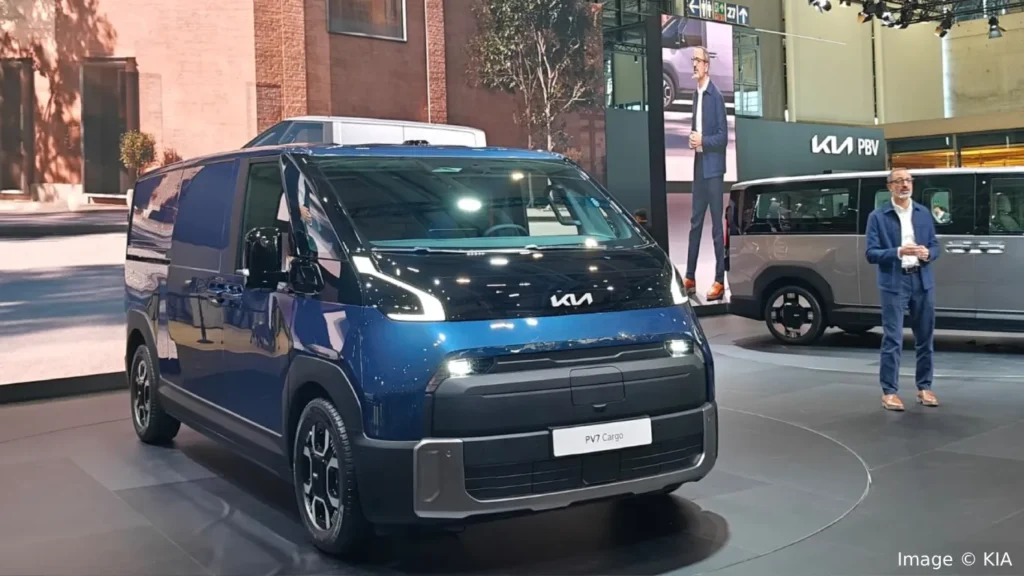

Kia just unveiled a van bigger than a Ford Transit at a German trade show — and on the very same day, a prototype was spotted testing on American roads. Here’s what the PV7 brings, and why a US launch is more likely than Kia’s willing to admit.
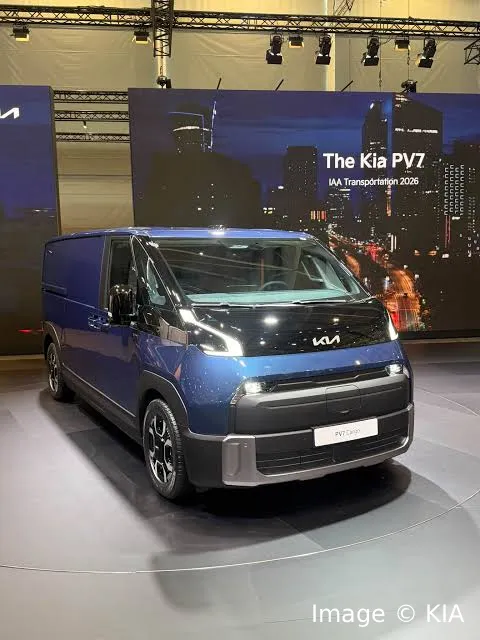
Hanover, Germany: Kia has officially pulled the covers off the PV7, its second dedicated all-electric Purpose-Built Vehicle (PBV), at IAA Transportation 2026. It’s bigger than Kia’s own Carnival minivan, runs an 800-volt platform, and Kia plans to spin it into 23 separate variants worldwide. The bigger story for American readers: a disguised PV7 prototype was spotted testing in the US within days of the reveal, even though Kia hasn’t confirmed a US launch.
Key Takeaways:
- World premiere: September 14, 2026, IAA Transportation, Hanover, Germany
- Built on Kia’s dedicated E-GMP.S PBV platform
- Two battery options: 71.5 kWh and 96.2 kWh (NCM)
- Up to 285 miles (460+ km) WLTP range on the Long Range Cargo
- 800V architecture: 10-80% charge in ~25 minutes on a 350kW charger
- Cargo volume up to 8.0 m³ (282.5 cu ft), payload up to 2,645 lbs
- Passenger version seats up to 9
- 23 total variants planned globally
- Spotted testing in the US the same week as its debut; official US launch still unconfirmed, complicated by 25% import tariffs on Korean-built EVs
Table of Contents
What’s New: Kia’s Biggest Electric Van Yet
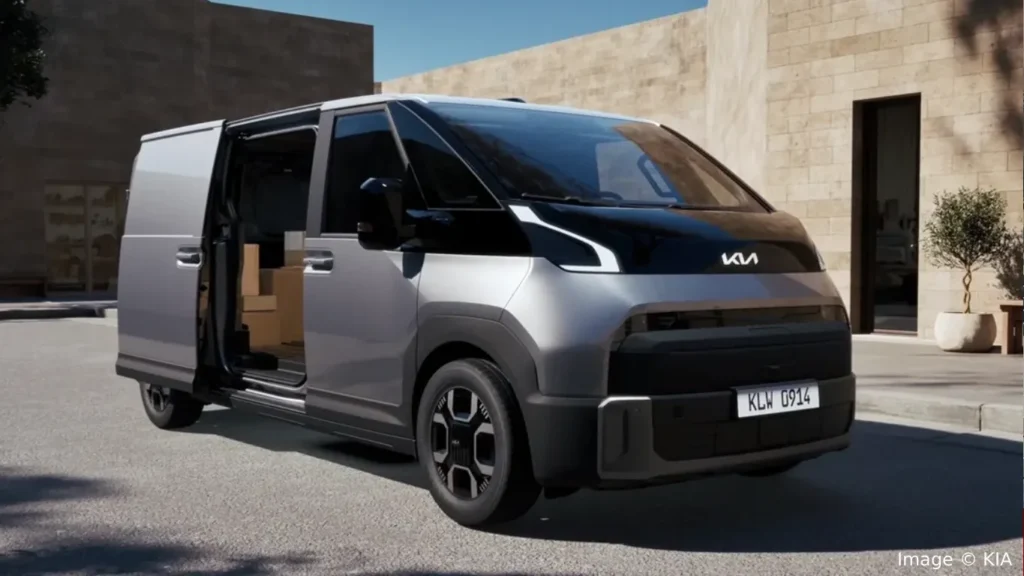
The PV7 follows last year’s PV5 as Kia’s second dedicated PBV, but it’s a serious step up in size. Built on Kia’s E-GMP.S (Electric-Global Modular Platform for Service) architecture, the PV7 measures 210.6 inches long, 78.5 inches wide, and 78.3 inches tall, riding on a 137.8-inch wheelbase — roughly two feet longer than the PV5 and longer overall than the Volkswagen ID. Buzz Cargo LWB.
Kia calls this a “Flexible Body System,” meaning wheelbase, length, and interior layout can be varied across the eventual 23-variant lineup, which will include Chassis Cab models and specialized conversions.
Also Read: Kia’s 2027 EV3 Undercuts Nearly Every Rival EV With a Sub-$30,000 US Starting Price
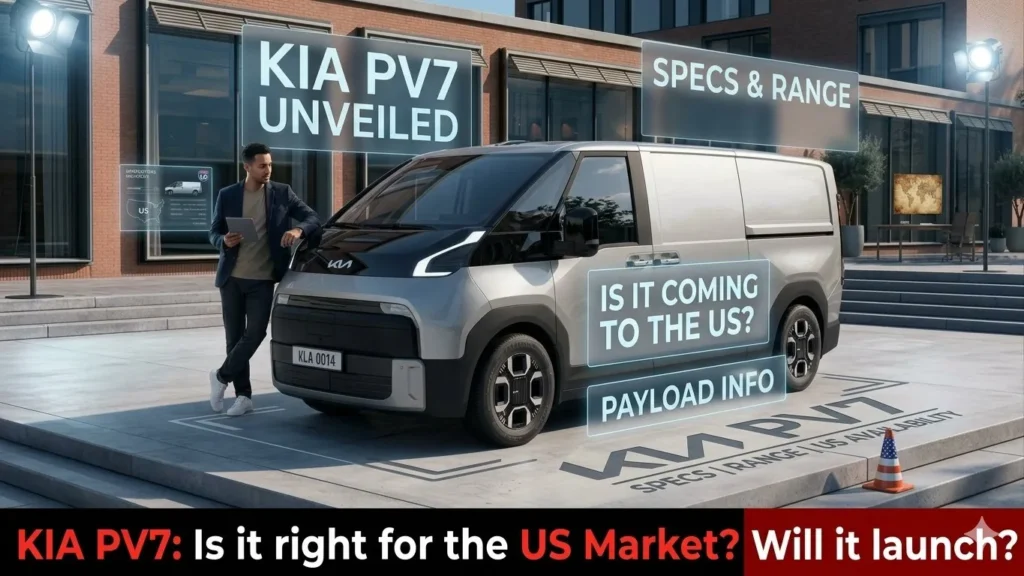
Is the Kia PV7 Coming to the US?
Kia hasn’t confirmed it — officially, the PV7 launches only in South Korea and Europe starting in the second half of 2027, with “additional markets” to follow. But there’s a real signal worth flagging: the same week the PV7 was unveiled in Germany, Electrek reported a disguised prototype testing on American roads. That mirrors exactly what happened with the smaller PV5, which was spotted charging in Indiana and testing in Arizona months before Kia said anything official about a US launch.
The catch is tariffs. Every PBV, PV7 included, is built at Kia’s Hwaseong plant in South Korea, which currently puts it in line for a 25% import tariff into the US. That’s a real obstacle to competitive pricing against domestically-built rivals like the Ford E-Transit and Rivian’s commercial vans. On the other hand, Kia has been actively expanding US-based production at its West Point, Georgia plant for the EV6 and EV9, and with Kia’s US EV sales down significantly year-over-year, a fleet-focused van could be a logical way to diversify. Read this as “plausible, not confirmed” rather than a done deal.
Battery, Range & Charging: The 800V Advantage
Kia offers the PV7 with two NCM (nickel-cobalt-manganese) battery packs — 71.5 kWh and 96.2 kWh. The Long Range Cargo variant with the larger pack delivers a claimed 285 miles (460+ km) on the WLTP cycle, though Kia itself flags this as a preliminary, pre-homologation figure — expect the eventual EPA number to land lower once it’s tested against Kia’s real-world loaded weight and highway speeds.
The bigger deal is the 800V architecture, which Kia says can take the battery from 10% to 80% in the mid-20-minute range on a 350kW DC fast charger — quick for a van this size, and quicker than most gas-to-electric van conversions on sale today. Power comes from a front-mounted motor making up to 200kW (268 hp) and 420Nm (309 lb-ft) of torque, with front-wheel drive standard for now; Kia has confirmed an all-wheel-drive version is coming later.
Cargo & Passenger Variants: Space For Everyone
The PV7 Cargo comes in 2- and 3-seat cabin configurations, with the Long version offering 215 cubic feet of cargo space that grows to 282.5 cubic feet in the High Roof variant — enough for three Euro pallets, backed by a dedicated heavy-loading drive mode. Payload tops out at 2,645 lbs on the compact body and 2,568 lbs on the Long. Buyers get a choice of full-open twin-swing rear doors or a conventional lift-up tailgate.
The Passenger variant is built for shuttle, rental, and family use, seating up to nine occupants in the global spec, using a Long-Rail Easy Remove Seats system that lets owners reconfigure the cabin. Both body styles get Vehicle-to-Load (V2L) capability, so the PV7 can run power tools, camping gear, or job-site equipment directly off the battery — handy for American contractors and outdoor outfitters alike.
Tech & Safety
Inside, the PV7 runs Kia’s Pleos Connect infotainment system on Android Automotive OS across 12.9-inch and 14.6-inch displays, paired with the Gleo AI voice assistant for navigation and vehicle controls. On safety, it gets a 7-airbag system — including an unusual roof-mounted co-driver airbag that frees up dashboard storage — plus Level 2 driver assistance: Forward Collision-Avoidance Assist, Lane Keeping Assist 2.0, Highway Driving Assist 2.0, Pedal Misapplication Safety Assist 2.0, and a Surround View Monitor. Fleet operators get real-time diagnostics and tracking through the Kia Business Solutions Portal.
Kia PV7 Full Specifications
| Spec | PV7 Cargo (Long) | PV7 Passenger (Long) |
|---|---|---|
| Dimensions (L x W x H) | 210.6″ x 78.5″ x 78.3″ | 210.6″ x 78.5″ x 78.3″ |
| Wheelbase | 137.8″ | 137.8″ |
| Battery | 71.5 / 96.2 kWh (NCM) | 71.5 / 96.2 kWh (NCM) |
| WLTP Range | 285 mi (96.2 kWh, claimed) | Not yet published |
| Motor / Power | Up to 268 hp, 309 lb-ft, FWD | Up to 268 hp, 309 lb-ft, FWD |
| Fast Charging | 10-80% in ~25 min (350 kW) | 10-80% in ~25 min (350 kW) |
| Cargo / Seating | 215 cu ft (282.5 cu ft High Roof) | Up to 9 seats |
| Payload | Up to 2,568-2,645 lbs | N/A |
| Confirmed Launch | Korea & Europe, H2 2027 | Korea & Europe, H2 2027 |
Note: All figures are preliminary and based on Kia’s world premiere disclosure; final specifications and any US-market figures may change following homologation and EPA testing.
Kia PV7 vs the Competition
In the US, the PV7’s natural rivals are the Ford E-Transit and Mercedes-Benz eSprinter, both of which are already on sale domestically and avoid the import-tariff question entirely. Neither offers an 800V charging architecture as standard, though, which gives the PV7 a real edge on charging speed if and when it arrives. Globally, its closest match by size is the Volkswagen ID. Buzz Cargo LWB, which the PV7 actually beats on interior volume and payload.
AutoAkhbar Verdict
The PV7 is an ambitious van — bigger than a minivan, quicker to charge than most passenger EVs, and flexible enough to become two dozen different vehicles. Whether Americans get to buy one comes down to two things Kia hasn’t settled yet: tariffs on its Korean-built PBVs, and whether the West Point, Georgia plant eventually builds one locally. The US test-mule sighting is a good sign, but treat a US PV7 as “likely eventually,” not “coming next year.” Pricing and homologated range figures are still pending — expect firmer numbers closer to the H2 2027 on-sale date.
Official Source: Kia PV7 World Premiere — Kia Worldwide