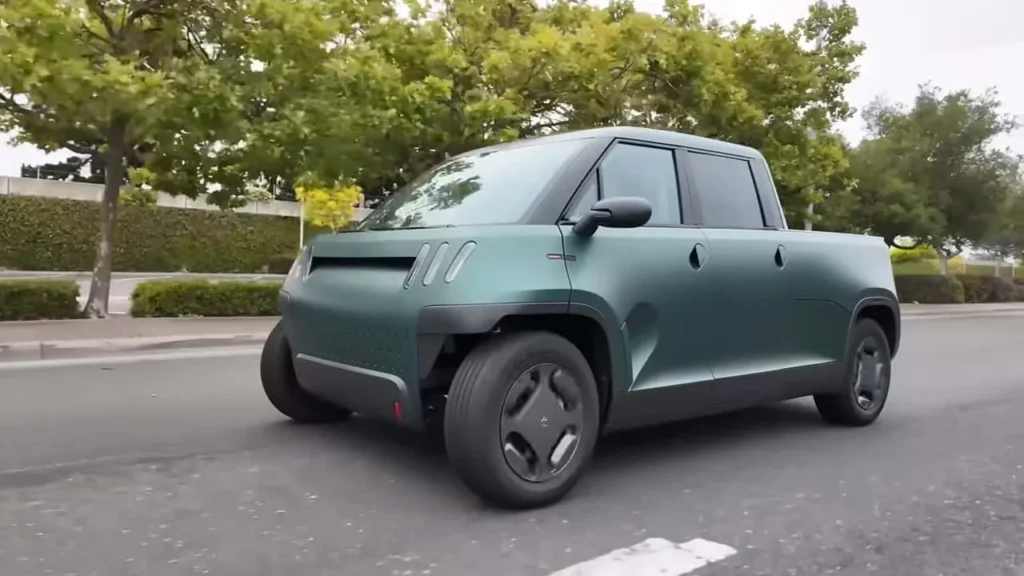

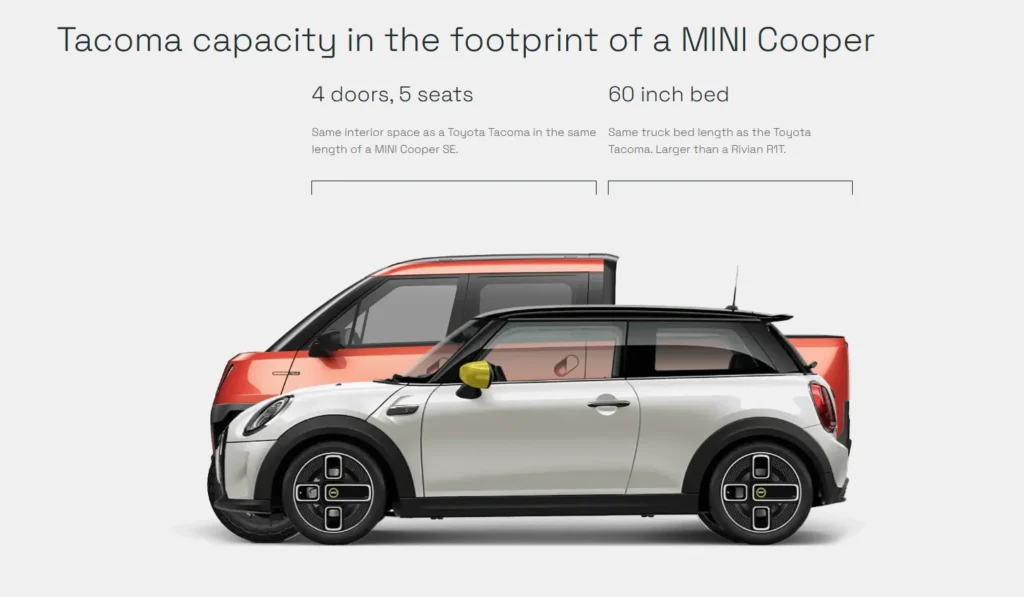
Trucks in America keep getting bigger, chunkier, and honestly kind of ridiculous for city driving. One California startup is doing the exact opposite. Telo Trucks — named after the Greek word “telos,” meaning “purpose” — is building an electric pickup that’s the same length as a Mini Cooper, but with the bed space of a Toyota Tacoma. Small footprint, big attitude. That’s the whole pitch.
Here’s the full lowdown on the Telo MT1 — the vision, the founders, who’s bankrolling it, the full spec sheet, how big the market opportunity really is, what’s happening on social media, and (most importantly) an honest, rational take on whether this thing is legit or just another EV startup pipe dream.
Table of Contents
The Vision Behind Telo — Who’s Actually Building This Thing
Telo Trucks kicked off in 2022 out of San Carlos, California, founded by three guys who all bring something different to the table:
- Jason Marks (CEO) — spent his career building test systems for driver-assistance safety features at major US automakers. His “aha” moment was painfully relatable: he couldn’t find parking for his own Tacoma in San Francisco, so he set out to build something that actually fit city life.
- Forrest North (CTO) — cut his teeth on the original Tesla Roadster development team and later founded Mission Motors, an electric motorcycle company.
- Yves Béhar (Co-founder & CCO) — a genuine design legend. His firm fuseproject shaped Telo’s entire look and brand identity. Béhar’s been vocal that the whole point is cutting emissions from light-duty trucks, which account for a whopping 10.5% of total US transportation emissions.
Bottom line on the vision: give people all the capability of a full-size truck, minus the bloat. This isn’t just a design flex — Telo is going straight after urban buyers who need real utility but refuse to deal with parking a land yacht every day.

What Actually Makes the Telo Truck Different
The compact EV truck space is heating up — Slate Truck and a yet-unnamed affordable Ford EV pickup are also in the mix — but Telo is widely considered the most radical-looking of the bunch. Here’s what sets it apart:
- Cab-forward design: No wasted space up front — everything goes toward passengers and cargo.
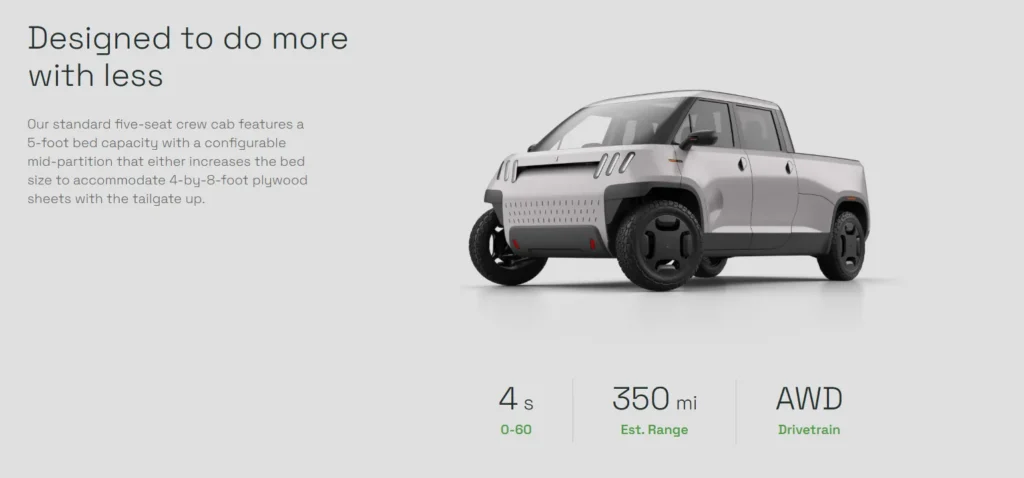
- Adjustable midgate: The 60-inch bed folds open into an 8-foot bed when you need to haul something long. Clutch feature.
- Capital-efficient manufacturing: Instead of building a mega-factory, Telo’s leaning on contract manufacturers (Aria Group for prototypes, Schwab Industries for the body-in-white) and starting with a small batch of ~500 units.
- Solar option: Telo teamed up with Aptera Motors to offer a solar cab-top, solar tonneau cover, and solar camper top.
Telo MT1 Specs — The Full Breakdown
| Length | 152 inches (3,861 mm) |
| Width | 73 inches |
| Height | 67 inches |
| Wheelbase | 111 inches |
| Curb Weight | 4,400 lb |
| Battery Options | 77 kWh (Standard) / 106 kWh (Long Range) |
| Range | 260 miles (Standard) / 350 miles (Long Range) |
| Power | 300 hp (Single Motor, RWD) / 500 hp (Dual Motor, AWD) |
| 0–60 mph | ~6.0 sec (RWD) / ~4.0 sec (AWD) |
| Payload | 2,000 lb (RWD) / 1,700 lb (AWD) |
| Towing Capacity | 6,600 lb (RWD) / up to 8,000 lb (AWD) |
| Bed Size | 60″ (up to 96″ with midgate) x 56″ x 18″ |
| Charging | NACS connector, DC fast charge 20–80% in ~20 min |
| Seating | Up to 5 (optional third-row seating in the bed) |
| Starting Price | $41,520 (before incentives) |
| Target Production | Q4 2026, low-volume run |
Source: Telo Trucks official site, Wikipedia — Telo MT1, Autoblog
Who’s Bankrolling Telo? The Investors
Telo’s raised cash across three rounds so far:
- Pre-Seed ($2M) — led by GoAhead Ventures.
- Seed ($6M) — led by Neo.
- Series A ($20M, September 2025) — this round was actually led by Yves Béhar himself and Tesla co-founder Marc Tarpenning, with TO VC, E12 Ventures, Neo, Salesforce CEO Marc Benioff, Uncorrelated Ventures, Nova Threshold, and MCJ all jumping in too.
Total funding raised sits at roughly $27.8 million. Having Marc Tarpenning on the board is a big deal — this is a guy who literally co-founded Tesla — and it adds real credibility. That said, a famous name on your cap table doesn’t guarantee you’ll actually ship product.
How Big Is the Market Opportunity, Really?
Telo’s racked up over 12,000 refundable reservations, representing a claimed $600M+ in demand. But those reservations only require a $152 fully-refundable deposit, so it’s smarter to treat this as “genuine interest” rather than “locked-in sales.”
Zoom out, though, and the compact/affordable truck category is legitimately on fire in the US right now — the Ford Maverick’s runaway popularity, the upcoming Slate Truck (targeting ~$25-28K), and Ford’s own unnamed affordable EV pickup are all riding the same wave. Telo’s positioning itself as the design-forward, premium play in that lane.
The Social Media Buzz
Telo’s active across the board — X (@TELOtrucks), Instagram, Facebook, LinkedIn, Threads, and a solid YouTube channel where they run a “How Will You TELO?” series.
Engagement is real, but the sentiment is a mixed bag. The enthusiast crowd (especially compact-truck forums) is hyped on the design and packaging. But there’s a solid skeptic contingent out there too, comparing Telo to flopped EV startups like Fisker and Canoo, arguing the numbers look “too good to be true” for a scrappy little startup.

Also Read : REO Runabout: The $21,500 Gas Truck With a Manual Gearbox That America Has Been Waiting For
The Real Talk — Is This Legit or Just Hype?
Gotta keep it real here. Telo’s pitch sounds great on paper, but EV startup history is littered with cautionary tales:
- Timeline keeps slipping: Production was originally slated for early/late 2025, now it’s Q4 2026 — a pretty familiar pattern in EV-startup land.
- Certification’s still pending: Crash and safety testing is still underway as of mid-2026, and that has to wrap before production can actually start.
- Reservations ≠ Orders: A $152 refundable deposit is a low-commitment signal, full stop. Remember, Tesla’s Cybertruck racked up 200,000+ reservations and only a fraction ever turned into actual deliveries. Same caution applies here.
- Scaling is the real test: Contract manufacturing keeps costs lean, but the first batch is just ~500 units. Going from slick prototypes to thousands of certified, warranty-backed vehicles is exactly where startups like Fisker went down.
- Pricing is a bit awkward: $41,520 undercuts the Rivian R1T and F-150 Lightning, sure, but it’s a lot pricier than Slate Truck’s ~$25-28K target. Urban buyers want small — but will they pay a premium for it? Still an open question.
On the flip side, the positives are real too: an experienced founding team (Tesla and Mission Motors pedigree), a genuinely differentiated design, a legit board member in Marc Tarpenning, and a manufacturing partner already locked in. This isn’t pure vaporware — but it’s not a sure thing either.
Bottom line: The Telo Truck is a genuinely interesting engineering bet with medium-to-high execution risk. It’s a US-only play for now, with zero confirmed plans for a global rollout — but it’s still a solid case study for anyone tracking where compact urban EVs are headed.
Stay tuned to AutoAkhbar for updates on the Telo Truck: The Tiny Electric Pickup Truck
FAQs
When is the Telo Truck launching?
The company’s targeting Q4 2026 for its first low-volume production run of roughly 500 units.
How much does the Telo Truck cost?
Pricing starts at $41,520 for the base RWD/Standard battery trim, topping out around $49,999 for the dual-motor version.
Will the Telo Truck come to other markets?
Not currently — Telo Trucks has no confirmed plans for expansion beyond the US market right now.