
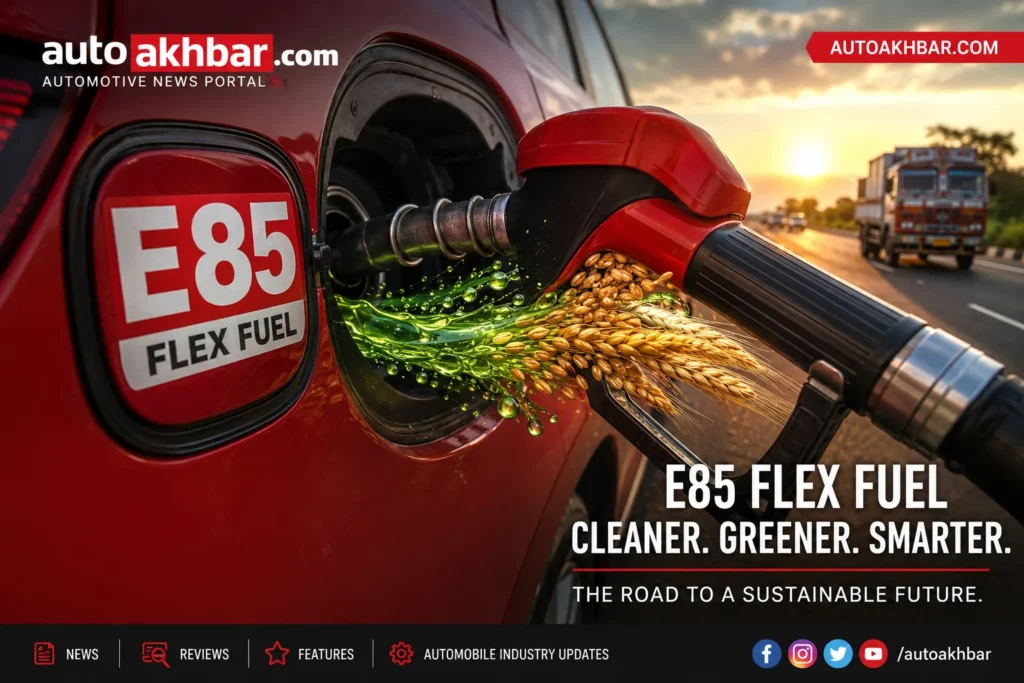

On World Environment Day, June 5, 2026, Union Petroleum Minister Hardeep Singh Puri inaugurated India’s very first E85 dispensing station at Indian Oil’s Pusa Road outlet in Delhi — and with it, the Maruti Suzuki WagonR became the country’s first flex-fuel passenger car. At just ₹82.12 per litre — a full ₹20 cheaper than regular petrol — India’s automotive future just got a whole lot greener and more affordable.
₹82.12
E85 Price / litre in Delhi
₹20
Cheaper than E20 petrol
500
Target pumps by Dec 2026
5,000
Target pumps by end 2027
If you have only heard about E85 in news headlines and wondered what all the fuss is about, you are in the right place. This guide breaks down everything — what E85 is, how it is made, how a flex-fuel engine actually works under the hood, which cars in India can run on it, what problems other countries faced with flex fuel and how they fixed them, which upcoming Indian cars will support E85, and straight answers to the most commonly asked questions. One article, everything covered.
Table of Contents
What Exactly is E85? How is it Different from Regular Petrol?
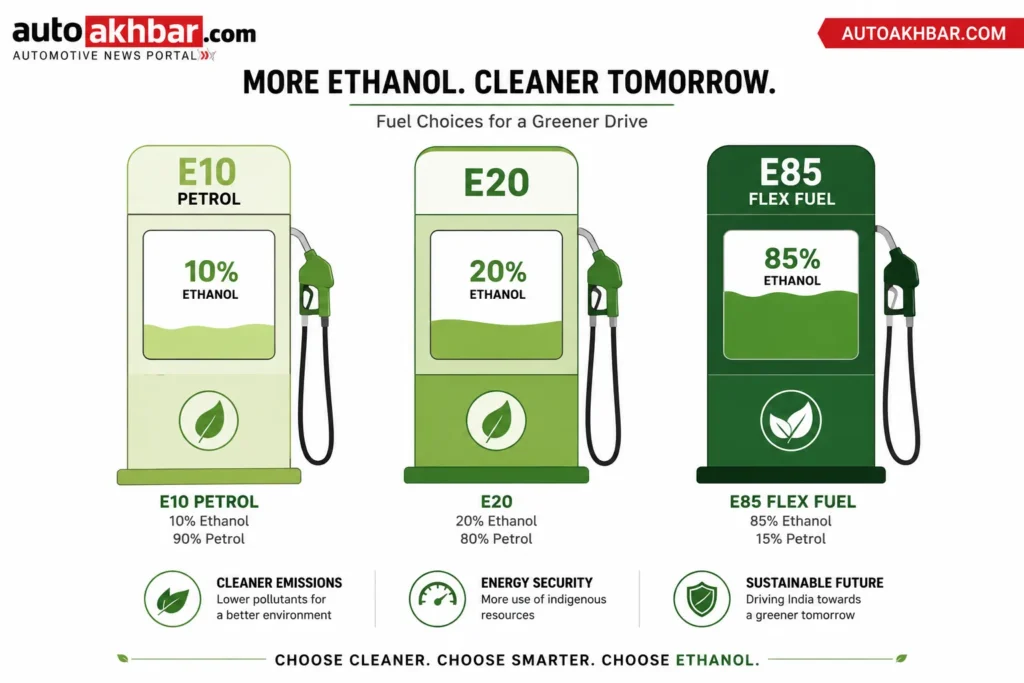
In simple terms, E85 is a fuel blend containing 85% ethanol and just 15% regular petrol. This is a massive step up from what you are currently pumping into your car — E20, which has 20% ethanol and 80% petrol. The “E” stands for Ethanol, and the number tells you the percentage of ethanol in the blend.
Ethanol itself is an alcohol-based biofuel produced from agricultural crops — primarily sugarcane and maize in India. It is not a synthetic chemical; it is made by fermenting and distilling plant sugars, making it a genuinely renewable fuel. India produced record ethanol volumes in 2025, which is exactly why E85 is now commercially viable.
E10
Old Standard
10% ethanol, 90% petrol. India’s baseline until 2022. Now phased out nationally.
E20
Current Standard
20% ethanol, 80% petrol. Available at every pump across India since April 2025.
E85
New Revolution
85% ethanol, 15% petrol. Only for Flex-Fuel Vehicles (FFVs). Just launched in Delhi.
E100
Pure Ethanol
100% ethanol. Used in Brazil. Tata Punch FFV will support this in India.
Critical Warning: E85 is a petrol-based fuel, not diesel. Never put it in a diesel engine. And equally important — never put E85 in a regular E20-rated petrol car. It is exclusively designed for Flex-Fuel Vehicles (FFVs). Doing otherwise can cause serious, costly engine damage. Fuel stations will have clear signage — always check before filling.
How is Flex Fuel Made? The Ethanol Production Story
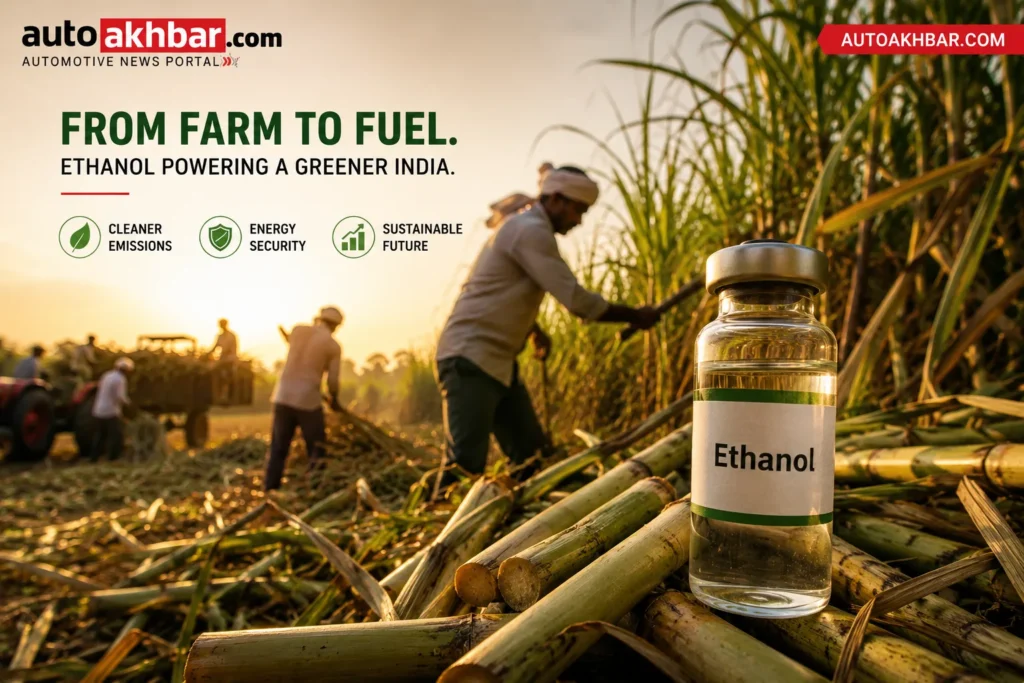
India’s ethanol for E85 comes primarily from sugarcane juice and B-grade molasses — a byproduct of sugar manufacturing. States like Uttar Pradesh, Maharashtra, and Karnataka are India’s ethanol powerhouses. The basic production chain: sugarcane is harvested → juice is extracted → fermented by yeast → distilled into anhydrous ethanol (99.9% pure) → blended with petrol at certified facilities → dispatched to fuel pumps.
What makes this exciting for India is the direct farmer benefit. Sugarcane farmers — the traditional “Annadatas” — now also become energy suppliers, or what Minister Puri called “Urjadatas.” India’s ethanol blending was at a mere 1.5% in 2014. By 2025, it reached 20% nationwide — a 13x jump in a decade. That remarkable progress is what made the June 2026 E85 launch possible.
For E85 specifically, the ethanol content must be “anhydrous” — meaning water content is stripped out to below 0.3%. This is critical because water in fuel causes phase separation in high-ethanol blends, which can seriously damage the fuel system. The Bureau of Indian Standards (BIS) has already set the monofuel standard for E85, giving it full regulatory legitimacy across India.
E85 Petrol in India: The Fuel Revolution You Weren’t Ready For
Flex-Fuel Engine Technology — What Happens Under the Hood?
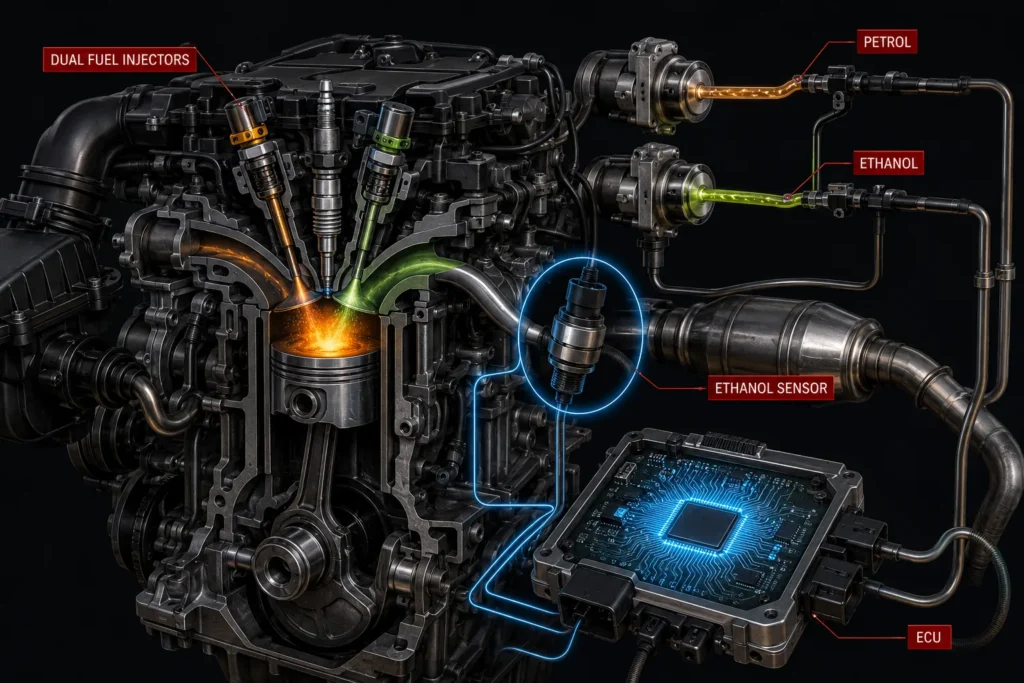
A flex-fuel engine (FFV engine) looks almost identical to a regular petrol engine from the outside. But the internal hardware and software are fundamentally different. Here is a component-by-component breakdown of what makes an FFV tick:
Flex Fuel Sensor (Ethanol Content Sensor)
This is the brain of the FFV system. Located in the fuel line, it shoots infrared light through the fuel and measures how much gets absorbed. Since ethanol absorbs infrared differently than petrol, the sensor calculates the exact ethanol percentage in real-time — whether the tank has E20, E50, E85, or anything in between. This data is sent instantly to the ECU.
Modified ECU (Engine Control Unit)
The ECU reads the fuel sensor data and automatically adjusts three key parameters: fuel injection quantity (ethanol needs 30–40% more volume than petrol for the same energy output), ignition timing (ethanol’s octane ~113 RON vs petrol’s ~91–95 RON allows more aggressive ignition advance), and air-fuel ratio (petrol needs 14.7:1, ethanol needs 9:1). The Maruti WagonR’s K12N FFV engine does all this on the fly, seamlessly.
Ethanol-Resistant Fuel System Components
Ethanol is an alcohol — it is chemically corrosive to materials that petrol tolerates fine. A regular car’s rubber fuel hoses can swell and degrade. Carbon steel fuel lines can pit and corrode. FFVs are built with stainless steel fuel lines, fluoropolymer (Viton) rubber seals, hardened stainless injector tips, and an ethanol-compatible fuel tank coating. This is why you absolutely cannot run E85 in a non-FFV — it is a materials compatibility issue, not just a tuning one.
Higher Octane Advantage — More Performance Potential
Ethanol’s octane rating of ~113 RON is significantly higher than petrol’s 91–95 RON. This means engine knock (premature detonation) is far less likely, allowing FFV engines to run higher compression ratios and more aggressive ignition advance. Performance-tuned FFV engines actually produce more power on E85 than on petrol. For the WagonR and Fronx FFV, Maruti has kept power output broadly similar to the petrol versions, but combustion is cleaner and more controlled.
Cold Start Management System
Ethanol does not vaporise as easily as petrol at low temperatures, which can make cold starts difficult in sub-zero conditions. FFVs address this through enriched fuel injection during cranking, a longer injector pulse width at startup, and in extreme cases, a small auxiliary petrol tank for cold-start priming. In India’s climate — where temperatures rarely drop below 5°C even in northern winters — this is barely a concern for most owners.
India’s E85 Roadmap — From 2014 to Today
2014
Ethanol blending at just 1.5%
India was importing nearly 89% of its crude oil. Ethanol adoption was negligible, and the push for energy independence had barely begun.
2022
E10 achieved nationwide
10% ethanol blending rolled out across the country — the first major milestone in the National Biofuel Policy roadmap.
Auto Expo 2023
First FFV prototypes unveiled
Maruti showcased the WagonR FFV prototype. Toyota unveiled the Innova Hycross FFV — billed as the world’s first BS6 Stage II electrified flex-fuel vehicle. Minister Nitin Gadkari drove it personally.
April 2025
E20 mandatory nationwide — 5 years ahead of schedule
Originally targeted for 2030, E20 blending was achieved by April 2025 thanks to rapid sugarcane ethanol capacity expansion in Maharashtra, UP, and Karnataka.
June 4–5, 2026
🚀 E85 officially launched in India
On World Environment Day, Minister Hardeep Singh Puri inaugurated India’s first E85 pump at Indian Oil’s Pusa Road outlet, Delhi. Maruti WagonR unveiled as India’s first flex-fuel passenger car. E85 priced at ₹82.12/litre. Hero MotoCorp Splendor+ and HF Deluxe FFV bikes also featured.
Dec2026
500 E85 pump network
Target of 500 E85 dispensing stations across Delhi-NCR, Mumbai, Pune, Nagpur, and Bengaluru corridors. Initial phase already deploying 50–100 stations.
End of 2027
5,000 pumps nationwide
Full-scale E85 infrastructure across India’s major cities. Tata, Hyundai, Mahindra, and Toyota FFV models expected to be commercially available by this point.
Which Cars in India Can Run on E85?
This is the most critical practical question. Only Flex-Fuel Vehicles (FFVs) can use E85. Putting E85 in a regular E20 petrol car will cause misfires, injector damage, fuel system corrosion, and potentially destroy the engine. Here is the full picture of FFVs in India right now and in the pipeline:
WagonR Flex Fuel
1.2L K12N engine modified for E20–E85. India’s first flex-fuel passenger car. Currently for commercial sector, consumer launch coming. Price approx ₹6–8.5 lakh.
Splendor+ & HF Deluxe FFV
E20 to E85 compatible commuter motorcycles. FFV technology reaching India’s mass two-wheeler market for the first time. Showcased at the June 2026 E85 launch event.
Fronx Flex Fuel
1.2L K12 engine reworked for E20–E85. Power unchanged at ~89 bhp, 113 Nm. Expected price ₹9–10 lakh. Urban buyers’ most likely first FFV compact SUV.
Innova Hycross FFV
World’s first BS6 Stage II electrified flex-fuel vehicle. Hybrid + E85 — best of both worlds. First revealed by Nitin Gadkari in 2023. Commercial launch expected 2026–27.
Punch Flex Fuel
Showcased at Bharat Mobility Expo 2025. 1.2L Revotron engine. Supports E85 to E100 — most future-proof FFV in India. 86 bhp, 115 Nm. Launch expected late 2026 / early 2027.
Creta Flex Fuel
1.0L turbo engine with ethanol compatibility. India’s best-selling SUV in flex-fuel avatar. Demonstrated 2025. Consumer launch post-2026.
Global Flex Fuel Story — What Other Countries Experienced
India is not starting from scratch here. Brazil, the USA, and Sweden have been running flex-fuel vehicles for decades. Their journey is full of valuable lessons — both the wins and the very real problems they encountered and eventually solved.
🇧🇷
Brazil — The World’s Flex Fuel Capital
Brazil launched its ethanol programme after the 1970s oil crisis, and today over 75% of all vehicles on Brazilian roads are FFVs running on E100 (pure ethanol). The biggest early problem was cold-start failure — pure ethanol would not ignite reliably below 15°C. The solution became industry standard: a small auxiliary petrol tank stored under the bonnet, used only during cold cranking. Modern FFVs have replaced this with electronic fuel heaters and ECU-managed cold-start enrichment. Brazil proved at scale that ethanol-based mobility works — and India is directly following that model.
🇺🇸
USA — 20 Million FFVs, Mileage the Big Debate
America had over 20.9 million registered FFVs as of 2022 — yet many owners did not even know their car was flex-fuel capable. The core complaint: E85 delivers 15–30% less mileage than petrol because ethanol has roughly 33% lower energy density. However, since E85 is priced lower at the pump, the per-kilometre running cost often works out comparable or cheaper. A secondary challenge was cold starts below freezing — GM and Ford invested heavily in cold-weather ECU tuning, ultimately shipping winter blends with lower ethanol percentages (sometimes as low as E51) to ease cold starts in northern states.
🇸🇪
Sweden — Conquering Sub-Zero Flex Fuel
Sweden has one of the highest FFV penetration rates in Europe. Their challenge was the most extreme: making E85 start reliably at -25°C. The solution came through factory-fitted fuel heating systems, precision cold-start fuel enrichment tables in the ECU, and strategic winter blends. Sweden’s success in solving cold-start issues means today’s modern FFVs globally come pre-equipped with these solutions — which is good news for India, as these problems do not even exist in our warm climate.
🇮🇳
India — The Unique Challenge Set
India’s cold-start worry is minimal thanks to a predominantly warm climate. But three challenges are specific to the Indian context: first, pump availability is still very limited outside major metros — the 500-pump rollout by December 2026 is critical for adoption. Second, consumer confusion between E20 and E85 must be managed through clear pump signage and FFV vehicle badging. Third, ethanol supply consistency — since production depends on sugarcane and maize seasons — needs multi-feedstock diversification, which the government is actively working on.
Problems vs Solutions — Head to Head
| ⚠️ Problem | ✅ Solution |
|---|---|
| Mileage drops 15–30% because ethanol has lower energy density than petrol | E85 is priced ₹20/litre cheaper. Even with higher fuel consumption, the per-km running cost remains comparable or lower — and will tip further in E85’s favour as prices stabilise. |
| Cold start difficulty — ethanol does not vaporise easily in low temperatures | India’s warm climate makes this a non-issue for most regions. Modern FFVs include ECU cold-start enrichment and fuel heaters for edge cases in colder hill stations. |
| Ethanol is corrosive — can damage rubber hoses, steel lines, and seals in non-FFV engines | FFVs are factory-built with ethanol-resistant components: stainless steel fuel lines, Viton rubber seals, hardened injectors. Never a problem in a genuine FFV. |
| Very limited E85 pump availability across India right now | Government’s phased rollout: 50–100 pumps immediately, 500 by December 2026, 5,000 by end of 2027. Pusa Road, Delhi is just the starting gun. |
| Consumer confusion — people may accidentally put E85 in non-FFV cars | Mandatory clear pump signage confirmed by Minister Puri. FFV cars carry distinct Flex Fuel badging. Government awareness campaigns planned alongside rollout. |
| Seasonal ethanol production — sugarcane supply is not year-round consistent | Government promoting maize-based and multi-feedstock ethanol plants alongside sugarcane, and building strategic ethanol storage buffers for supply stability. |
The Real Price Math — Is E85 Actually Cheaper to Run?
₹82.12
E85 per litre — Delhi, June 2026
Regular E20 petrol currently ~₹102/litre in Delhi
₹20 savings per litre
Even with 20–25% higher fuel consumption on E85, net per-km running cost remains broadly comparable — and will tip further in E85’s favour as prices stabilise and pump network grows.
Let us run the numbers clearly. Say your car delivers 15 km/litre on regular petrol (E20). On E85, the same car might give around 12 km/litre — roughly a 20% drop in efficiency. Running cost on petrol: ₹102 ÷ 15 = ₹6.80 per km. Running cost on E85: ₹82.12 ÷ 12 = ₹6.84 per km. Nearly identical today. The government has signalled its intent to keep E85 pricing meaningfully lower as adoption scales. According to Minister Puri, consumers should be able to recover the additional cost of an FFV vehicle within approximately three years purely through fuel savings — making the switch a financially rational long-term decision
Sources & References
ANI News — India Launches E85 Fuel, June 5, 2026 ↗AutoPunditz — E85 Launched in Delhi at ₹82.12/litre ↗Smartprix — Maruti WagonR: India’s First Flex Fuel Car ↗Autocar India — WagonR Flex Fuel Production Spec Revealed ↗PIB.gov.in — Ministry of Petroleum Official Press Release ↗CarhP India — All Upcoming Flex Fuel Cars in India 2026 ↗AngelOne — 500 E85 Stations by End 2026 ↗AutoNexa — Flex Fuel Vehicles India 2026 Complete Guide ↗
Your Questions Answered — E85 FAQ.
Is E85 available in India right now?
Yes! E85 was officially launched in India on June 5, 2026, at Indian Oil’s Pusa Road pump in New Delhi — inaugurated personally by Union Petroleum Minister Hardeep Singh Puri on World Environment Day. As of right now, availability is limited to this first station, but the government has confirmed 50–100 pumps will be operational across Delhi-NCR, Mumbai, Pune, Nagpur, and Bengaluru within weeks. The target is 500 stations by December 2026 and 5,000 stations by the end of 2027. So if you already own a flex-fuel vehicle like the Maruti WagonR Flex Fuel, you can start fuelling with E85 in Delhi today.
Can E20 cars run on E85?
Absolutely not — and this is critical to understand. E20-rated cars are designed for a maximum of 20% ethanol content. Filling E85 in such a car can cause immediate misfires and rough running, damage rubber fuel line seals and hoses due to ethanol’s corrosive nature, corrupt injector seals, trigger fuel system corrosion, and cause serious long-term engine damage. Only cars with an explicit “Flex Fuel” or “FFV” badge — like the new Maruti WagonR Flex Fuel — can safely use E85. When in doubt, check your owner’s manual. At the pump, always look for clear E85 signage — it will be distinct from regular petrol nozzles.
Is it better to run E85 or regular petrol?
If you own an FFV, E85 is increasingly the better choice — here is why. Advantages: E85 is currently ₹20/litre cheaper than regular petrol in Delhi, it burns cleaner with significantly lower carbon emissions, it has a higher octane rating (~113 RON) meaning less engine knock and more efficient combustion, and it directly supports Indian farmers while reducing crude oil import bills. The trade-off: mileage drops approximately 15–30% because ethanol has lower energy density. However, running the actual cost per kilometre, E85 works out to roughly the same as petrol today and is expected to become cheaper as production scales up. For regular petrol cars, E85 is not an option at all — it would cause engine damage.
Is E85 a petrol or diesel?
E85 is a petrol-type fuel — it has nothing to do with diesel. It is used exclusively in spark-ignition engines (petrol engines), never in compression-ignition engines (diesel). The composition is 85% ethanol — an alcohol-based biofuel produced from sugarcane, maize, or other agricultural crops — blended with 15% regular petrol. Ethanol is the same class of alcohol found in spirits, but in anhydrous (water-free) form for fuel use. The key distinction from diesel: petrol engines use a spark plug to ignite the fuel-air mixture; diesel engines rely on compression heat alone. E85 is designed specifically for the spark ignition process and cannot work in a diesel engine under any circumstances.





Pingback: Yamaha FZ Blue Flex Launched: Price, Specs & Mileage 2026