

What if your regular gasoline car could run on E85 — the same high-octane fuel that powers race cars and flex-fuel trucks — starting today, for under $800, with a two-hour garage job? That’s not a fantasy. It’s exactly what a flex fuel E85 conversion kit does. And in 2026, these kits have become smarter, more plug-and-play, and easier to install than ever before. Whether you drive a Toyota, a Honda, a Mustang, or a GM truck — there’s a good chance your car is compatible. Let’s get into it.
📌 Also read: India’s E85 Revolution Has Officially Begun — The Complete Guide
Table of Contents
What Is E85 and Why Should You Care in 2026?
E85 is a fuel blend made of 51–83% ethanol and the rest regular gasoline. The exact ratio varies by region and season — in colder climates, the blend drops to around 51% ethanol (called E51) in winter months to ensure easy cold starts. In warm regions, it sits closer to 85% ethanol, hence the name.
Now here’s why E85 matters right now in 2026:
- Ethanol is over 100 octane. Regular 91 octane premium gasoline doesn’t come close. Higher octane means your engine can handle more compression and ignition timing advance without knocking — which directly translates to more horsepower.
- EPA’s RFS Set 2 Final Rule (effective June 2026) has set the highest renewable fuel volume requirements in US history, meaning E85 supply is stronger and more stable than it’s ever been.
- Domestic ethanol usage hit 14.34 billion gallons in 2025, and the national average ethanol blend rate broke the historic 10% wall for the first time ever — reaching 10.51%.
- E85 averaged $0.50 less per gallon than regular gasoline nationally through late 2025, with some regions seeing nearly a dollar per gallon in savings.
- Emissions drop by up to 80% compared to pure gasoline, making it one of the greenest liquid fuels you can pump at a conventional fuel station.
The one trade-off: fuel economy drops by roughly 15–27% on E85 compared to gasoline, because ethanol contains less energy per gallon. The math still works out in your favor if E85 is at least 20–25% cheaper per gallon at your local pump — but you should run the numbers for your specific area before committing.
⚡ Quick Stat: A properly installed E85 conversion kit can add 10–20% more horsepower to a naturally aspirated engine. On a turbocharged or supercharged engine, the gains can be significantly higher because ethanol’s cooling effect directly lowers intake temperatures — which means you can run more boost.
How Does a Flex Fuel E85 Conversion Kit Actually Work?
This is the part most guides skip over — and it’s the most important thing to understand before you buy anything.
A standard car’s ECU (Engine Control Unit) is programmed to inject a very specific amount of fuel based on the oxygen sensor feedback and a few other inputs. That calibration is set for gasoline. Ethanol, however, needs roughly 30–35% more fuel volume than gasoline to produce the same energy output (because it has lower energy density per litre). If you just dump E85 into an uncalibrated car, the engine will run lean — which is dangerous and can cause serious engine damage.
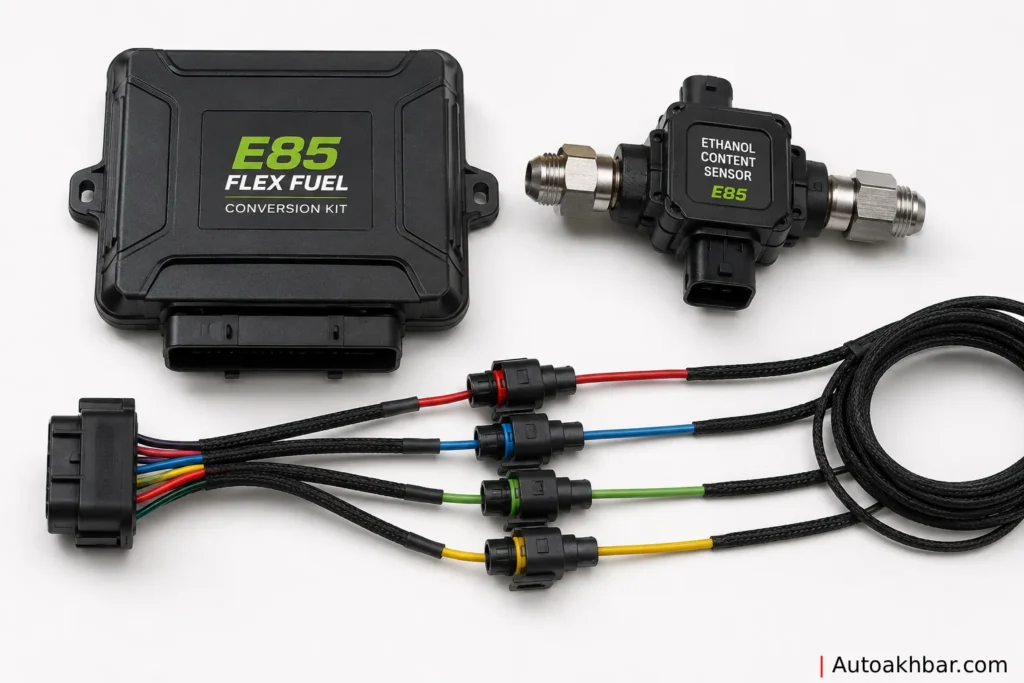
A flex fuel conversion kit solves this by acting as a piggyback ECU — it intercepts the signal between your car’s computer and the fuel injectors, reads the ethanol content in the fuel (via an ethanol sensor placed in the fuel line), and automatically increases injector pulse width (open time) by the correct amount so the engine always gets the right fuel-to-air ratio.
The factory ECU never even knows anything changed. No check engine lights. No warranty voiding (in most cases). No re-flashing required.
The three main hardware components are:
- Ethanol Content Sensor (ECS) — installed in-line on the fuel feed line between your fuel rail and fuel pump. It measures the exact % of ethanol in real time, up to 1,000 times per second on modern kits.
- Piggyback Control Module — the brain. It takes the ECS reading and calculates the exact duty cycle adjustment needed for your injectors.
- Injector Harness — a set of plug-and-play connectors that sit inline between your factory injector connectors and the injectors themselves. No cutting of factory wiring required.
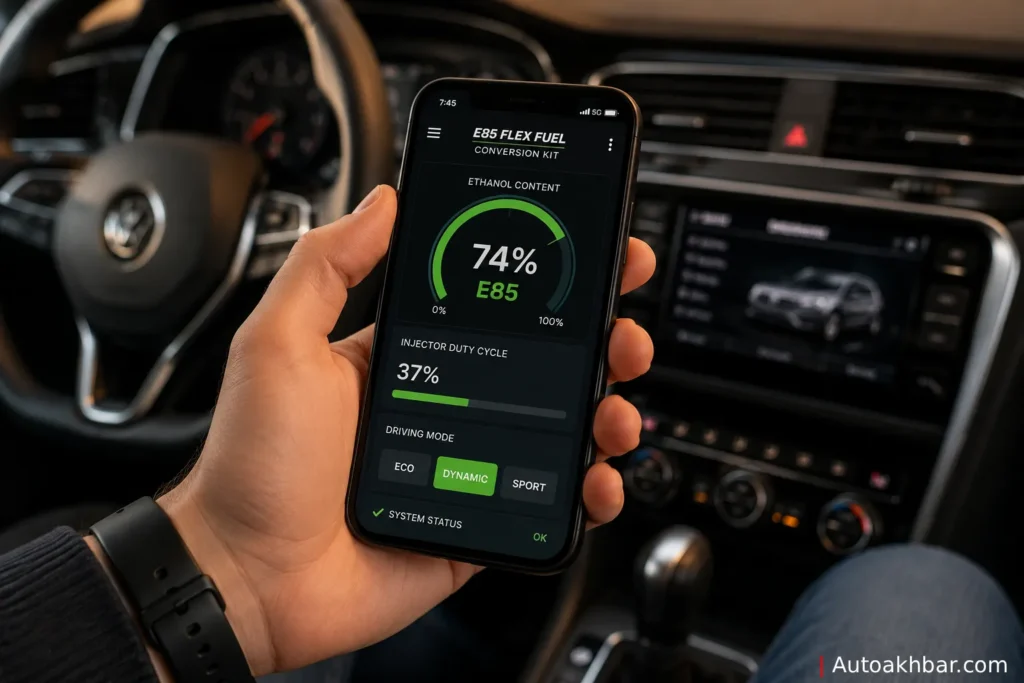
Modern 2025–2026 kits like the eFlexFuel eFlexPlus also come with a smartphone app (via Bluetooth) that lets you switch between Eco, Dynamic, and Sport modes, monitor ethanol content live, adjust cold-start fueling, and even log data — all from your phone.
Step 1: Check If Your Car Is Compatible
Before you buy anything, you need to verify three things about your car:
A. Fuel Injectors Must Handle E85
Ethanol is mildly corrosive to older rubber compounds and certain metals used in early fuel system components. Most cars made after 1996 have fuel injectors that are E85-tolerant, but not all. Reputable kit manufacturers like eFlexFuel verify your injector compatibility as part of the purchase process — always use that verification step.
If your injectors are borderline, you’ll also need to check their flow capacity. Since E85 requires ~35% more fuel volume, undersized injectors running at 100% duty cycle on E85 can’t deliver enough fuel. The kit manufacturer’s tech team can assess this for you.
B. Fuel Pump Must Be High-Flow Enough
Stock fuel pumps on many NA (naturally aspirated) cars are often sufficient for E85 conversions at stock power levels. However, if you’re running a modified engine — upgraded turbo, bigger injectors, higher boost — a high-flow fuel pump upgrade (such as a Walbro 450 or DeatschWerks DW300) is highly recommended before installing the E85 kit.
C. Fuel Lines and Tank Must Be Ethanol-Compatible
Most cars built after 2000 use ethanol-safe fuel lines. If you own a classic or a car built before 1995, consult a specialist — some older rubber fuel lines and tank seals degrade over time with high-ethanol fuels.
💡 Pro Tip for 2026: Use the compatibility checker on eFlexFuel.com or FuelEconomy.gov to quickly see if your car is listed as FFV-compatible or if a kit is available.

Step 2: Choose the Right Kit for Your Build
Not all E85 conversion kits are created equal. In 2026, there are three main tiers:
Tier 1 — Daily Driver / Budget: eFlexEco (~$299–$399)
Best for: stock or mildly modified naturally aspirated cars driven daily. Fully automatic, no tuning required, EPA-compliant. Plug-and-play. Reduces carbon emissions by up to 80%. Install time: 1–2 hours for an experienced mechanic, 2–4 hours for a first-timer.
Tier 2 — Performance: eFlexPlus (~$599–$799)
Best for: enthusiast cars, mild turbo builds, trucks. Includes the smartphone app (Eco / Dynamic / Sport modes), live ethanol content monitoring, cold-start fueling adjustment, and up to 10% more power on naturally aspirated engines, up to 12% on forced-induction applications. Most popular choice.
Tier 3 — Full Custom Tune: eFlexPro (~$999+)
Best for: built engines, high-boost applications, drag cars. Includes all eFlexPlus features plus two additional analog inputs (MAP, MAF, TPS, or wideband O2) for custom tuning via the eFlexTuner software. Gives tuners full control over the fuel map on E85.
📌 Also read: E85 Petrol in India: The Fuel Revolution You Weren’t Ready For
Step 3: Tools and Supplies You’ll Need
Here’s your complete shopping list before starting the install. Most of these are standard garage tools:
- ✅ Your E85 conversion kit (everything needed is included in reputable kits)
- ✅ Socket set and ratchet (8mm–13mm is typical)
- ✅ Flathead and Phillips screwdrivers
- ✅ Fuel line disconnect tools (plastic, for quick-connect fittings — cheap, critical, don’t skip)
- ✅ Zip ties and wire loom (for clean routing)
- ✅ Nitrile gloves (fuel contact is inevitable)
- ✅ Shop rags and a small catch container (for residual fuel when disconnecting lines)
- ✅ A phone or tablet (for kit setup and the smartphone app)
- ✅ Torque wrench (for sensor fittings — over-tightening cracks the housing)
Safety first: Work in a well-ventilated area. Keep a fire extinguisher nearby whenever you’re working on fuel lines. Never smoke or allow sparks near an open fuel system.
Step 4: Install the Ethanol Content Sensor In-Line
This is the most mechanically involved step of the entire install. Take your time here.
4a. Locate the Fuel Feed Line
The fuel feed line runs from the fuel pump (at the tank) toward the fuel rail and injectors. On most modern cars, this is a hard line under the car or a rubber hose in the engine bay that you can trace from the fuel rail backwards. Consult your vehicle-specific forum or the kit manufacturer’s vehicle-specific instructions — they often have photos.
4b. Depressurize the Fuel System
This is non-negotiable. Fuel rails are under 40–60 PSI of pressure. Disconnect the fuel line without depressurizing and you’ll get a face full of gasoline.
Method: Pull the fuel pump fuse (check your fuse box diagram or owner’s manual for the correct fuse). Start the engine and let it run until it stalls — typically 10–30 seconds. The engine dying means the rail pressure has been consumed. Now it’s safe to disconnect.
4c. Cut the Fuel Feed Line and Install the Sensor
Using your fuel line disconnect tool (for quick-connect fittings) or a line wrench (for banjo fittings), disconnect the line at a point that has enough clearance for the sensor housing — typically 4–6 inches of clearance needed.
The ethanol sensor will have two ports: IN (from the fuel tank/pump) and OUT (toward the fuel rail). Connect them correctly. Flow direction matters — the sensor will indicate the correct direction on the housing.
Tighten the fittings by hand first, then use a wrench — do not overtighten. Thread the sensor’s wiring harness back toward the engine bay.
4d. Check for Leaks Before Closing Everything Up
Reinstall the fuel pump fuse. Cycle the ignition key ON–OFF–ON–OFF–ON three times (don’t crank) to repressurize the system. Let it sit for 60 seconds and inspect every connection point for drips or seeps. Zero tolerance here — any leak needs to be fixed before the engine starts.
Step 5: Connect the Injector Harness
This is actually the easiest part of the whole install — it’s genuinely plug-and-play on modern kits.
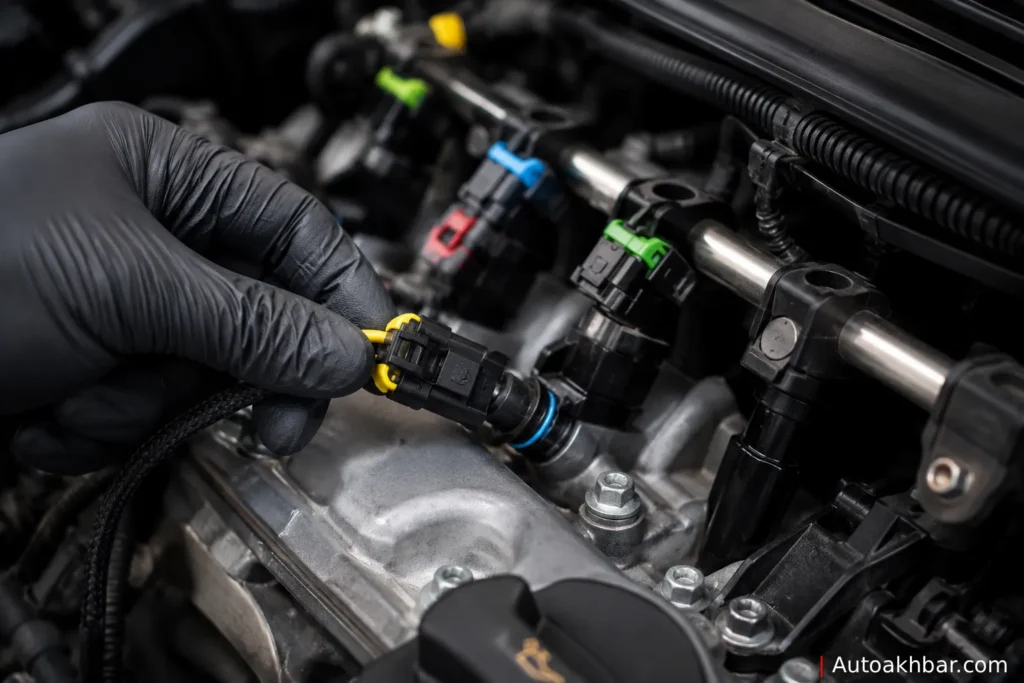
Each fuel injector on your engine has a two-wire connector attached to it. The injector harness from your kit provides an intermediate connector for each injector — you simply:
- Unplug the factory injector connector from the injector.
- Plug the kit’s IN connector into the injector.
- Plug the factory connector into the kit’s OUT connector.
- Repeat for all injectors (4, 6, or 8 depending on your engine).
Bundle the harness wiring neatly alongside the factory engine harness using zip ties. Never route wiring near exhaust manifolds or other heat sources. The control module end of the harness should be routed to wherever you plan to mount the piggyback ECU — typically a cool, accessible spot in the engine bay away from heat and direct water spray.
Step 6: Mount and Connect the Piggyback ECU Module
The control module is the brain of the kit. It’s usually a compact, sealed waterproof unit roughly the size of a pack of cards.
Mounting:
Most kits include a mounting bracket. Choose a location that is:
- Away from the exhaust manifold and engine block heat (aim for intake side of the engine bay)
- Protected from direct rain splash (but modern modules are rated IP67 waterproof)
- Accessible — you may want to reach it for firmware updates or diagnostics later
Wiring:
Connect the following wires as per your kit’s vehicle-specific instructions:
- Injector harness plug — main multi-pin connector from the injector harness goes directly into the module
- Ethanol sensor connector — plug from the ethanol sensor goes into the module
- 12V power wire — connect to a switched 12V source (ignition-on power, not always-on battery power). Many installers use the fuse box using a fuse tap.
- Ground wire — bolt to a clean chassis ground point. Do not use painted surfaces — find a bare metal bolt.
On kits with Bluetooth (eFlexPlus and eFlexPro), the module also has an internal antenna — no additional wiring needed for the app connectivity.
Step 7: First Start-Up and System Check
Before the first start on E85, do one full start-up on regular gasoline. This confirms the install is correct and there are no issues before ethanol enters the system.
- Turn the ignition on (don’t crank) and listen for the fuel pump prime — you should hear a brief hum from the tank for 2–3 seconds.
- Check for any check engine lights. There should be none.
- Crank and start the engine. Let it idle.
- Rev it gently — listen for any abnormal sounds, misfires, or stumbling.
- Check under the hood: inspect all fuel line connections for leaks with the engine running and system pressurized.
- Download the smartphone app (if applicable) and pair it with the module via Bluetooth. Confirm the app is detecting the module.
If everything looks and sounds good — congratulations, the mechanical install is complete!
Step 8: First Fill-Up With E85
Here’s something most DIY guides get wrong: you don’t need to drain your tank before switching to E85. The conversion kit handles any blend automatically.
Simply drive to your nearest E85 station (use the AFDC Fuel Station Locator from the US Department of Energy to find E85 near you) and fill up normally. The ethanol sensor will detect the new fuel blend in real time within a few miles of driving, and the module will begin adjusting injector timing automatically.
Don’t be surprised if the first 20–30 miles feel slightly different as the system calibrates to the new blend. This is completely normal.
On your smartphone app, you’ll be able to watch the ethanol content reading rise as the new fuel mixes through the system. Once it stabilizes, switch the app to your preferred driving mode:
- Eco Mode — optimized for maximum fuel economy
- Dynamic Mode — balanced performance and efficiency (recommended for daily driving)
- Sport Mode — maximum power extraction, best for track days or spirited driving
The 2026 Reality Check: What No One Tells You
Let’s be completely honest about what to expect after the conversion:
✅ What Actually Gets Better:
- Engine runs cooler — ethanol absorbs heat during vaporization, reducing intake temps
- Less engine knock — the high octane (100+) eliminates detonation even under hard acceleration
- Real-world power increase, especially noticeable above 4,000 RPM
- Significant reduction in tailpipe CO₂ and particulate emissions
- Fuel savings (market-dependent — check your local E85 price vs. premium gas)
⚠️ What to Watch Out For:
- MPG will drop 15–27% — your tank will feel like it’s shrinking. This is expected.
- Cold starts need attention — in temperatures below 10°C / 50°F, E85 is harder to ignite. Kits with cold-start fueling adjustment handle this automatically, but in extreme cold climates, keeping some gasoline in the blend helps.
- E85 availability varies by region — the Midwest has abundant E85 stations, but rural areas in some states may have limited access. Always check before committing.
- Older fuel system components may degrade — inspect rubber fuel hoses and O-rings annually if you’re running E85 long-term.
- Not legal for emissions testing in all states — check your state’s smog inspection rules. Most eFlexFuel kits are EPA-compliant, but verify for your state.
Rare Tip: The E85/Gas Blend Optimization Formula
Most drivers on E85 run pure E85, but serious tuners know that blended fuels can be fine-tuned for specific goals:
- E30 (30% ethanol) — the sweet spot for NA engines on a stock fuel system. Gives you noticeably higher octane without requiring injector duty cycle upgrades. A very popular choice in motorsport.
- E50 — used by tuned turbocharged cars that need higher octane for aggressive boost maps but don’t want to run full E85 year-round.
- E85 (full) — maximum power and cooling, ideal for built engines, race applications, or summer-only vehicles.
The beauty of a flex fuel kit is that you can pour any combination into the same tank and the kit adjusts automatically. No manual changes needed. This is something a simple ECU reflash or standalone tune cannot do.
Legal and Warranty Considerations (2026 Update)
A question that comes up in every comment section: “Will this void my warranty?”
The honest answer: it depends on your country, state, and manufacturer. In the United States, the Magnuson-Moss Warranty Act means a dealer cannot void your entire vehicle warranty just because you installed an aftermarket part — unless they can specifically prove the part caused the failure in question. That’s a meaningful legal protection.
eFlexFuel kits are EPA-compliant (legal under the EPA’s Tampering Policy) and do not modify the factory ECU, OBD system, or trigger a Check Engine Light when properly installed. They are among the cleanest, most reversible aftermarket modifications available.
In other countries (UK, EU, Australia), the rules differ — consult a local automotive legal expert before installing if warranty preservation is critical to you.
📌 Also read: Latest Auto News — AutoAkhbar Newsroom
Quick Comparison: E85 Conversion Kit vs. ECU Tune vs. Factory FFV
| Feature | Conversion Kit | ECU Tune (E85 Map) | Factory FFV |
|---|---|---|---|
| Auto fuel blend detection | ✅ Yes | ❌ No | ✅ Yes |
| Works on non-FFV cars | ✅ Yes | ⚠️ Sometimes | ❌ N/A |
| Check engine light risk | ✅ None | ⚠️ Possible | ✅ None |
| Reversible | ✅ Fully | ⚠️ Requires reflash | ❌ N/A |
| DIY-friendly | ✅ Yes (2–4 hrs) | ❌ Shop required | ✅ Out of box |
| Cost | $300–$1,000 | $500–$2,000+ | New car purchase |

Final Verdict
Installing a flex fuel E85 conversion kit is genuinely one of the best dollar-for-dollar upgrades you can do to a performance car in 2026. It’s clean, it’s reversible, it doesn’t touch your factory ECU, and the gains — both in power and in potential fuel savings — are real and measurable.
If you’re running a stock car on regular 87 or 91 octane and you have access to E85 in your area, this is a no-brainer weekend project. If you’re building a performance car, the kit becomes the foundation that unlocks everything else your engine is capable of on ethanol.
The 2026 kits — particularly the eFlexPlus — are genuinely impressive. Bluetooth app control, automatic blend detection up to 1,000 times per second, no CEL, and a DIY install that a patient first-timer can complete in an afternoon. It’s one of those rare automotive mods where the marketing actually undersells the product.
Happy wrenching. ⚙️
— AutoAkhbar Editorial Team
📌 Got questions about your specific car’s compatibility? Drop them in the comments below — our community and team will help.
FAQ Section
Can I install a flex fuel E85 conversion kit on any car?
Not every car, but the vast majority of petrol-powered cars made after 1996 can be converted. The key compatibility checks are your fuel injectors (must handle ethanol), fuel pump flow rate, and fuel line material. Reputable kit manufacturers like eFlexFuel verify all three before shipping your kit — always use their compatibility checker first.
Will installing an E85 conversion kit void my car’s warranty?
In the US, the Magnuson-Moss Warranty Act protects consumers — a manufacturer cannot void your entire warranty simply because you installed an aftermarket part. They must prove the part caused the specific failure. Most eFlexFuel kits are also EPA-compliant and do not modify the factory ECU. However, laws vary by country, so check local regulations.
How much horsepower does a flex fuel E85 kit actually add?
On a naturally aspirated engine, expect a real-world gain of 10–20% more power. On turbocharged or supercharged engines, gains can be higher because ethanol’s cooling effect lowers intake temperatures, allowing more boost. Actual results depend on your engine, injector sizing, and whether you’re also running a supporting tune.
Will my fuel economy drop after switching to E85?
Yes — expect a 15–27% drop in miles per gallon because ethanol has lower energy density than gasoline. However, E85 is typically priced 20–50 cents less per gallon than regular gas. You break even on cost per mile if E85 is at least 20–25% cheaper per gallon at your local pump. Check your local prices before deciding.
How long does it take to install an E85 flex fuel conversion kit?
An experienced mechanic can complete most installs in 1–2 hours. For a first-time DIY installer with no prior mechanical experience, budget 3–4 hours. The most time-consuming part is the ethanol sensor installation in the fuel line. Everything else is genuinely plug-and-play.
Can I still use regular gasoline after installing a flex fuel kit?
Absolutely — that’s the whole point of “flex fuel.” The conversion kit reads ethanol content in real time and adjusts automatically. You can fill up with pure gasoline, pure E85, or any blend in between, at any time. No manual adjustments or mode changes needed (though premium kits offer optional driving modes via a smartphone app).
Does a flex fuel kit trigger a Check Engine Light?
When properly installed, a quality conversion kit (like eFlexFuel models) does not trigger a Check Engine Light. These kits use piggyback technology that sits between your injectors and the factory ECU — they intercept and modify the injector signal without touching the ECU, OBD system, or any diagnostic logic.
What is the difference between the eFlexPlus and eFlexPro kits in 2026?
Both are premium performance kits with smartphone app control and automatic ethanol detection. The eFlexPro adds two extra analog sensor inputs (MAP, MAF, TPS, or wideband O2) and includes eFlexTuner software for custom fuel map tuning. The eFlexPro is aimed at professional tuners and built engines; the eFlexPlus is the ideal choice for most enthusiast applications.