
Let’s be honest — most car buyers in India have heard the word “hybrid” thrown around a lot lately. Maruti has mild hybrids. Toyota has self-charging hybrids. Honda has e:HEV. But when BYD says “hybrid,” they mean something genuinely different. Something that almost feels like cheating.
The BYD DM-i Super Hybrid — where DM stands for Dual Mode Intelligent — is a plug-in hybrid system that’s been designed from scratch with one philosophy: drive like an EV almost all the time, use petrol only when you have to.
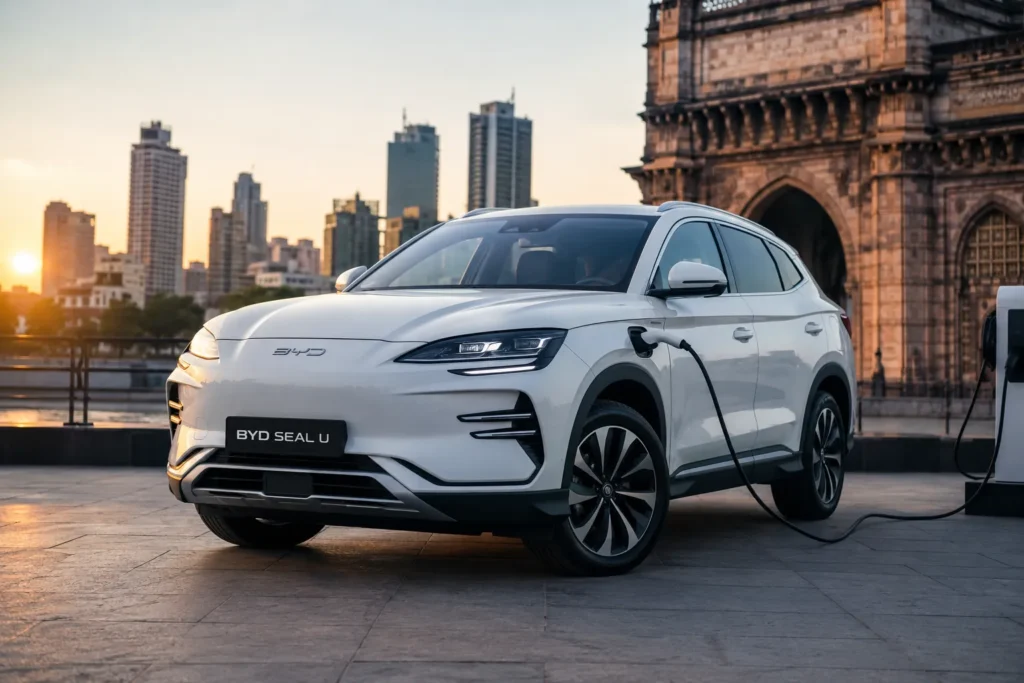
On June 9, 2026, BYD formally unveiled this technology in India. The first car to carry it will be the BYD Seal U (known internationally as the Sealion 6), expected to launch in India by late 2026 at an estimated price of ₹45–50 lakh. Before that happens, let’s deep-dive into exactly what DM-i is, why its numbers seem almost impossible, and why it matters for India specifically.
Table of Contents
What Exactly Is BYD DM-i?
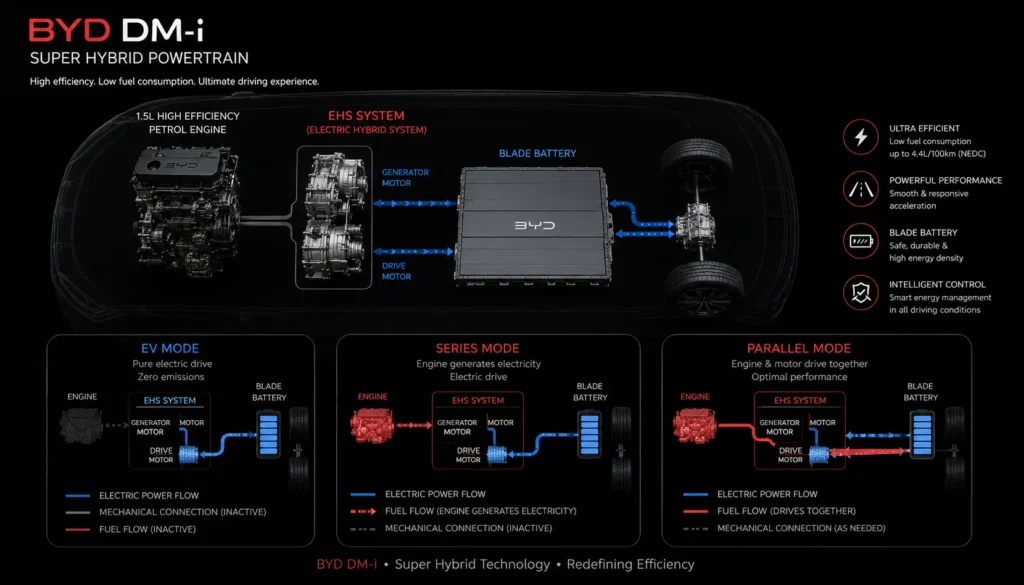
DM-i stands for Dual Mode Intelligent. The “dual mode” refers to the fact that the car can operate on two completely independent power paths — pure electric, or a combination of electric and petrol — and the “intelligent” part means the car decides which mode to use automatically, based on your speed, battery level, and driving demand.
But here’s what makes DM-i genuinely different from a Toyota hybrid or a Maruti SHVS mild hybrid: DM-i is not an electric motor helping a petrol engine. It’s a petrol engine supporting an electric motor.
In most conventional hybrids, the petrol engine does the bulk of the work. The electric motor jumps in during acceleration or at low speeds. In BYD’s DM-i, the electric motor is always the primary driver. The petrol engine’s main job is to act as a generator — producing electricity to feed the motor or recharge the battery — and only takes over driving duties in specific high-speed scenarios.
BYD developed DM technology in-house, starting with the first generation in 2008. The system has evolved through five generations, with the latest 5th Generation DM-i (also marketed as “Super DM”) launched globally in May 2024 and updated further in August 2025. It is the version coming to India.
How DM-i Is Different From Every Other Hybrid in India
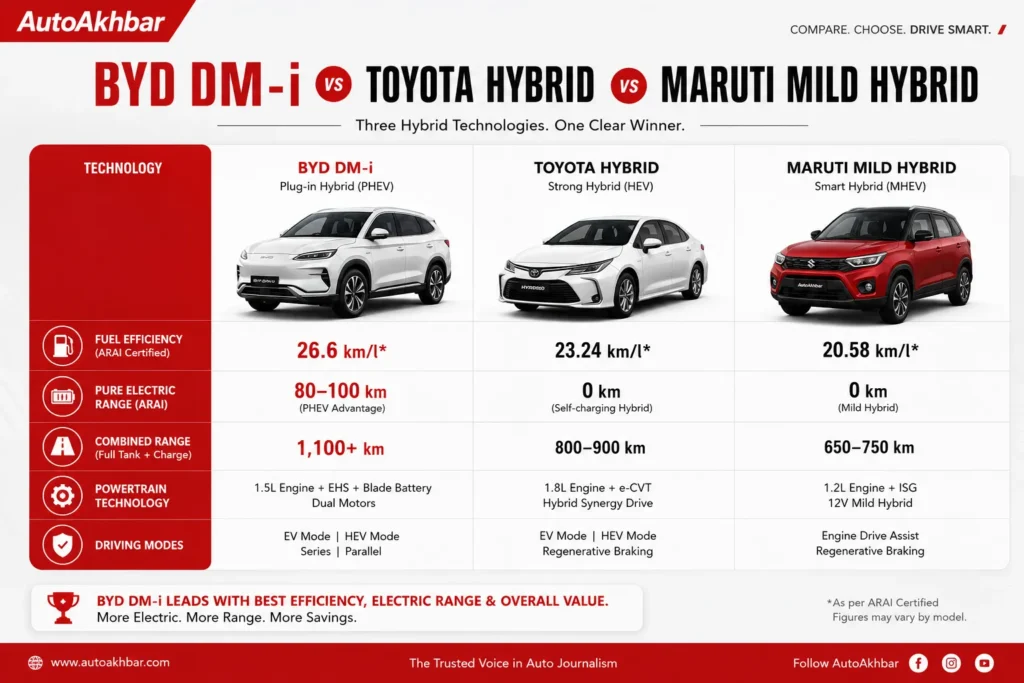
This is where it gets interesting — and a little confusing — because “hybrid” is used as a catch-all label in India for technologies that are actually very different.
| Feature | Maruti SHVS (Mild Hybrid) | Toyota Self-Charging Hybrid | BYD DM-i Super Hybrid |
|---|---|---|---|
| Can plug in to charge? | ❌ No | ❌ No | ✅ Yes (PHEV) |
| Pure EV range | 0 km | ~2 km max | 70–140 km |
| Combined total range | ~700 km | ~800 km | 1,200–2,100 km |
| Primary drive source | Petrol engine | Petrol engine | Electric motor |
| Fuel consumption | ~18–22 kmpl | ~23–28 kmpl | 2.6L/100km (~38 kmpl equivalent) |
| V2L (power external devices) | ❌ No | ❌ No | ✅ Yes |
The gap is enormous. For someone who charges at home (or at work), the DM-i essentially becomes a pure EV for daily commutes — and you only touch petrol on long highway drives. That’s a fundamentally different ownership experience.
How DM-i Works: The Three Driving Modes Explained
DM-i automatically shuffles between three distinct modes depending on conditions. You don’t manually switch — the car’s intelligent management system does it for you thousands of times during a journey.
Mode 1: Pure EV Mode
When the battery has sufficient charge and you’re driving at normal city speeds, the petrol engine stays off completely. The car runs purely on electricity from the Blade Battery through the traction motor. This is the mode you’ll spend most of your time in if you charge regularly. Silence, instant torque, zero tailpipe emissions.
Mode 2: HEV Series Mode (Range-Extender Logic)
When the battery drops below a threshold, the petrol engine starts — but it doesn’t connect to the wheels. Instead, it drives a generator (the P1 motor) that produces electricity, which then powers the traction motor. Think of it like a diesel locomotive: the engine generates power, the electric motor drives the vehicle. This mode is extremely efficient because the engine always runs at its optimal RPM range — never over-revving, never lugging.
Mode 3: HEV Parallel Mode (Highway/Performance)
At high speeds (typically above 100 km/h) or during hard acceleration — overtaking on a highway, for instance — both the petrol engine and the electric motor connect to the wheels simultaneously. This delivers maximum power and is also efficient at sustained high speeds where electric motors lose their efficiency advantage over combustion engines.
The Three Engineering Pillars: Engine, EHS & Blade Battery
DM-i’s performance is built on three core components that BYD designed entirely in-house — no parts from Bosch, no borrowed platforms from anyone.
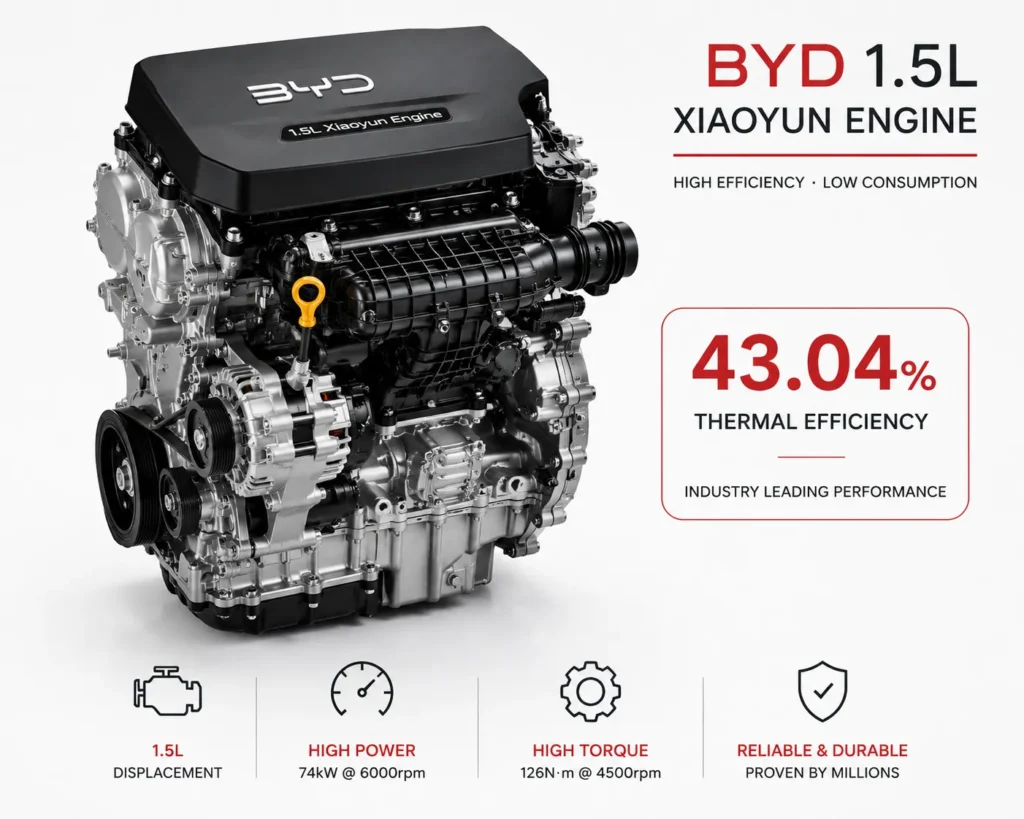
1. The Xiaoyun 1.5L Petrol Engine — A Generator, Not a Regular Engine
This is probably the most misunderstood part of DM-i. The 1.5-litre Xiaoyun engine was engineered specifically for hybrid use. It is not a conventional petrol engine adapted for a hybrid. Key differences:
- Uses an Atkinson Cycle (not Otto Cycle) for higher efficiency at the cost of lower peak power — which doesn’t matter when an electric motor handles peak demands.
- Operates in a narrow, highly efficient RPM band — it almost never revs hard.
- Thermal efficiency of 43.04% (India-spec DM-i) — compared to about 38–40% for a typical modern petrol engine. In the 5th generation global spec, this rises to 46.06%.
- Maximum power: 74 kW, peak torque: 126 Nm — modest on its own, but paired with electric motors, performance is brisk.
Higher thermal efficiency means more of the fuel’s energy becomes useful work instead of heat waste. Most great production engines sit around 40–41%. BYD pushing past 46% is a legitimately significant engineering achievement that the global automotive press has verified.
2. The EHS (Electric-Hybrid System) — The Brain
The EHS is the electro-mechanical core of DM-i. It integrates two electric motors:
- P1 motor (Generator motor): Connected to the engine, handles electricity generation and engine start.
- P3 motor (Traction motor): Drives the wheels in EV and Series mode. Up to 145 kW (194 hp) and 325 Nm, with 97.7% peak efficiency.
The EHS uses an E-CVT (no traditional gearbox) — which is why DM-i cars feel so smooth and linear. There are no gear shifts, no jerks, no delays. The system’s overall working efficiency improved from 87.6% to 92% in the 5th generation, and power density went from 65 kW/L to 75 kW/L.
3. The Blade Battery (LFP Chemistry) — The Safety Vault
The India-spec Seal U DM-i will carry an 18.3 kWh Blade Battery — a version optimised for high-power hybrid applications rather than the larger packs used in BYD’s pure EVs.
Also Read : BYD’s Gen 2 Blade Battery: A Game-Changer for the EV Industry in 2025
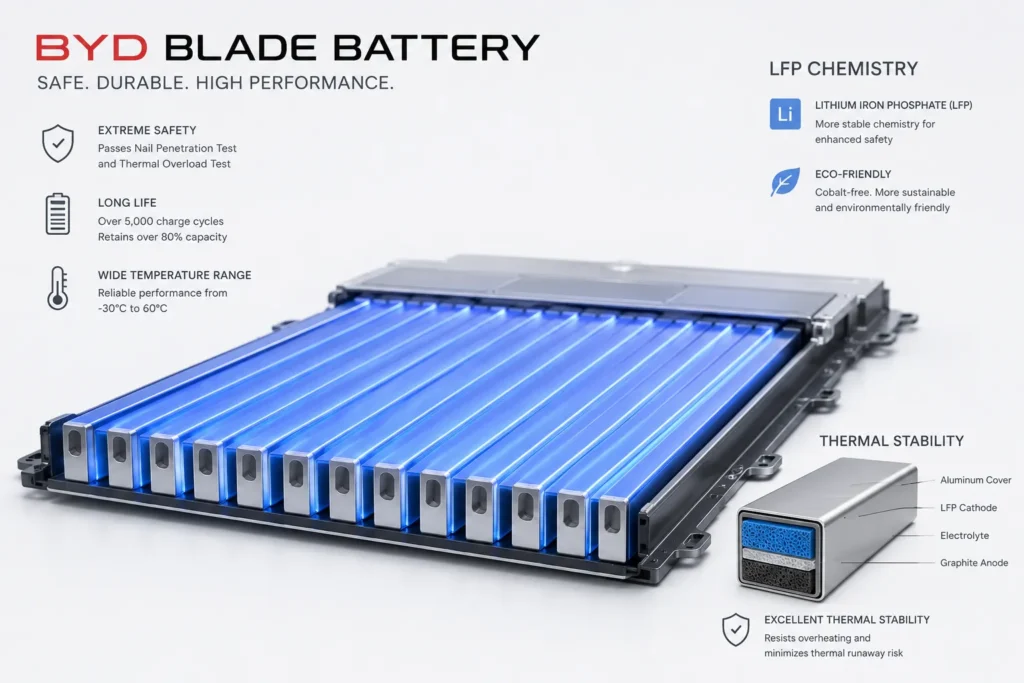
BYD’s Blade Battery uses LFP (Lithium Iron Phosphate) chemistry. Key reasons why this matters:
- No cobalt — more sustainable and far cheaper to produce.
- No thermal runaway — LFP cells do not catch fire the way NMC cells in many other EVs can. The Blade Battery has passed nail penetration, crush, and rollover tests without igniting.
- Longer cycle life — LFP chemistry lasts significantly more charge cycles than NMC.
- Supports V2L (Vehicle-to-Load) — you can use the car to power external devices, appliances, or even run a fan in a power cut.
5th Generation DM-i: The 2024–2026 Upgrade That Changed Everything
BYD launched the 5th Generation DM-i in May 2024 with two new models — the Qin L DM-i and Seal 06 DM-i — and it immediately set new global benchmarks that no rival has matched since. Here’s what changed:
| Spec | 4th Gen DM-i | 5th Gen DM-i (2024) | 5th Gen Updated (Aug 2025) |
|---|---|---|---|
| Engine Thermal Efficiency | ~43% | 46.06% | ~47%+ range |
| Fuel consumption (NEDC) | ~3.8L/100km | 2.9L/100km | 2.6L/100km |
| Combined range (full tank + full battery) | ~1,200 km | 2,100 km | 2,100 km+ |
| EHS working efficiency | 87.6% | 92% | 92%+ |
| 0–100 km/h (performance variant) | ~8 sec | 7.5 sec (base) / 5.9 sec (AWD) | Same |
The August 2025 update was particularly impressive — BYD pushed the fuel consumption down from 2.9L to 2.6L per 100km through an OTA (over-the-air) software update. Yes, they improved fuel efficiency wirelessly, like a software patch on your phone. This update was certified by China’s National Automotive Quality Inspection and Testing Center.
BYD has invested over ₹1.15 lakh crore (CNY 140 billion) in R&D since 2000, with a team of 100,000+ engineers. DM-i is what that investment looks like in practice.
The 5th Gen also introduced a global first in October 2025 — BYD launched a biofuel-compatible DM-i variant for Brazil, running on ethanol blends. This shows the architecture’s versatility — a hint that flex-fuel compatibility could theoretically come to India too, given the government’s push for E20 and E85 ethanol blending. (Read our complete guide to E85 flex fuel in India to understand why this matters.)
What DM-i Feels Like in Real Life
Numbers are numbers, but what does DM-i actually feel like behind the wheel? Based on international reviews and test drives:
- Dead silent in the city: In EV mode, the experience is identical to driving a pure BEV. No engine noise, no vibration, instant torque from zero.
- The engine start is almost unnoticeable: When the petrol engine kicks in, it doesn’t jolt the car. It slides in so smoothly that many drivers don’t realise it has happened. This is by design — the EHS absorbs the transition.
- No range anxiety: With 1,200 km (India spec Seal U) to 2,100 km of combined range, there is no equivalent to the “am I going to make it?” anxiety that pure EV drivers sometimes feel on long trips.
- Real-world fuel consumption: Independent tests with a depleted battery returned about 4.2L/100km in mixed driving — much higher than the lab-perfect 2.6L, but still exceptional for a vehicle this size. Charge it regularly and you’ll mostly never need petrol.
- Regenerative braking: DM-i recovers energy during braking and downhill driving. On a 10 km downhill stretch, testers saw the battery gain 4% charge just from regen.
BYD DM-i in India: Seal U Launch Details, Price & Rivals
BYD confirmed on June 9, 2026, that the Seal U (also known as Sealion 6) will be the first DM-i model to launch in India. Here’s everything confirmed:
| Specification | Details (India Spec) |
|---|---|
| Expected Launch | Late 2026 (December 2026) |
| Expected Price | ₹45–50 lakh (ex-showroom) |
| Engine | 1.5L turbo-petrol (DM-i Xiaoyun) |
| Battery | 18.3 kWh Blade Battery (LFP) |
| EV-only range | ~70 km (India claim) |
| Total combined range | 1,200+ km |
| Max power (AWD) | Up to 344 bhp / 550 Nm |
| 0–100 km/h | As low as 5.9 seconds |
| Dimensions | 4,775mm L × 1,890mm W × 1,670mm H, 2,765mm wheelbase |
| Key Features | 15.6″ rotating touchscreen, 19″ alloys, vegan leather, Infinity audio, 360° camera, ADAS, V2L |
| Main Rivals | Jetour T2 PHEV, Toyota Fortuner, Volkswagen Tayron, Skoda Kodiaq |
The Seal U will be the first PHEV in India to offer genuine V2L capability — meaning you can run a fan, charge your laptop, or even power a small appliance directly from the car’s battery. Given India’s power supply reliability issues in many regions, this is a quietly useful feature.
BYD currently has 48 showrooms across 40 Indian cities and has crossed 14,000 customers. The Seal U adds a completely new segment — premium PHEV SUV — that no Indian brand currently serves at this technology level.
Also, if you’re curious about BYD’s current India EV lineup before the PHEV arrives, check out our BYD Sealion 7 review — the Seal U will look almost identical on the outside, except for a functional grille at the front.
Should You Wait for the BYD Seal U DM-i?
If you are in the market for a premium SUV in the ₹45–55 lakh range — yes, absolutely wait and test-drive it before deciding.
Wait for it if:
- You have a parking space at home or office with a power socket (charging is just 16A domestic)
- Your daily commute is under 70 km — you’ll rarely use petrol
- You do occasional long interstate highway trips — the 1,200 km combined range handles those easily
- You want a smooth, EV-like experience without the range anxiety of a pure EV
Consider alternatives if:
- You have no home charging option — without regular charging, DM-i’s main advantage disappears, and it becomes an expensive petrol car
- You need ground clearance for serious off-roading — the Seal U is an urban SUV, not a trail-basher
- Your budget is below ₹40 lakh — at that point, a well-specced Toyota Hyryder or Maruti Grand Vitara strong hybrid makes more sense
One last thing worth mentioning: BYD is also expected to bring the Atto 2 DM-i to India eventually — a more compact SUV with DM-i technology, which would put a sub-₹30 lakh PHEV in reach of a much wider audience. That would genuinely change India’s hybrid market.
For now, if you want the most advanced plug-in hybrid technology available in India in 2026, BYD’s DM-i Super Hybrid in the Seal U is the clear answer. Nothing else comes close on paper — and increasingly, nothing comes close in real life either.
Sources: BYD India official announcement (June 9, 2026), Autocar India, CarWale, DriveSpark, MarkLines Automotive Industry Portal, BYD Europe official website, EV.com, Autocar India Seal U preview. All technical specifications are as per publicly available information at time of writing.
🌐 External Links Used in Article (authoritative sources)
- BYD Europe official DM-i page:
https://www.byd.com/eu/technology/byd-super-dm-plug-in-hybrid-technology - Autocar India — Seal U preview:
https://www.autocarindia.com/car-news/byd-seal-u-india-launch-by-end-2026-with-phev-powertrain-439917 - DriveSpark — DM-i 5 things:
https://www.drivespark.com/four-wheelers/2026/byd-dm-i-technology-india-top-5-things-to-know-086127.html
FAQ BYD DM-i Super Hybrid
What does DM-i stand for in BYD?
DM-i stands for Dual Mode Intelligent. The “dual mode” refers to the car’s ability to run on pure electric power or a combination of electric and petrol, while “intelligent” means the car’s onboard system automatically selects the optimal mode based on speed, battery level, and driving demand — without any input from the driver.
What is the fuel efficiency of BYD DM-i Super Hybrid?
The 5th Generation BYD DM-i achieves 2.6 litres per 100km fuel consumption (NEDC standard, updated August 2025) when the battery is depleted. If you charge regularly, the fuel cost for daily commuting can drop close to zero since the car runs on pure electric power for city driving. Combined range on a full battery and full fuel tank is up to 2,100 km in global variants.
What is the difference between BYD DM-i and a Toyota self-charging hybrid?
The fundamental difference is who’s in charge. In a Toyota self-charging hybrid (like the Hyryder), the petrol engine is the primary driver and the electric motor assists. In BYD DM-i, the electric motor is always the primary driver and the petrol engine mainly generates electricity. BYD DM-i is also a plug-in hybrid (you can charge it from a socket), while Toyota’s self-charging hybrid cannot be plugged in. BYD DM-i offers 70–140 km of pure electric range; Toyota hybrids offer near zero.
When is BYD Seal U DM-i launching in India?
BYD has confirmed the Seal U DM-i (also known as Sealion 6 in some markets) will launch in India by December 2026. It will be BYD’s first plug-in hybrid model in India and is expected to be priced between ₹45–50 lakh (ex-showroom).
Does BYD DM-i require special charging infrastructure?
No. The BYD Seal U DM-i can be charged using a regular 16A domestic socket — the same socket used for air conditioners or geysers. No special charging station is required, though using a dedicated home charger or AC fast charger (like those found at malls and offices) will reduce charging time significantly.
What is BYD Blade Battery and is it safe?
BYD Blade Battery uses Lithium Iron Phosphate (LFP) chemistry and is known for exceptional safety. It has passed extreme tests including nail penetration, crush, overcharging, and rollover tests without catching fire or emitting smoke. Unlike NMC batteries used in some rivals, LFP chemistry does not experience thermal runaway — making it one of the safest battery technologies in any vehicle today.
Can BYD DM-i work without charging (if I don’t plug in)?
Yes. BYD DM-i functions perfectly without ever plugging in — it will simply behave more like a traditional fuel-efficient petrol car, with the engine charging the battery on the go. However, this means missing out on the biggest advantage: near-zero running cost for daily commutes. The system is designed to reward regular charging but penalises no one for skipping it.
What is the thermal efficiency of BYD’s DM-i engine?
The India-spec DM-i system uses the Xiaoyun 1.5L petrol engine with a thermal efficiency of 43.04%. The global 5th Generation DM-i (which will likely come to India over time) has an engine thermal efficiency of 46.06% — the highest of any production engine in a plug-in hybrid globally, later improved to approximately 47% in the August 2025 update.