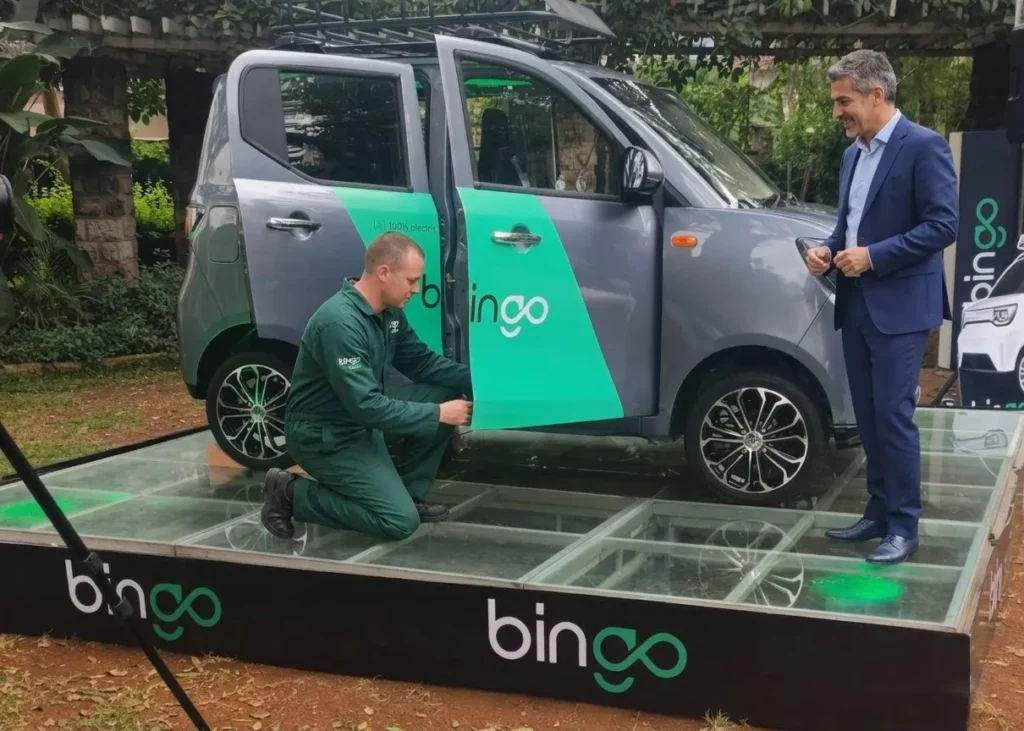

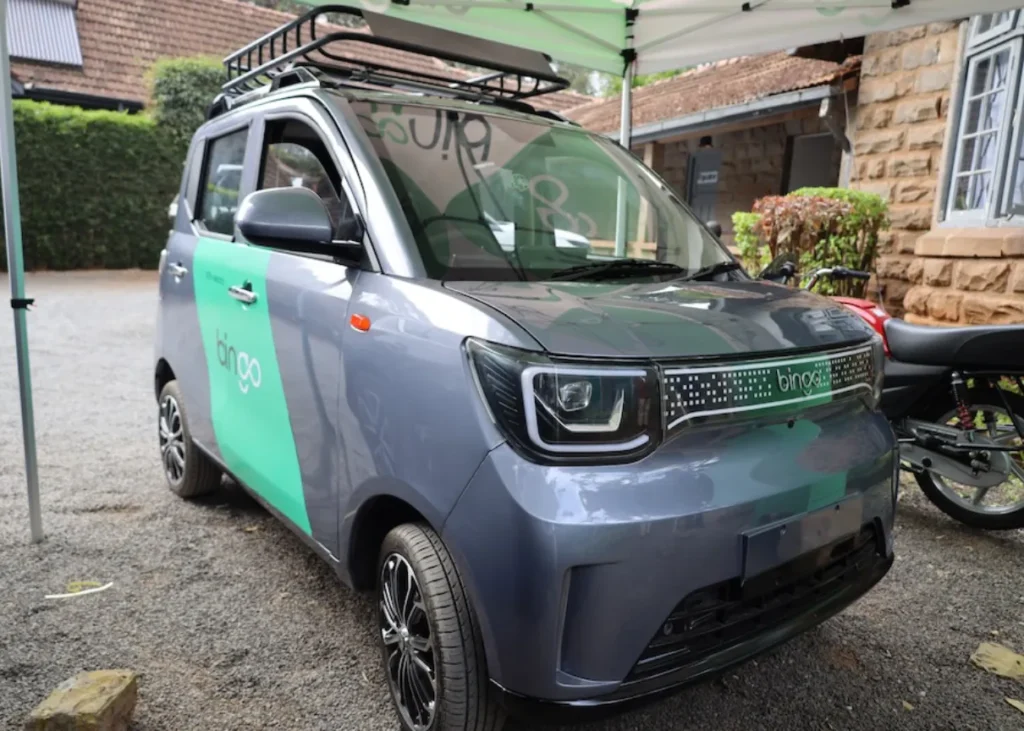
The Bingo E2 is a tiny four-seat electric car with a claimed 440 km range, a price tag of about Ksh 1.8 million (roughly $12,000), and a very specific job: keeping Uber-style drivers earning instead of waiting at chargers. The California-based startup unveiled it in Nairobi on July 28, 2026, and Kenya is the first market for what Bingo calls a complete ecosystem for ride-hailing and delivery drivers, not just a car.
Table of Contents
Quick Verdict: Who Is the Bingo E2 For?
- Who should buy: Ride-hailing and delivery drivers, and fleet owners who want to put a vehicle on the road through a managed operator.
- Who should skip: Families, highway commuters and anyone who wants a regular private car. This is a micro EV built for city work.
- The biggest compromise: The headline range depends on the swappable battery network, which Bingo is still building.
- Autoakhbar value view: On paper, a strong price for the job. Real-world proof will come once units are on the road.
The Dual-Battery Idea Explained
The E2 uses two battery systems. According to The Standard, a fixed battery is claimed to give 310 km and a swappable battery adds another 130 km, which is how Bingo reaches the 440 km total. ZAG Daily reports a 31 kWh main battery plus a secondary system made of four swappable modules. Capital FM also describes the second system as four swappable packs.
The logic is simple. A driver who runs out of the swappable portion can exchange packs instead of sitting on a charger, so the car stays earning. The E2 can also use public charging stations and supports car-to-car charging between E2 vehicles, as Business Daily reported.
Specs: Paper Claims vs What to Expect
| Parameter | Claimed spec | What to watch for |
|---|---|---|
| Range | Up to 440 km (310 km fixed + 130 km swappable) | Claimed figure; real range with AC, passengers and traffic will be lower |
| Battery | 31 kWh main battery + four swappable modules | Swap-station coverage decides how useful the extra range is |
| Top speed | 90 km/h | Fine for city use, limited for highways |
| Size and class | About 3 metres long, L7e micro EV, four seats | Business Daily notes it is designed to carry three passengers |
| Safety tech | Five-camera surveillance system | Crash-safety ratings have not been published |
| Price | Ksh 1.8 million (about $12,000) | Swap charges are not announced yet |
Price and the Business Model
Money254 reports the E2 is priced at Ksh 1.8 million, below several EVs now sold in Kenya. Bingo says drivers can buy it outright, use lease-to-own financing, or rent short-term, with charging, insurance and trade-in services handled through local partners, according to ZAG Daily.
Business Daily adds that Bingo keeps ownership of the removable battery packs to bring down the purchase price, similar to the model electric motorcycle companies already use in Kenya. The company had not announced what a battery swap will cost at the time of that report, and that number will matter a lot to a driver working out daily profit.
Fleet OS: Own an E2 From Anywhere
Alongside the car, Bingo launched a cloud-based Fleet Operating System. Money254 explains that fleet owners anywhere in the world can buy an E2, assign it to a vetted local driver and watch its performance from a phone. ZAG Daily says more than 7,500 assets, including two-wheelers, swappable batteries and swap cabinets, are already connected to the platform.
Also Read : Wuling Air EV 2026: New Aira EV Is Rp 59 Million Cheaper
Production and Sales Targets
Capital FM reports that Bingo plans to import 10 to 20 vehicles first, then begin assembly in Nairobi by December, starting with 100 units. The company is aiming for 1,500 sales in 2027 and 10,000 EVs on Kenyan roads by the end of 2028.
Note that reports differ on the details. Business Daily earlier mentioned local assembly from January at the AVA plant in Mombasa, while Capital FM says Nairobi by December. We will update this post when Bingo confirms the final plan.
The Deal-Breakers to Think About
- Infrastructure risk: Swap stations, DC fast chargers and roadside battery support are planned, not yet widespread.
- Unknown swap costs: Cheaper purchase price can be offset by recurring battery fees.
- New brand: No long-term reliability, spare-parts or resale track record in Kenya yet.
- Limited speed and size: A 90 km/h top speed and micro-car dimensions suit city jobs, not long trips.
Autoakhbar Bottom Line
The Bingo E2 is less about the car and more about the economics behind it. If swap stations and pricing arrive as promised, it could cut downtime and fuel spending for Kenyan drivers. Until real owners share range, battery fees and reliability numbers, treat the 440 km figure as a company claim, not a guarantee.
FAQ Bingo E2 EV
What is the Bingo E2 range?
Bingo claims up to 440 km using a 310 km fixed battery and a 130 km swappable battery.
What is the Bingo E2 price in Kenya?
It is priced at Ksh 1.8 million, which is about $12,000.
Who is the Bingo E2 designed for?
It is built for ride-hailing and last-mile delivery drivers, plus fleet owners using Bingo’s Fleet OS.
When will the Bingo E2 be built in Kenya?
Capital FM reports assembly in Nairobi by December, starting with 100 units, after an initial import of 10 to 20 vehicles.
Sources
- Capital FM: California EV startup Bingo enters Kenya with battery-swapping cars
- The Standard: Firm unveils AI-powered electric taxi for ride-hailing market
- Business Daily Africa: New firm targets taxi drivers with Sh1.8m electric vehicle
- Money254: Bingo launches Ksh1.8M dual-battery electric car
- ZAG Daily: Bingo unveils micro EV for Africa’s ride-hailing market