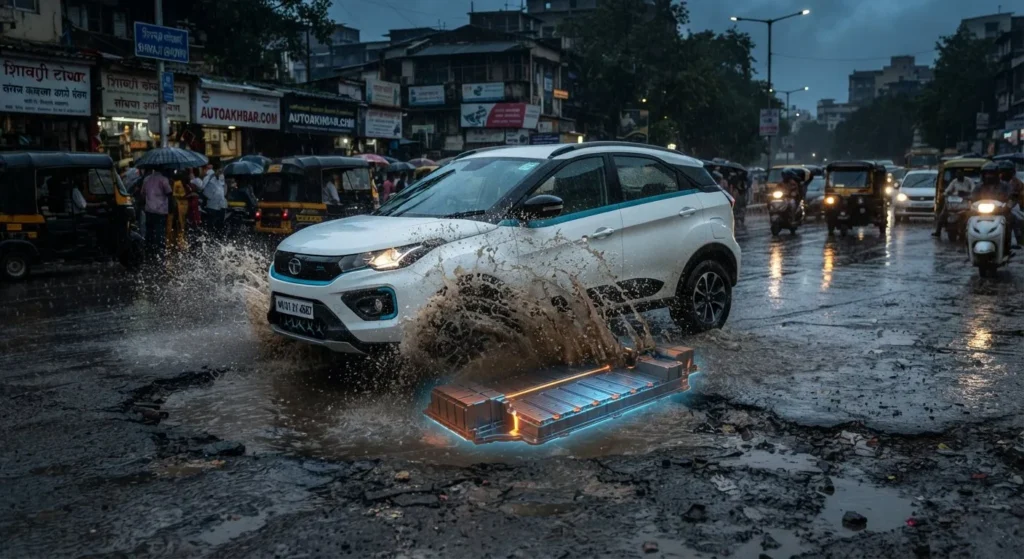

A pothole hit that costs a petrol car a few tens of thousands of rupees can push an electric car into “total loss” territory. The reason is not that EVs are fragile. It is that the most expensive part of an EV sits flat on the floor, is often sealed into the body, and cannot be inspected or fixed in an ordinary garage. When an insurer cannot tell whether that battery is safe, writing the car off is the cheaper decision.
Autoakhbar Quick Verdict
- Who should still buy an EV: City commuters who park at home, charge cheaply and ask the right repair and insurance questions before signing.
- Who should think twice: Buyers who treat running cost per km as the only number, and heavy-use fleet or delivery riders who face higher claims risk.
- The biggest compromise: A low-speed underbody hit can become a battery-pack problem, not a bumper problem.
- Risk level: Moderate for private owners, higher for commercial use. It is manageable if you check battery design and insurance cover first.
Table of Contents
Why a small crash becomes a big bill
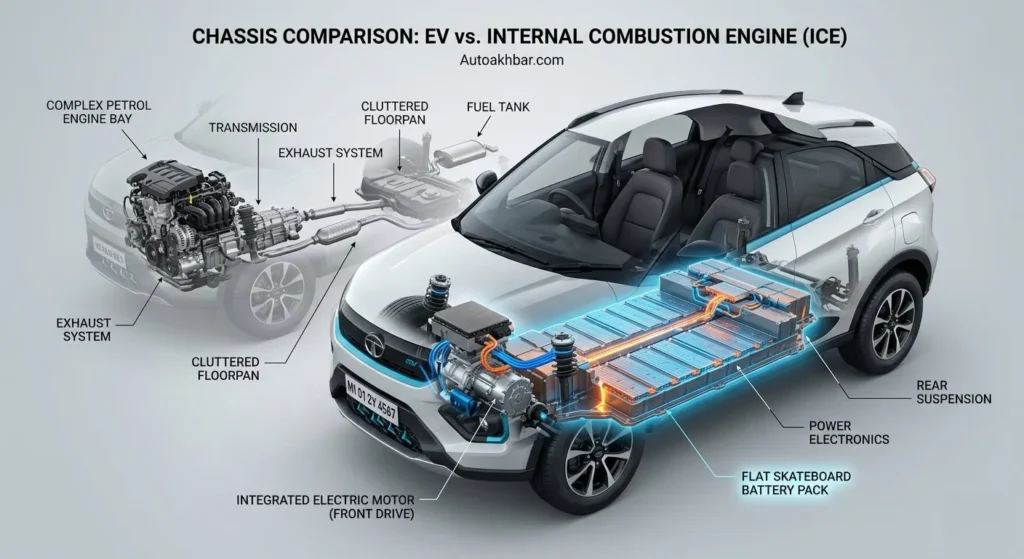
In a petrol car, the engine sits high behind the bonnet with some underbody protection. In an EV, the battery is a thin, heavy slab running across the bottom of the car. On Indian roads, that is exactly where potholes, speed breakers and waterlogged patches strike first.
The battery is also the costliest component. It is commonly estimated at 40-60% of an EV’s price, depending on pack size. So even minor damage to the pack can mean a repair estimate that looks frightening next to the car’s market value.
Sealed packs: cheaper to build, harder to fix
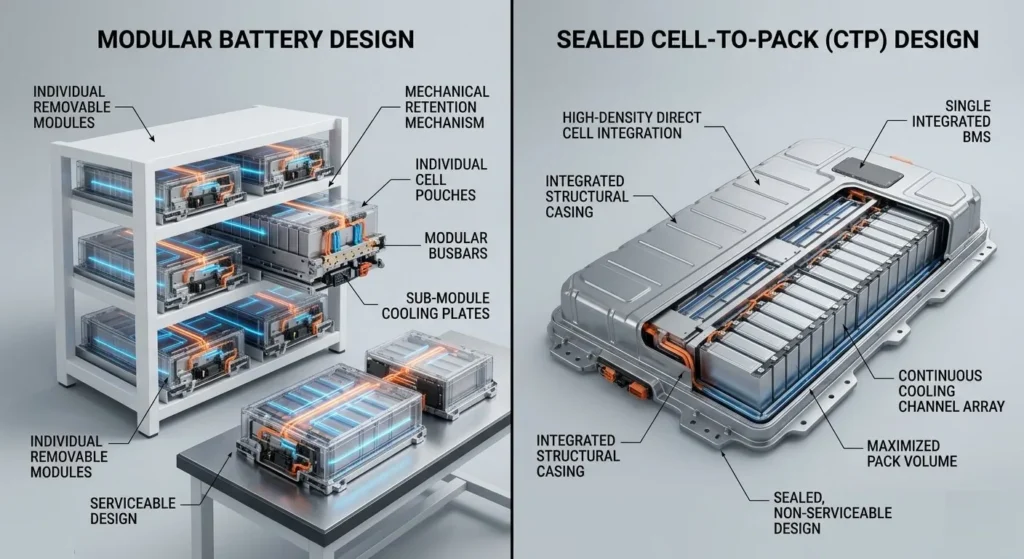
Older EVs often used packs made of removable modules. If a few cells failed, a technician could replace a module. Many newer designs use cell-to-pack or structural battery packs, where cells are built straight into a single unit and sometimes into the car’s structure. This removes parts, weight and assembly time, which lowers the maker’s cost.
The trade-off lands on the owner. If no garage can open the pack, nobody can verify which cells are fine. Not every EV is built this way, and some makers, including Ford, have been making packs easier to repair, according to a Fleet News report on the Reuters investigation. That same report quotes industry sources describing some structural packs as having “zero repairability.”
Why insurers choose “total loss”
After a crash, a damaged lithium-ion battery can carry a delayed fire risk, and the tools to test cells inside a sealed pack are mostly in specialist labs, not roadside workshops. Insurers are left with two options: accept the risk and pay for any later fire, or declare the car a total loss. Most pick the second.
The result can be wasteful. Salvage firm Synetiq told Reuters that at least 95% of cells in the stored battery packs at its Doncaster yard were undamaged and reusable, as reported by Fleet News. The cars were written off because nobody could prove that.
Petrol vs EV after the same pothole hit
| Factor | Petrol car | EV with sealed pack |
|---|---|---|
| Most expensive part | Engine, high up and shielded | Battery slab on the floor |
| Typical outcome | Garage repair, car back on the road | Pack inspection, possible replacement or total loss |
| Damage check | Visual and mechanical, any workshop | Needs specialist diagnostics |
| Insurer risk view | Predictable | Uncertain, with fire concern |
The insurance side: who really pays
Quotes for EVs commonly run higher than for comparable petrol cars on the own-damage portion, because that premium follows the vehicle’s value and repair risk. The regulator’s 15% discount on EV third-party premiums helps, but third-party is a small slice of the bill.
Two gaps catch owners out. Water damage, such as driving through a flooded road in monsoon, usually needs an add-on, and zero-depreciation covers can treat batteries differently from the rest of the car. Read the battery clause line by line.
The UK’s Thatcham Research found EV claims were 25.5% costlier and took 14% longer to repair than petrol equivalents, as reported by News24. Hertz’s CEO said collision repairs on an EV can run about twice those on a comparable petrol car, and the company expected about $245 million in depreciation losses on the 20,000 EVs it planned to sell, per CNN via ABC7. That works out to roughly $12,250 per vehicle.
Aloso Read : Jaguar Type 00 vs Type 01: What Changed From Concept to Production
China shows where this is heading
China insures more EVs than any other market, and it is struggling too. Insurers lost about 5.7 billion yuan ($802 million) underwriting new energy vehicle policies in 2024, with a combined ratio near 107%, according to Bloomberg data republished by Carrier Management. A ratio above 100% means insurers paid out more than they collected. In the same report, EV owners were about twice as likely to file claims. Ping An said its EV book was profitable, so pricing carefully clearly helps.
A fix may be coming: repair, not replace
CATL, the world’s largest EV battery maker, runs a repair network called Ning Service. It says cell-level repair of cell-to-pack batteries can cost 10-20% of a full replacement, per New Mobility, and it plans to reach 100 cities worldwide by the end of 2026, according to Notebookcheck. These are the company’s own claims and nothing like this is confirmed for India yet. If it scales, insurers could price EVs lower. It also raises a question for independent mechanics, who may be shut out if only the battery maker can repair the pack.
Deal-breakers sales reps rarely mention
- Battery repairability: Ask whether the pack is modular or structural, and who is authorised to repair it.
- Underbody protection: Ask about the guard under the pack and ground clearance, then judge it against your own roads.
- Insurer behaviour: Ask insurers whether battery damage typically goes to repair or total loss under their policy.
Before you buy: a 5-point checklist
- Compare insurance quotes for the exact variant, not just the sticker price.
- Add flood or water-ingress cover if you drive in monsoon cities.
- Read how the policy treats battery depreciation.
- Ask the dealer for a written battery repair and replacement cost.
- Search owner forums for crash and underbody-damage claims on that model.
Autoakhbar Bottom Line
EVs are not unsafe, and cheap running costs are real. But the sticker price and cost per km hide a risk that appears only after a crash: the battery was built for the manufacturer’s cost sheet, not for your repair bill. Buy one if the numbers still work after you factor in insurance and repairability, and walk away from any dealer who cannot answer the battery questions above.
FAQ EVs Get Scrapped
Why do insurers declare EVs a total loss after minor accidents?
If the battery may be damaged and cannot be tested affordably, insurers fear delayed fires and costly pack replacement. Writing the car off is often the safer financial call.
Are all EV batteries impossible to repair?
No. Some packs are modular and allow module replacement, while cell-to-pack and structural designs are harder to open. Check the design for your exact model.
Does EV insurance cover battery damage in India?
Accident damage is covered under a comprehensive policy, but water damage usually needs an add-on and depreciation rules may differ for the battery. Always read the policy wording.
Should I avoid buying an EV because of this?
Not necessarily. Compare insurance quotes, battery design and repair options first, so the total cost of ownership is clear before you buy.