
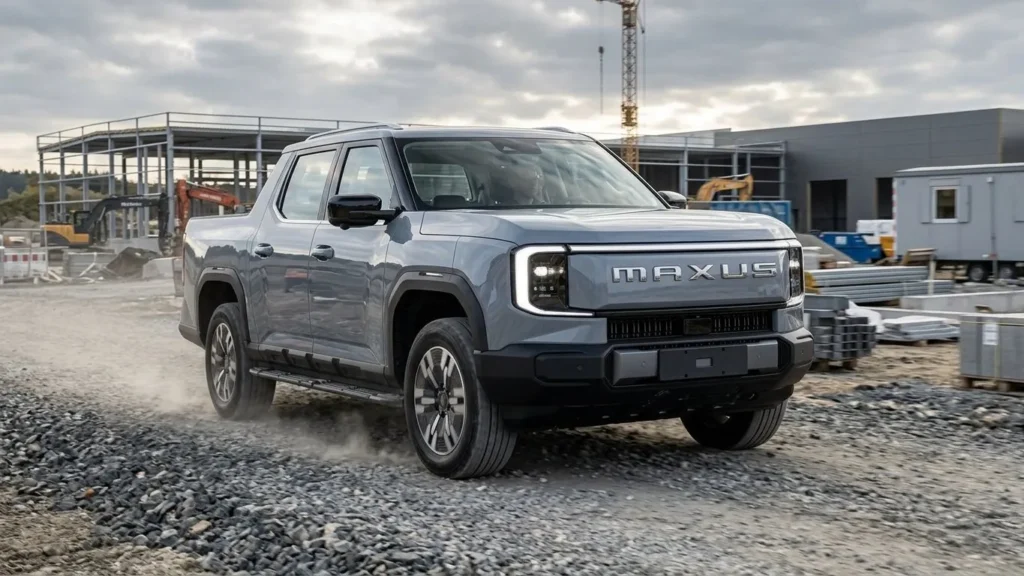
By Mukul Dev Sachar, Editor, AutoAkhbar.com | Fact-checked and updated: Oct 01, 2026
A 442-horsepower electric pickup truck with air suspension and a 0-60 mph time that embarrasses hot hatches sounds brilliant in a press release. But talk to any working tradesperson on a rainy Tuesday morning in Leeds or Munich, and they’ll ask you just one simple question: “Can it carry a standard one-tonne pallet of cement without breaking the law?” The brutal answer for the Maxus eTerron 9 is no. Behind all the futuristic sheet metal, high-voltage marketing, and details from its official SAIC Maxus European showcase, lies a 2.88-tonne beast trapped by its own battery weight.
When SAIC Maxus rolled out the primitive, rear-wheel-drive T90 EV back in 2022, fleet buyers rightfully dismissed it as a half-baked compliance vehicle. The eTerron 9 was built to prove Chinese manufacturing could build a genuine heavy-duty workhorse. Yet in a European market strictly governed by 3,500 kg gross vehicle weight (GVW) limits on standard driving licences, that massive 102 kWh battery pack creates a bizarre legal penalty that could break its commercial utility on day one.
Table of Contents
Autoakhbar Quick Verdict
- 🚗 Target Buyer: Lifestyle pickup buyers, commercial site managers, and eco-conscious businesses operating primarily within regional urban zones who can claim VAT and benefit-in-kind (BIK) tax relief.
- ❌ Who Should Skip: Heavy haulers who regularly load pallets of bricks, aggregate, or heavy machinery directly into the cargo bed.
- ⚠️ The Big Compromise: A restricted certified payload of around 620 kg—trailing far behind the 1-tonne benchmark set by traditional diesel pickups like the Ford Ranger or Toyota Hilux.
- ⭐ Value Index: 7.2 / 10 (Incredible cabin refinement and genuine 3.5T braked towing, but a starting price north of £60,000 makes it a tough pill to swallow).
Specs & The Commercial Reality Check
On paper, the eTerron 9 shames virtually every internal-combustion truck on European roads in pure sprint pace and equipment, but commercial payload maths tell the harder story:
| Specification | Maxus eTerron 9 | Typical Diesel Rival (e.g. Ford Ranger) | The Reality Check |
|---|---|---|---|
| Powertrain / Output | Dual Motor AWD (442 hp / 325 kW) | 2.0L – 3.0L Turbo Diesel (205–240 hp) | The Maxus offers savage acceleration (0-62 mph under 6 sec). |
| Battery / Claimed Range | 102 kWh LFP (267 miles WLTP) | ~80L Diesel Tank (450–550 miles) | Real-world winter highway range drops closer to 180–200 miles. |
| Braked Towing Capacity | 3,500 kg (3.5 tonnes) | 3,500 kg | Matches diesel parity, but towing heavily tanks battery consumption. |
| Payload Capacity | ~620 kg | 1,000 kg – 1,060 kg | The Achilles heel: Cannot carry standard heavy industrial loads legally. |
Performance, Battery & Highway Consumption
Motive power comes from a front 170 hp motor coupled with a 272 hp rear motor, providing true all-wheel traction. The torque delivery is instantaneous, transforming this 5.5-metre behemoth into an absurdly swift machine off the line. Furthermore, multi-link rear suspension paired with air springs gives it unladen ride quality that leaf-sprung diesel trucks simply cannot touch.
However, physics cannot be cheated. Real-world testing (including independent European cold-weather 1,000 km trials) highlights an average consumption around 38 to 40 kWh per 100 km at motorway speeds. With a 102 kWh battery, sustained 70 mph driving yields roughly 170 to 190 miles of usable range between stops. While 115 kW peak DC fast-charging takes you from 20% to 80% in approximately 40 minutes, it remains noticeably behind the lightning-fast 800V architectures powering modern passenger EVs.
Cabin Comfort & Everyday Practicality
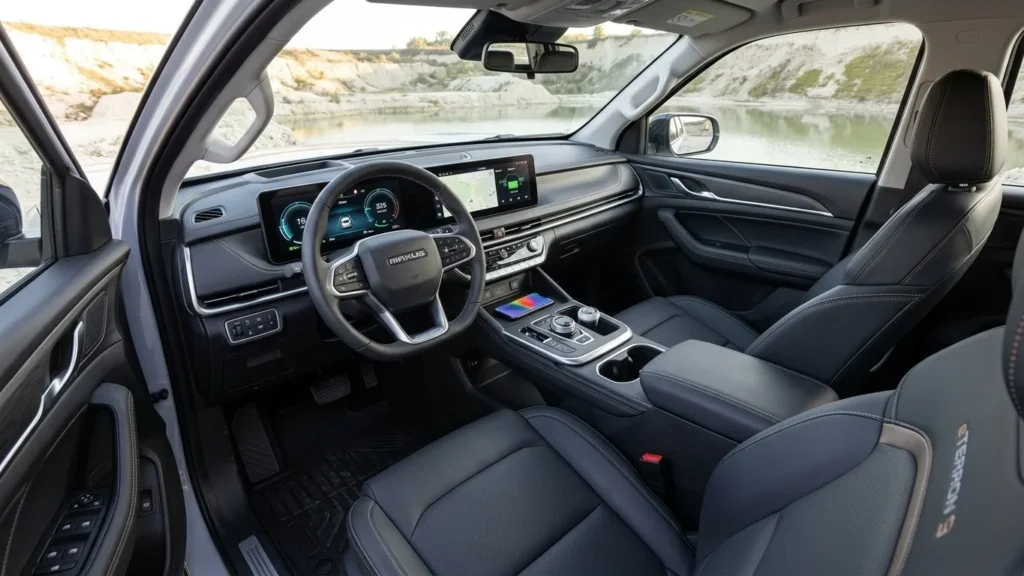
Step inside, and you would be forgiven for thinking you entered a premium executive SUV rather than a utility pickup. Dual floating digital screens dominate the dashboard, backed by responsive software, a 360-degree camera system, and hard-wearing yet soft-touch cabin materials. Crucially, unlike controversial cabin shifts seen in cars like the new 2027 BMW 3 Series redesign where essential buttons were purged, Maxus smartly preserved a dedicated panel for vital climate controls below the display.
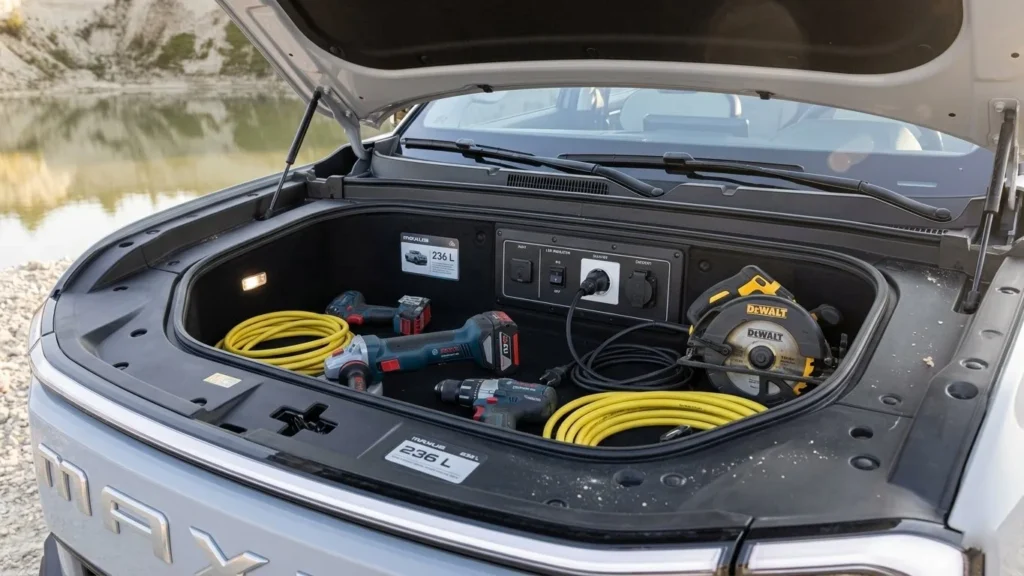
Practicality perks include a spacious 236-litre illuminated frunk under the front bonnet—ideal for locking away expensive power tools or charging cables—and bidirectional Vehicle-to-Load (V2L) outlets delivering up to 6.6 kW to run heavy on-site equipment.
The Deal-Breakers: What Most Reviews Won’t Tell You
- The 620 kg Payload Trap: Let’s do the real-world site maths that Maxus’ marketing team won’t put on a billboard: The truck weighs 2,880 kg. To keep it legal on a standard car driving licence, the gross limit is 3,500 kg. That leaves you roughly 620 kg. Put two burly 95 kg groundworkers in the front seats, toss their muddy toolbags and a dog in the back, and your legal payload shrinks to barely 400 kg. In plain English? A £60,000 work truck that gets legally overloaded by half a pallet of gravel or a modest stack of timber—raising severe tax classification issues under HMRC commercial vehicle tax guidelines.
- Over-Zealous Driver Monitoring: The camera sensor module mounted on the steering column frequently flashes false warnings if you rest a hand at the top of the wheel, requiring regular manual deactivation through menus.
- Slow DC Peak Curve: In a world where commercial operators prioritize minimum downtime, the 115 kW peak charging ceiling means cross-country haulage requires calculated, extended charging stops.
Autoakhbar Bottom Line
Here is the cynical reality: The eTerron 9 is a marvel of Chinese EV engineering, but it solves a problem most tradespeople didn’t have while creating two massive new ones. Similar to what we analyzed in our 2026 Toyota RAV4 PHEV price review, high upfront ticket prices and tax threshold traps can quickly sour the value proposition for buyers trying to balance real-world running costs against utility.
If you are a site director who wants to claim massive BIK business-tax write-offs and occasionally power a circular saw from the bed to impress clients, buy it. But if your truck’s primary job is hauling heavy steel, towing horseboxes through winter muck, and taking a daily beating without spreadsheet anxiety over legal payload caps—cancel the deposit. The trusty diesel Hilux isn’t losing its crown today.
Frequently Asked Questions
What is the real-world range of the Maxus eTerron 9?
While Maxus claims up to 267 miles on the official WLTP cycle, real-world mixed driving delivers roughly 210–230 miles in mild weather, and approximately 175–190 miles at continuous motorway speeds or during colder winter conditions.
Can the Maxus eTerron 9 carry 1 tonne of payload?
No. Due to its 2,880 kg kerb weight and the 3,500 kg gross vehicle weight (GVW) ceiling for standard European driving licences, the certified payload is capped at approximately 620 kg.
Can the Maxus eTerron 9 tow a 3.5-tonne trailer?
Yes. Unlike earlier electric pickups, the eTerron 9 is rated for a full 3,500 kg (3.5T) braked towing capacity, though heavy towing will significantly accelerate battery consumption.