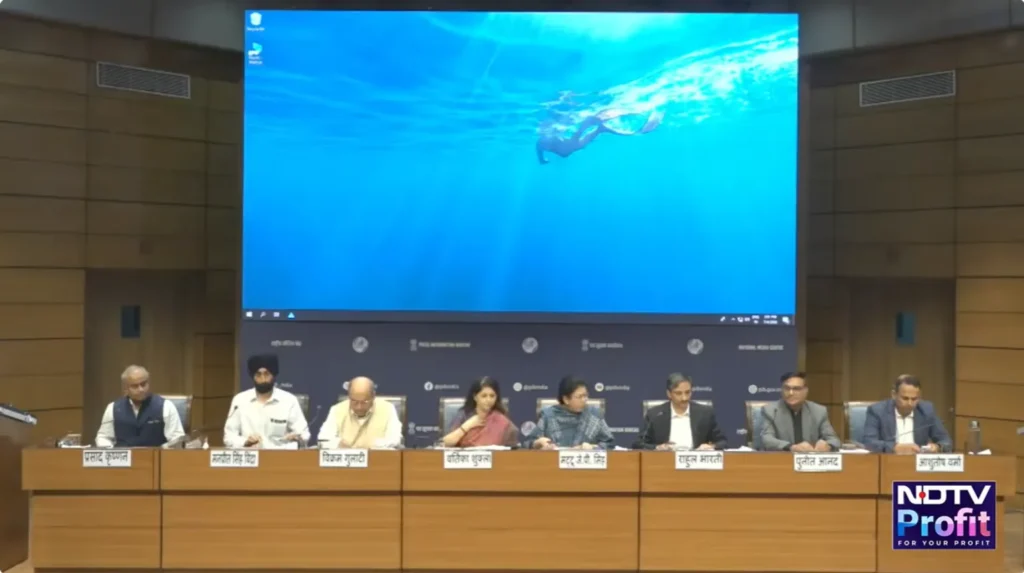

Government and top automakers held a press conference to calm public fears over E20 ethanol fuel — but a closer look at the transcript reveals unanswered questions on ARAI’s independence, missing complaint channels, and undisclosed safety margins.
Quick Answer: At a recent press conference, Indian automakers (Maruti, Hyundai, Hero, Toyota Kirloskar) defended E20 ethanol fuel as safe, but failed to name any official complaint channel for affected owners, did not commit to releasing testing data publicly, and did not directly address ARAI’s funding conflict of interest. Owners currently have no dedicated E20 complaint line but can use the government’s CPGRAMS portal instead.
India’s leading automakers — Hyundai, Maruti Suzuki, Hero MotoCorp, and Toyota Kirloskar Motors — along with former Engineer India Limited CMD Vertika Shukla, recently held a press conference to address growing public concern over E20 ethanol-blended petrol. The stated goal was to reassure consumers that E20 is safe, tested, and not damaging vehicles.
But a detailed review of the transcript shows that several of the sharpest questions asked by journalists were either deflected, answered with vague assurances, or not answered at all. Here are five gaps that stand out.
Table of Contents
1. “No Complaints Received” — But No One Said Where to Complain
Throughout the press conference, representatives from Maruti Suzuki and Hero MotoCorp repeatedly used the same defense: “We have not received such complaints.” Maruti cited servicing over 2.8 crore cars with no E20-related concerns flagged.
Here’s the problem: at no point did the panel, the moderator, or any official specify an actual channel — a helpline, an email ID, a government portal — where an affected owner could formally lodge an E20-related complaint. If there is no clearly publicized complaint mechanism, “zero complaints” is a misleading metric. It doesn’t prove the absence of problems; it only proves the absence of a place to report them. This is arguably the single biggest accountability gap in the entire press conference.
If automakers and the government are serious about tracking real-world E20 issues, owners don’t have to wait for a dedicated helpline — genuine complaints can already be filed through the government’s own grievance portal, CPGRAMS. If the volume of complaints there tells a different story than “zero complaints,” that’s worth watching.
2. The Oil Industry Wasn’t in the Room
The one specific damage case addressed in detail — a viral video of a damaged vehicle — was attributed entirely to adulterated fuel, not E20 itself. The company said the vehicle’s fuel tank and lines were flushed and refilled with “standard” E20, and the issue was resolved.
But fuel adulteration and quality control at the pump level falls under Oil Marketing Companies (OMCs), not vehicle manufacturers. No representative from the oil industry was present at this press conference. So the people best positioned to explain how adulteration is being prevented at the retail level were never asked to answer for it — automakers answered on their behalf, for an industry they don’t control.
Read More : Government vs Public Concerns About E20 Petrol Rollout 2025
3. Testing Data Was Never Made Public
A journalist directly asked why the original E20 testing report — reportedly covering roughly 40,000 km of testing across two-wheelers and four-wheelers — has not been released publicly for independent scrutiny, as would typically happen before any major regulatory shift.
The response was general reassurance about “rigorous testing” involving ARAI and other stakeholders, but no commitment was made to release the report or open it to public/independent review.
4. ARAI’s Independence Was Questioned — and Sidestepped
One of the most pointed questions was about the Automotive Research Association of India (ARAI), the body responsible for certifying E20 compliance. Since ARAI is funded by both auto companies and the government, a journalist asked how its testing can be considered truly independent.
The answer given was that ARAI follows international protocols (it is a party to UNECE) and undergoes accreditation for testing vehicles that are also exported globally. This addresses process credibility, but it does not address the funding conflict of interest that was actually asked about.
5. The Industry Knows More Than It’s Saying
Maruti Suzuki’s representative admitted that vehicles certified for E20 are built with a safety margin well beyond the current 20% blend requirement — meaning the cars could likely tolerate higher ethanol percentages. But when asked to specify that number, the answer was: “We have not taken a call on that.”
This suggests the industry already has internal data on higher-blend tolerance (E25, E30) that it is choosing not to disclose publicly — a decision that appears to be about liability rather than technical uncertainty.
What This Means for Vehicle Owners
To be fair to the panel, some points were addressed honestly — Maruti Suzuki openly admitted E20 causes a 3-3.5% mileage drop compared to E10, and explained the government’s move toward E85 flex-fuel vehicles rather than pushing E20 higher for regular cars anytime soon.
But on the core trust-building questions — where to file a complaint, why testing data isn’t public, and how ARAI’s independence holds up — the answers fell short of what a genuinely transparent process would look like. If you’re currently driving a pre-2023 vehicle on E20, there’s no evidence of a widespread damage pattern, but fuel adulteration remains the real risk factor to watch — and, ironically, there’s still no clear place to report it if you’re affected.
Key Facts at a Glance
| Point | Status |
|---|---|
| Official E20 complaint channel | Not specified by panel |
| Testing report made public | No |
| ARAI funding conflict addressed | Not directly answered |
| Mileage drop (E20 vs E10) | Confirmed: 3–3.5% |
| E25/E27 rollout plan | None confirmed for regular vehicles |
| Alternative complaint route | CPGRAMS (pgportal.gov.in) |
FAQ
Where can I file a complaint if I think E20 fuel has damaged my vehicle?
This is unclear. During the press conference, automakers stated they have received no E20-related complaints, but no official complaint channel — helpline, email, or portal — was named. Owners with concerns should currently approach their vehicle’s authorized service center directly and keep records.
Is ARAI’s E20 testing really independent?
ARAI is funded by both automobile companies and the government, which raises a legitimate conflict-of-interest question. Officials point to ARAI’s international accreditation and UNECE membership as proof of rigor, but this does not directly resolve the funding independence concern.
Can E20 damage cars made before 2023?
Automakers claim internal testing on older E10-designed vehicles run on E20 fuel shows no significant corrosion or damage. However, this data has not been released for independent public verification.
How much mileage do I lose with E20 compared to E10?
Maruti Suzuki confirmed E20’s calorific value is 3-3.5% lower than E10, resulting in a proportional drop in fuel efficiency.
Is India moving to E25 or E27 next?
No confirmed plans currently exist for regular vehicles. Higher ethanol blends like E85 are being rolled out specifically for flex-fuel vehicles, not standard petrol cars.