
It’s that time of year again.
Schools are closed, offices are taking half-day Fridays, and every second WhatsApp group is buzzing with “road trip plan karo yaar” energy. Tourist season in India is properly here, and if you’re thinking about renting a car — whether you’re a domestic traveller, an NRI coming back home, or a foreign tourist trying to figure out how to get from Delhi to Agra without losing your mind — this guide is going to save you from some seriously avoidable mistakes.
Let’s be straight about one thing upfront: renting a car in India is nothing like renting one in the US, UK, or even Thailand. There are no counters at the airport where you show your passport and drive off. The pricing isn’t transparent. The insurance terms are confusing. And if you book through the wrong platform on the wrong day, you’ll end up paying almost double what you expected.
This isn’t a sponsored post. It’s a real breakdown of how the Indian car rental market actually works in 2026.
Table of Contents
First Things First: How Car Rentals Actually Work in India
India has two completely different car rental cultures running side by side, and most guides online confuse the two.
1. Chauffeur-Driven (The Most Common One)
You book a car. A driver comes with it. You don’t drive. This is the dominant model in India, and honestly for most road trips and outstation trips, it still makes the most sense. The standard package is 8 hours / 80 km for city use, or a per-km plus per-day driver allowance model for outstation trips (think Delhi to Jaipur, Mumbai to Pune, Bangalore to Coorg).
Key players here: Savaari, Ola Outstation, Uber Intercity, MakeMyTrip’s cab section, and local operators that your hotel or a quick Google Maps search will throw up.
2. Self-Drive (The App-Based One)
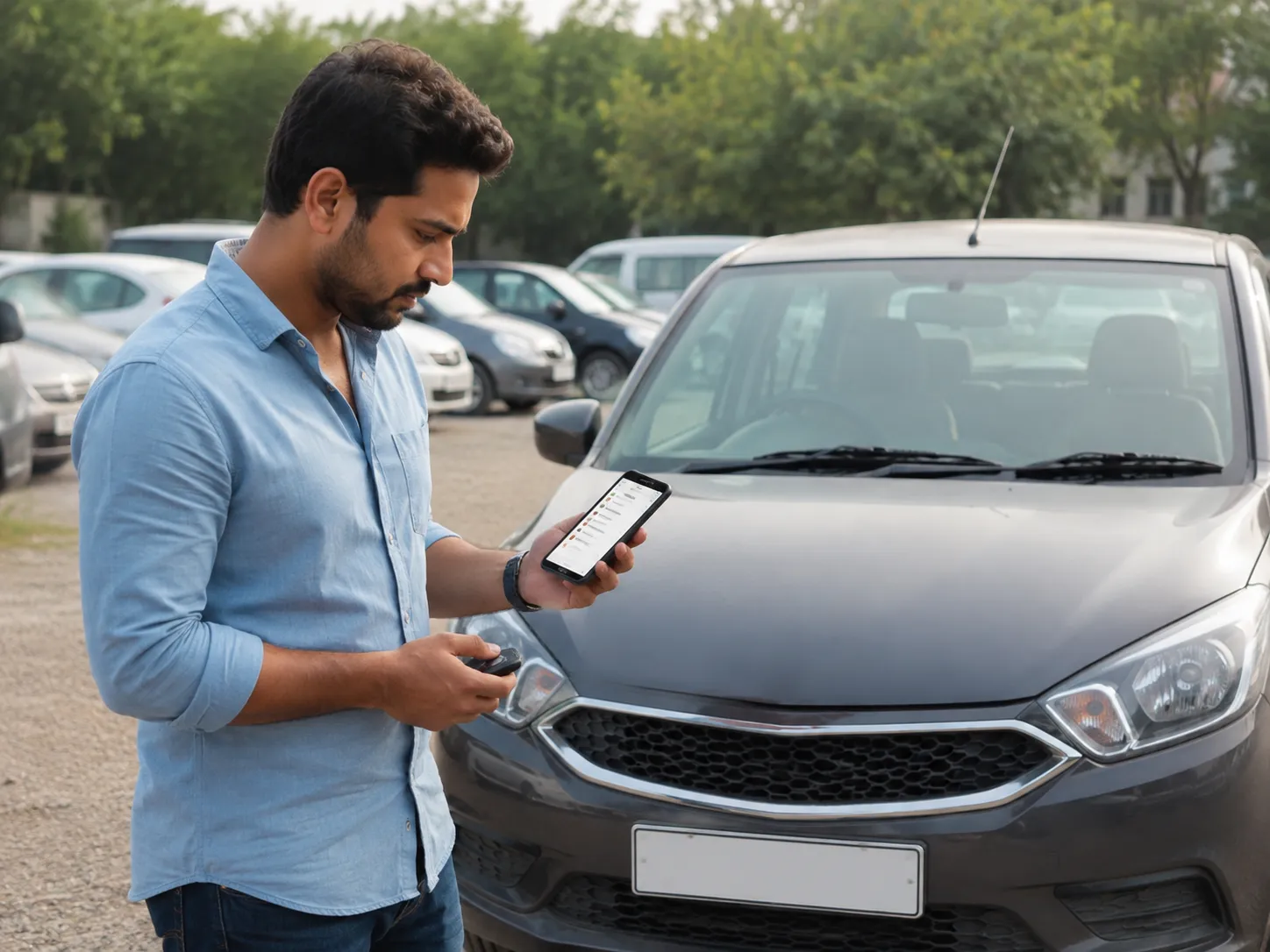
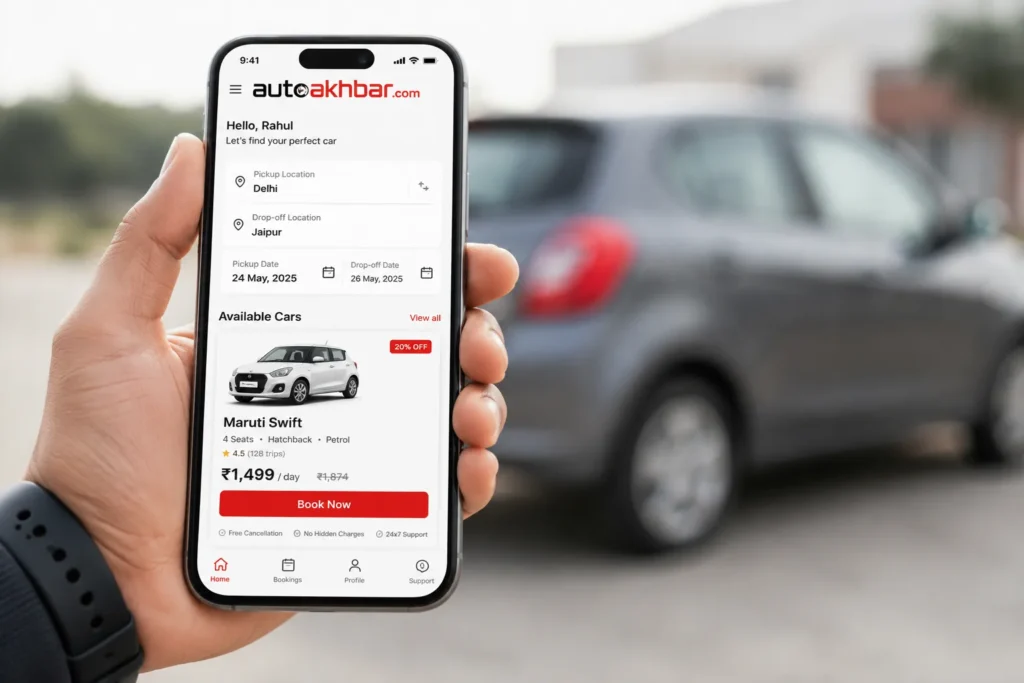
You rent the car, no driver. You upload your licence, pay a security deposit, pick up the car (sometimes it’s delivered to your door in metros now), and you’re on your own. This has genuinely matured in India over the last few years.
Main players: Zoomcar, Revv, MyChoize, and to a lesser extent Avis India and Hertz India at airports.
💡 Quick Decision Rule: If you’re doing a full-day trip in an unfamiliar city, or an outstation trip where you don’t know the roads — go chauffeur-driven. If you want freedom, privacy, and are comfortable driving in Indian traffic — self-drive. For just getting around town on a Tuesday afternoon? Just use Ola or Uber. It’ll be cheaper and less hassle.
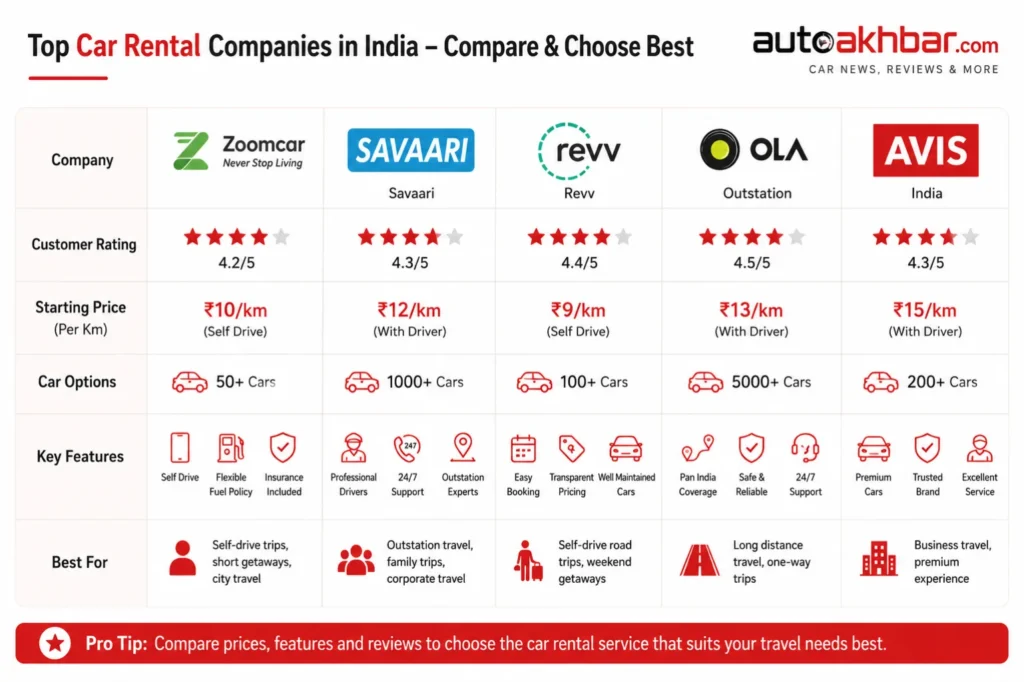
The Main Car Rental Companies in India 2026 – Real Talk
Let’s go through the big names you’ll actually encounter, and what you need to know about each one before you click “book.”
🔵 Zoomcar – India’s Largest Self-Drive Platform
Zoomcar is the biggest name in Indian self-drive, and it’s genuinely improved a lot in the last couple of years. The company is NASDAQ-listed and has over 40,000+ cars and 10 million+ users. It operates in 45+ cities.
What’s new in 2026: Zoomcar launched Home Delivery across 14 cities including Bangalore, Mumbai, Delhi, Chennai, Hyderabad, Pune, Jaipur, and Chandigarh – so the car comes to you. They also added Zoomcar Cabs (a pilot chauffeur-driven service that started in Bengaluru) and Zoomcar Vouchers for prepaid trips. The platform’s repeat booking rate has reportedly doubled, and the average trip rating sits at 4.73 out of 5 – which is decent for India.
What people like: Huge fleet variety (hatchbacks, sedans, compact SUVs, EVs), hourly and daily booking flexibility, proper app experience, home delivery in major cities.
What people don’t like: Car condition can vary wildly since it’s a host-guest marketplace (think Airbnb for cars – you’re renting someone’s personal car, not a company-owned fleet). Always check reviews and photos of the specific car before booking. The “Thrift Store” category (up to 50% cheaper) is great for same-day budget bookings.
Best for: City day-trips, weekend drives, people who want self-drive flexibility in metros.
🟠 Savaari – The Outstation Specialists
If you’re planning a one-way or round-trip outstation journey – like Bangalore to Mysore, Delhi to Rishikesh, or Mumbai to Mahabaleshwar – Savaari is arguably the most reliable option in the organised sector. They operate across 2,000+ cities, which is massive. MakeMyTrip acquired a majority stake in them back in 2023, so there’s institutional backing there.
What they’re known for: flat-rate transparent pricing, outstation intercity drops, airport transfers, and chauffeur-driven services. Drivers are trained, and the company has a 24/7 customer support line.
What people like: Transparent pricing upfront (fewer nasty surprises), reliable for intercity trips, drivers who can double as local guides, pet-friendly cab options in select cities, CNG cabs available.
Best for: Outstation trips, airport transfers, families with elderly members or luggage.
🟢 Revv – Subscription + Self-Drive
Revv offers both hourly rental and car subscription models, and one feature that genuinely stands out is 100% doorstep delivery and pickup across 22+ cities. They also allow you to pick up in one location and drop off at another within the same city. All Revv vehicles carry an All India Tourist Permit, so you can technically drive across state borders without hassle.
Best for: People who want a self-drive car for multiple days, or who need the convenience of home delivery.
🔴 Ola Outstation / Uber Intercity
Often overlooked but genuinely solid for outstation trips where you don’t want to self-drive. Prices are fairly competitive, the app experience is seamless if you’re already using these platforms, and you get the familiar interface. Works best for shorter outstation routes (under 300 km one-way) where pricing is clear.
🟡 Avis India & Hertz India
These global brands are available in India, mostly at major airports and through hotel tie-ups. The experience is more standardised, which is helpful for international tourists. Pricing tends to be on the higher side, but the cars are usually company-owned (more consistent condition) and customer service is more structured.
Best for: International tourists who want a familiar brand experience and consistent car quality.
2026 Car Rental Pricing – What to Actually Expect
Prices have gone up compared to pre-2023 levels, but India is still remarkably affordable by global standards. Here’s a realistic breakdown as of mid-2026:
Chauffeur-Driven (8 hours / 80 km local package, Tier-1 cities)
| Vehicle Type | Example Models | Per Day |
|---|---|---|
| Hatchback | Maruti Swift, Hyundai i20 | ₹2,000–₹2,800 |
| Compact Sedan | Maruti Dzire, Hyundai Aura | ₹2,500–₹3,500 |
| Mid-size Sedan | Honda City, Skoda Slavia | ₹3,500–₹5,000 |
| Compact SUV | Hyundai Creta, Kia Seltos | ₹3,500–₹5,500 |
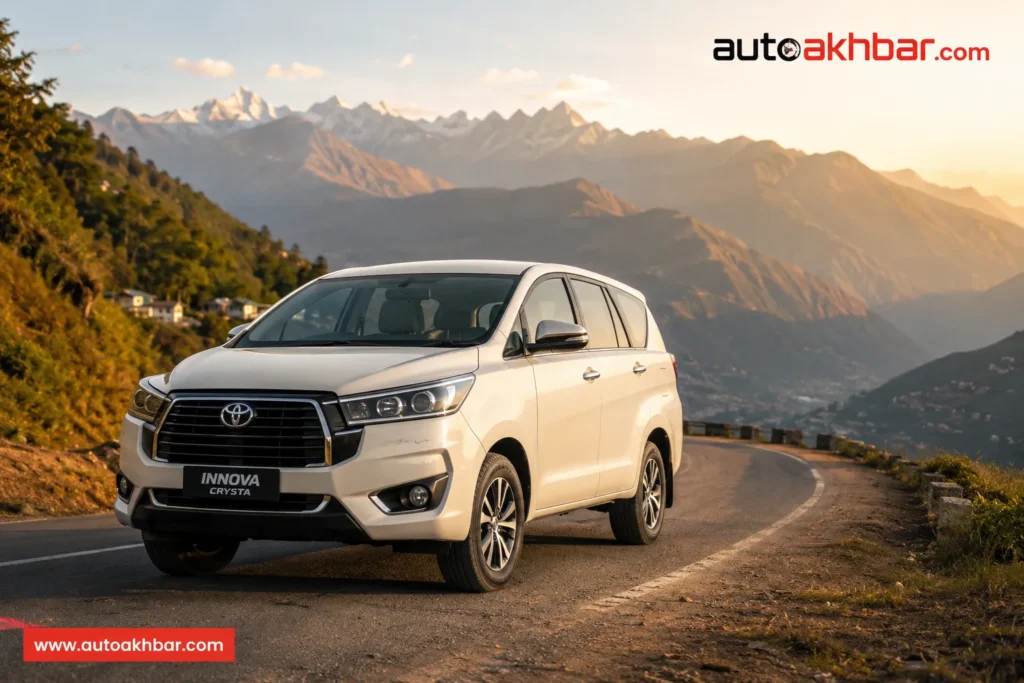
| MPV (7-seater) | Toyota Innova Crysta/Hycross | ₹4,500–₹7,000 |
| Premium / Executive | Toyota Camry, Skoda Superb | ₹6,500–₹10,000 |
| Luxury | Mercedes E-Class, BMW 5 Series | ₹15,000+ |
Self-Drive (per day, fuel NOT included)
| Vehicle Class | Per Day |
|---|---|
| Hatchback | ₹1,500–₹2,500 |
| Sedan | ₹2,500–₹4,000 |
| Compact SUV | ₹3,000–₹5,000 |
| Premium SUV | ₹5,000–₹8,000 |
📌 Note on Tier-2 Cities: Expect rates to be 20–30% lower outside the big metros. But popular tourist destinations (Goa, Manali, Shimla, Ooty, Coorg) run higher during peak season – sometimes 40–60% above normal. Book early.
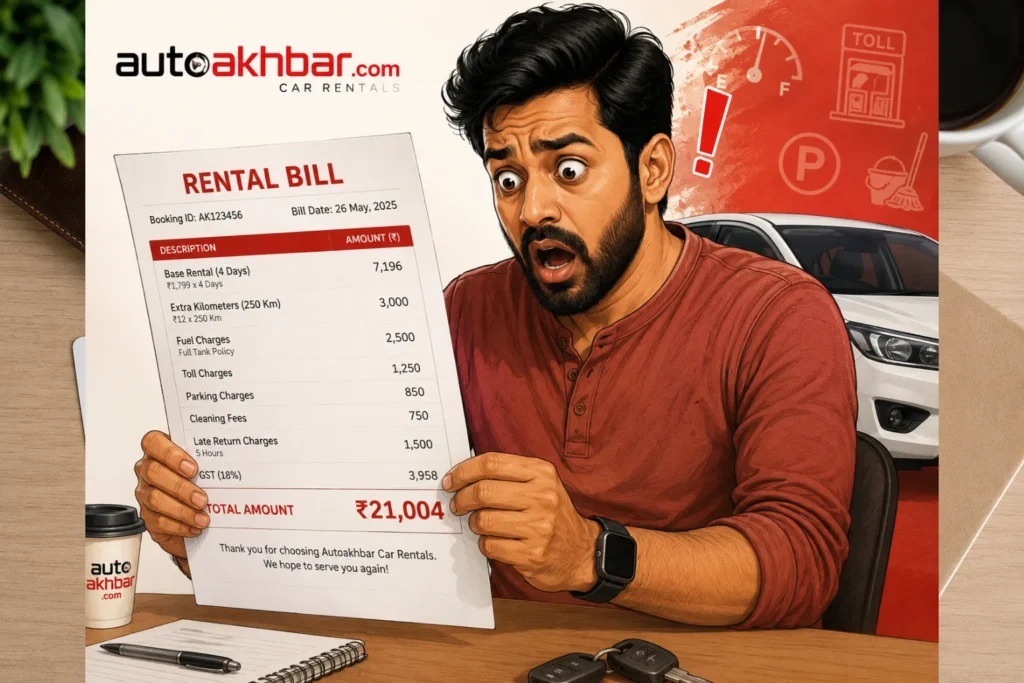
The “extra km” charges are where bills quietly inflate: expect ₹12–₹25 per km beyond the package limit. Driver allowance for outstation is typically ₹400–₹700 per day on top of the km rate. Night halt charges (if the driver stays away from home) add another ₹250–₹500 per night.
The Hidden Charges Nobody Warns You About
This is the section most blogs skip. Don’t.
⚠️ GST on top of the headline price: Most operators quote pre-GST rates. Depending on the operator’s structure, you could be paying 5–18% GST on top of what you agreed to. Always ask: “Is this price GST-inclusive?”
Toll and parking: Almost universally billed separately “at actuals.” On a Delhi-Agra-Jaipur Golden Triangle trip, tolls alone can add ₹800–₹1,500 to your bill.
Fuel policy confusion: Self-drive rentals are almost always “return with the same fuel level.” That sounds fair — until you return the car slightly below the level you picked it up at and get charged at a premium rate per litre. Take a photo of the fuel gauge when you pick up and when you return.
Cancellation charges: Most operators charge a full first-day fee if you cancel within 6 hours of pickup. Read the cancellation policy before you confirm.
Security deposit hold: For self-drive, your card gets hit with a deposit ranging from ₹5,000 (hatchback) to ₹40,000+ (premium SUV). This typically releases in 7–10 working days after return — not instantly. Factor this into your travel budget.
Damage deductibles: Standard insurance on self-drive rentals in India has a substantial excess — often ₹5,000–₹15,000. Tyre damage and interior damage are frequently not covered at all. The damage waiver add-on (₹150–₹400/day) is genuinely worth it for hill drives and monsoon season.
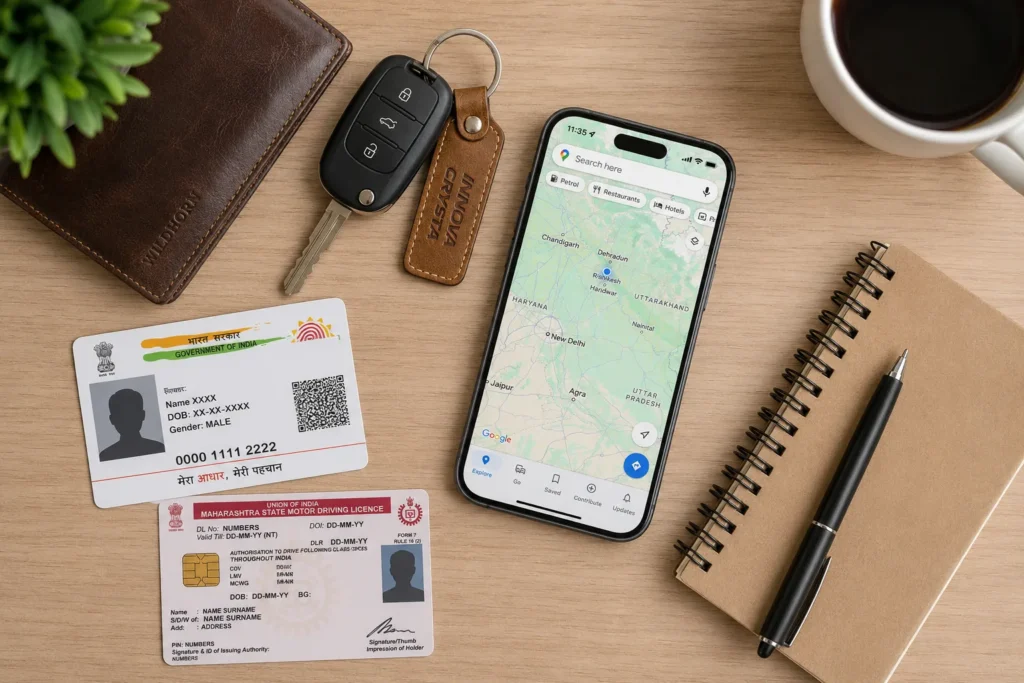
Documents You Absolutely Need
For Chauffeur-Driven Rentals:
- Phone number and a valid payment method. That’s pretty much it for domestic travellers.
- Passport (for international tourists, especially for inter-state trips where drivers may be asked for passenger ID at borders).
For Self-Drive Rentals:
- Valid Indian driving licence (held for at least 1 year, some operators require 3 years)
- International Driving Permit (IDP) if you’re a foreign tourist – get it from your home country before travelling, not from India
- Aadhaar card or PAN card for Indian residents
- Passport for international tourists
- Credit card for the security deposit (many operators don’t accept debit cards or UPI for deposits)
- Minimum age: 21 in most cases; 25 for premium/SUV categories
⚠️ Most Common Mistake: International tourists arriving in India and trying to rent a self-drive car without an IDP. Your home country driving licence alone is NOT enough. The IDP must be issued by your home country’s relevant authority before you fly. There’s no workaround for this.
Self-Drive vs. Chauffeur-Driven: Which Actually Makes Sense for You?
This is the honest version of this comparison.
| Situation | Go Chauffeur-Driven | Go Self-Drive |
|---|---|---|
| Unfamiliar city | ✅ | — |
| Outstation trip, new roads | ✅ | — |
| Family with elderly / kids | ✅ | — |
| Lots of luggage | ✅ | — |
| Want local knowledge / guide | ✅ | — |
| Comfortable driving in India | — | ✅ |
| Want privacy & flexibility | — | ✅ |
| Multi-day fixed itinerary trip | — | ✅ |
| Budget travel (5+ days) | — | ✅ |
| Quick single-day city use | Use Ola/Uber instead | Use Ola/Uber instead |
Here’s the economics no one spells out: for a single day in the city, a chauffeur-driven package (₹2,500) is actually cheaper than self-drive once you add fuel (₹600), parking (₹200–₹500 in metros), and the hassle of navigating unfamiliar roads. For a 5+ day outstation trip, self-drive is significantly cheaper and gives you complete freedom.
Tourist Season 2026 – What’s Different This Year
A few things worth flagging for 2026 specifically:
EV rentals are a real option now. Zoomcar has EVs in its fleet in metro cities. If you’re doing city trips in Bangalore, Mumbai, or Delhi, renting an EV for a day actually makes sense – lower running costs, no fuel hassle if the trip is under 200 km. Just confirm charging logistics before you pick up.
Demand is genuinely high this summer. Zoomcar reported a 43% year-on-year booking surge in the wedding season alone, and summer travel is even stronger. If you’re planning a weekend trip — especially to Goa, hill stations, or popular National Highway routes — book your car at least a week in advance, not 24 hours.
Home delivery is mainstream now. In 14 major cities, Zoomcar delivers the rental car to your address. This has changed the game for families and solo travellers who don’t want to commute to a pickup point. Expect this to expand further through 2026.
For hill station trips: If you’re heading to Manali, Shimla, Ooty, Munnar, or the Northeastern states, always get the damage waiver insurance add-on. Mountain roads are hard on tyres, and the standard policy almost never covers tyre damage.
💡 Local Taxi Stand Tip (Still Underrated): For smaller cities, hill stations, and rural areas, the prepaid taxi counter at the railway station or bus stand is often your most reliable option. Rates are pre-published, no haggling needed. And for multi-day trips in the same area, negotiating directly with a driver through your hotel can be 20–30% cheaper than any aggregator — especially off-peak.
Things to Do the Moment You Pick Up the Car
Whether it’s a chauffeur-driven vehicle or a self-drive rental, do these things before you leave the pickup point:
- Walk around the car and photograph every existing dent, scratch, and damage — roof, bumpers, side panels, windscreen chips. Time-stamp the photos. Send them to the operator’s WhatsApp immediately.
- Check tyre condition — look for sidewall cracks, especially for older cars. Report anything suspicious before driving off.
- Check the fuel gauge — take a photo. Match it to what the rental agreement says.
- Confirm what’s included in the package — km, hours, tolls, fuel – verbally and on paper.
- Get the driver’s personal number (for chauffeur trips) — not just the operator’s helpline. This saves you during delays, route changes, or emergencies.
- Check the spare tyre — yes, really. Many rental cars have missing or flat spares. You don’t want to discover this on a highway.
Places Where Renting a Car Makes the Most Sense in India
For some destinations, renting a car isn’t just convenient — it’s the only sensible way to travel. If you’re going to any of these places in 2026, a rental car will genuinely make your trip:
- Rajasthan Road Trip (Jaipur → Jodhpur → Jaisalmer → Udaipur) – distances between cities are huge, trains aren’t always practical, and having your own car lets you stop at forts and villages along the way
- Coorg, Karnataka – no railway station, public transport is terrible, driving through the coffee estates is half the experience
- Spiti Valley / Ladakh – self-drive SUV or 4×4 is the only way to truly do this; just make sure your rental car has an All India Tourist Permit and the operator allows high-altitude driving
- Northeast India (Meghalaya, Assam) – roads have improved massively, self-drive is now genuinely viable here
- Goa – self-drive scooters are the traditional choice, but a car for day trips to North Goa beaches or the hinterland makes a lot of sense for families
For more inspiration on Indian road trips, check out our guide to the best road trip cars available in India right now.
Quick Booking Checklist Before You Hit “Confirm”
- Is the price GST-inclusive?
- What are the km and hour limits in the package?
- What’s the extra km rate beyond the limit?
- Are tolls and parking included or billed separately?
- For outstation trips: what’s the driver allowance per day?
- For outstation trips: are night halt charges applicable?
- What’s the cancellation policy?
- For self-drive: what’s the fuel policy?
- For self-drive: what’s the security deposit amount, and how long until it’s released?
- For self-drive: what are the insurance deductibles, and is a damage waiver available?
- Has the driver been confirmed with photo and contact number? (outstation)
- Does the car have an All India Tourist Permit? (if crossing state borders)
The Honest Verdict
India’s car rental market in 2026 is genuinely better than it was five years ago. The apps are cleaner, home delivery is real in metros, pricing is more transparent on the better platforms, and there are more car options than ever — including EVs.
But the fundamentals haven’t changed: the airport counter culture doesn’t exist here, the insurance terms are still confusing if you don’t read carefully, and booking a popular route on a busy weekend without advance planning will leave you scrambling.
Go in prepared, use this checklist, and you’ll be fine. India’s roads are genuinely worth driving.
If you’re still figuring out which car to rent for your specific trip, check out our detailed guide on the best SUVs in India right now — some of the most popular rental options are on that list for a reason.
Have a rental experience from India — good or bad — that others should know about? Drop it in the comments below.
FAQ About Car Rental 2026
Which is the best car rental company in India in 2026?
It depends on what you need. For self-drive city rentals, Zoomcar is the largest and most established platform with 40,000+ cars across 45+ cities. For chauffeur-driven outstation trips, Savaari is widely considered the most reliable organised option, operating across 2,000+ cities with transparent pricing. For international tourists who want brand consistency, Avis India and Hertz India are available at major airports.
Can a foreign tourist rent a car in India?
Yes, but you must have an International Driving Permit (IDP) issued by your home country before arriving in India — your foreign driving licence alone is not sufficient for self-drive rentals. IDP must be presented alongside your original home country licence. Most major operators also require a credit card for the security deposit and a minimum age of 21–25 depending on the vehicle category.
How much does it cost to rent a car in India in 2026?
For a chauffeur-driven car (8 hours / 80 km local package) in a Tier-1 city, prices range from ₹2,000–₹2,800 for a hatchback to ₹4,500–₹7,000 for a 7-seater Innova. Self-drive rates (excluding fuel) start at ₹1,500–₹2,500 per day for a hatchback. Always confirm whether the quoted price includes GST, tolls, and fuel — these are frequently added separately.
Is Zoomcar reliable in India?
Zoomcar operates as a peer-to-peer marketplace — you’re renting cars listed by individual hosts, not a company-owned fleet. Car quality varies. The platform’s average guest rating is 4.73/5 as of 2026, and the platform has significantly improved with home delivery, better car verification through CARS24 partnership, and GPS tracking. Always check specific car reviews and photos before booking, and opt for “Guest Favourites” or “top-rated” listings for more consistent quality.
What is the 8-hour 80-km package in Indian car rentals?
This is the standard chauffeur-driven local package in India. It means you get a car with driver for up to 8 hours and up to 80 km of travel within one day for a fixed price. If you exceed either limit — whether in time or distance — extra charges apply per hour (₹150–₹400) and per km (₹12–₹25) depending on the car category. For most city sightseeing, 80 km is usually sufficient.
What hidden charges should I watch out for when renting a car in India?
The main ones: GST (5–18% on top of the headline price), tolls and parking billed separately at actuals, extra km/hour charges beyond the package limit, driver allowance for outstation trips (₹400–₹700/day), night halt charges if the driver stays overnight (₹250–₹500), fuel discrepancy charges on return for self-drive, and security deposit holds (₹5,000–₹40,000+ for self-drive, released in 7–10 working days).
Should I choose chauffeur-driven or self-drive in India?
Chauffeur-driven is better for outstation trips with unfamiliar routes, travelling with elderly or children, or if you’re not comfortable with Indian traffic. Self-drive makes more sense for multi-day trips with a fixed itinerary, when you want complete flexibility and privacy, and when you’re comfortable driving in India. For quick in-city trips, Ola or Uber is almost always cheaper and less hassle than either option.
How far in advance should I book a rental car in India?
For popular tourist seasons (summer May-June, Christmas-New Year, Diwali week) and hill station destinations like Manali, Shimla, or Ooty — book at least 1–2 weeks in advance. For self-drive in metros on regular weekdays, same-day or 24-hour booking usually works fine. For outstation chauffeur-driven trips, 48 hours ahead is the minimum recommended to get a good driver and confirmed vehicle.
External Links Used in Article
- https://www.zoomcar.com – Zoomcar official site
- https://www.savaari.com – Savaari official site
- https://www.revv.co.in – Revv official site
- https://nriinformation.com/cars/car-rentals – NRI India car rental 2026 guide (reference)