

Let me be honest with you — when I first heard about a ₹1.75 lakh electric four-wheeler, I rolled my eyes. India has seen a hundred such claims that quietly disappear. But when I actually walked into Balaji Motors on Dabwali Road in Sirsa, Haryana, and stood next to the Yakuza Karishma, my skepticism shifted — not completely, but enough to write this.
This is not a press release. This is what I saw, what the showroom people told me, and what I genuinely think about this vehicle after researching it for weeks. If you’re considering the Yakuza Karishma, or even just curious whether ₹2 lakh can buy you a real car in India in 2026 — read this fully before deciding.


Table of Contents
Ground Reality Story
During a visit to Dabwali Road, Sirsa, right next to the Honda Activa showroom, I spotted this Yakuza electric four-wheeler standing quietly inside Balaji Motors. No flashy launch, no paid hype — just a simple electric car meant for real people. At a time when bikes cost over ₹1.5 lakh, seeing a three-seater electric car at ₹1.25 lakh honestly felt like a reality check for the Indian EV market.
What Exactly Is the Yakuza Karishma?
The Yakuza Karishma is a compact 3-seater electric four-wheeler made by Yakuza EV, which operates under Maa Luxmi E-Vehicles Pvt. Ltd. — an Indian company with manufacturing and operations across Haryana, Madhya Pradesh, and Bengal.
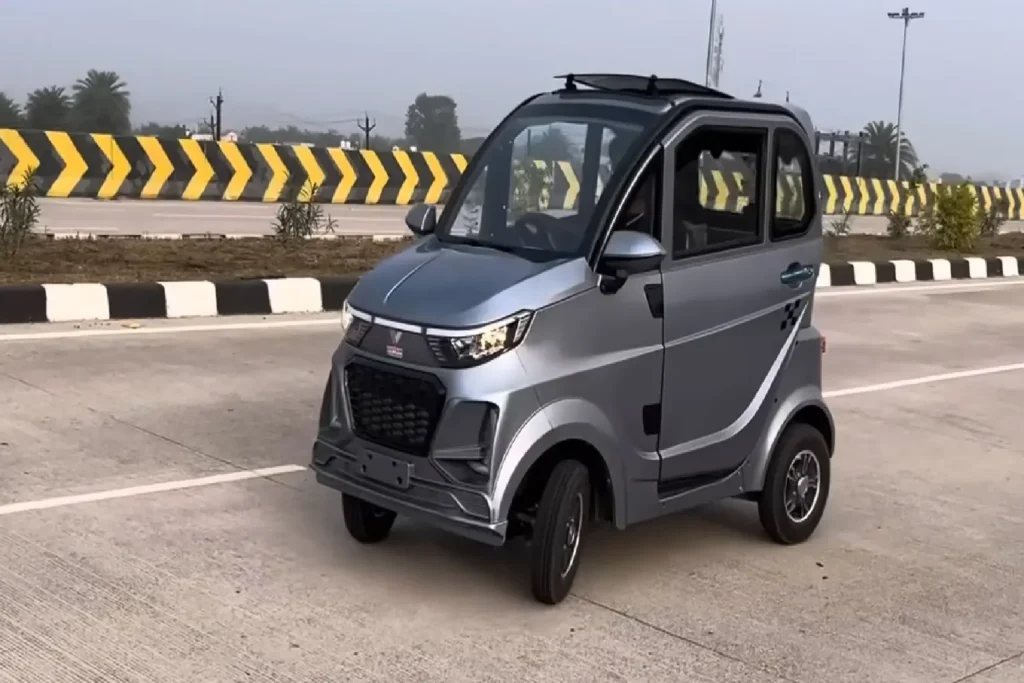
This isn’t a golf cart. It has actual doors, a touchscreen infotainment system, power windows, alloy wheels, a reverse camera, and button start. It runs on electricity, charges from a regular home socket, and is specifically engineered for Indian city roads — narrow streets, traffic-heavy zones, tight parking.
The company positions it as an alternative to bikes and scooters — not as a highway car, not as a family road trip vehicle, but as a practical city commuter that gives you a roof, some safety, and zero petrol tension.
That’s the sales pitch. Now let’s dig into the reality.
Yakuza Karishma: Full Specifications (2026)
| Spec | Details |
|---|---|
| Vehicle Type | Low-Speed Electric Four-Wheeler (LSEV) |
| Brand | Yakuza EV (Maa Luxmi E-Vehicles Pvt. Ltd.) |
| Seating | 3 persons (1 front + 2 rear) |
| Battery | 60V 45Ah Lead-Acid (2.7 kWh) |
| Real-World Range | 50–60 km per charge |
| Top Speed | 50 km/h (limited) |
| Charging Time | 6–7 hours via home socket (Type-2) |
| Charger Type | Standard home outlet — no special installation needed |
| Ex-Showroom Price | ₹1.70 – ₹1.75 lakh |
| On-Road Price (est.) | ₹2.00 – ₹2.15 lakh (with RTO + insurance) |
| Drive Type | Single electric motor, rear-wheel drive |
| Colors Available | White, Red (check with local dealer) |
| Sunroof | Yes |
| AC | No (built-in electric fans instead) |
Price Breakdown: What You Actually Pay
A lot of websites will tell you ₹1.25 lakh and call it a day. That’s misleading. Let me break it down clearly so you don’t get surprised at the dealership.
The ex-showroom price is around ₹1.70 – ₹1.75 lakh, depending on the variant and dealer. Once you add registration (RTO charges vary by state, typically 3%–15% for EVs), insurance (roughly 3% of ex-showroom), and other local charges — you’re looking at a total on-road cost of approximately ₹2.00 – ₹2.15 lakh.
For context: the cheapest mainstream highway-legal electric car in India right now is the Vayve Mobility Eva at ₹3.25 lakh, and the MG Comet EV starts at ₹7.50 lakh. The Yakuza Karishma is operating in an entirely different — and largely uncontested — budget bracket.
Important note on LSEV legality: Because this is a low-speed electric vehicle with a top speed of 50 km/h, it falls under a different vehicle category in India’s Motor Vehicles Act. Always confirm with your local RTO about registration requirements and whether it’s approved for road use in your state before purchasing.
Exterior: Compact, But Not Embarrassing
The first thing I noticed at the showroom was that it doesn’t look like a toy. It’s small — obviously — but it has design intent. The front has dual LED headlamps with DRL strips, a closed EV-style grille, and a company badge at the center. The side profile is clean with a sloping roofline.
What genuinely surprised me: alloy wheels on all four corners. For a sub-₹2 lakh vehicle, this is not something you’d expect. The ground clearance feels adequate for typical city roads.
It has two large doors — one on each side — shared between front and rear passengers. This is a deliberate design choice to keep the body compact. Once you accept this vehicle for what it is (an urban microcar, not a sedan), the exterior makes complete sense.
Interior: Usable, Honest, No Frills
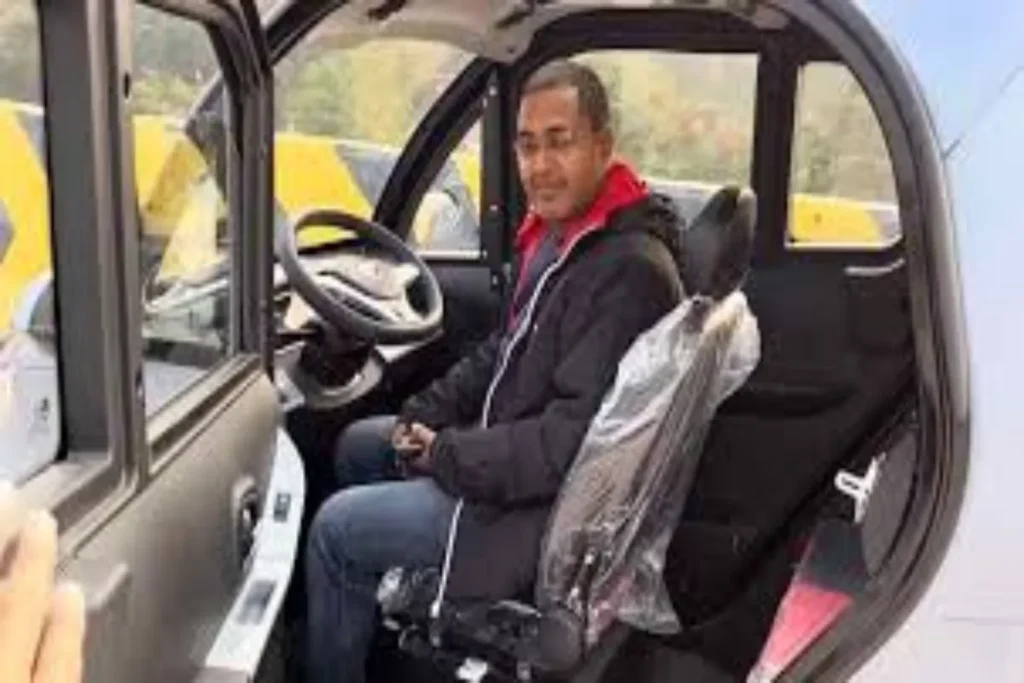
Inside, it’s tight — but not uncomfortable. I sat in the back with someone else and while it’s snug, it’s workable for a daily school drop-off or a short market run.
Here’s what you get:
- Touchscreen infotainment with FM, audio, and video playback
- Reverse camera that activates automatically when you shift into reverse
- Digital LED instrument cluster
- Power steering (a genuine surprise at this price)
- Power windows
- Button start with proximity smart key — car won’t start if the key isn’t nearby
- Sunroof for ventilation
- Electric fans (no AC — this is a significant limitation if you’re in peak Indian summer)
- Manually adjustable ORVMs
The no AC is the honest limitation. Yakuza explains this is because AC needs a much larger battery, which would raise the price. That’s fair reasoning. But if you’re buying this for someone commuting through Delhi or Chennai in May, factor this in seriously.
Battery, Range & Charging: The Real Numbers
This is where I want to be completely transparent with you, because I’ve seen some websites claiming 150 km range for this car. That’s not accurate.
The Yakuza Karishma uses a 60V 45Ah lead-acid battery with a total energy capacity of about 2.7 kWh. Lead-acid is an older, heavier battery chemistry compared to the lithium-ion used in more expensive EVs like the Tata Tiago EV or MG Comet. The advantage of lead-acid: it’s significantly cheaper, which is why this car can exist at this price point.
Real-world range: 50–60 km. This is what you can realistically expect — not 70, not 80, definitely not 150. Yakuza’s showroom staff confirmed 70–80 km as a figure, but real-world driving with two passengers, stop-start traffic, and fans running will likely put you at 50–60 km. Plan accordingly.
Charging time: 6–7 hours using your home socket. Plug it in before bed, fully charged by morning. No special home charger needed. Just a regular 15-amp socket.
For someone doing a 20–30 km daily city commute, this range is perfectly fine. For someone covering 60+ km daily, you’ll need to charge mid-day or look at a different vehicle.
Performance: City-Only, As Promised
Top speed is capped at 50 km/h. In heavy urban traffic, this is not a dealbreaker — most city roads in India don’t allow you to go faster anyway. What matters more is the low-speed torque, which electric motors deliver excellently.
The driving experience is beginner-friendly: light steering, smooth pickup from 0–30 km/h, and manageable braking. It’s not exciting, but it’s not supposed to be. Think of it as a step above a scooter — you get a cabin, protection from rain, a proper seat, and the ability to carry two people without anyone getting wet.
It’s genuinely not suitable for highways, state roads, or intercity travel. Accept this and you’ll love it. Expect it to be something else and you’ll be disappointed.
Safety: Honest Limitations
No airbags. No ABS. No crash test rating (as of this writing). These are real limitations that need to be said plainly.
What you do get: a reverse camera (which is actually useful for parking), large side mirrors, bright LED tail lamps, and the basic protection of an enclosed cabin — which is still far safer than a scooter in a fender bender.
For low-speed city use, the risk profile is manageable. For anyone planning to use this on high-speed roads — don’t. The top speed cap of 50 km/h is partly a safety feature; it keeps this vehicle in the lanes and zones where it belongs.
Who Is Yakuza as a Company?
This is worth understanding before you buy. Yakuza EV is a relatively young brand operating under Maa Luxmi E-Vehicles Pvt. Ltd., based in Haryana. The company produces around 600 units per day across its facilities in Haryana, Madhya Pradesh, and Bengal. They also make electric scooters.
One genuine concern I’d flag: service network. Yakuza is not Tata, Mahindra, or even MG. If something goes wrong with your vehicle outside of a major city, getting it serviced could be challenging. Before buying, ask your dealer specifically: how many service centers are within 50 km of your home? What’s the warranty period? Are spare parts readily available?
This is the kind of question most YouTube reviewers don’t ask, but it’s the one that determines your ownership experience three years from now.
Yakuza Karishma vs. The Alternatives
I’d be doing you a disservice if I didn’t put this in perspective.
| Vehicle | Type | Price (Ex-Showroom) | Range | AC | Highway-Legal |
|---|---|---|---|---|---|
| Yakuza Karishma | LSEV | ₹1.70–1.75L | 50–60 km | No | No |
| Vayve Mobility Eva | Car | ₹3.25L | Limited | No | Yes |
| MG Comet EV | Car | ₹7.50L | 230 km | Yes | Yes |
| Tata Tiago EV | Car | ₹7.99L | 250 km | Yes | Yes |
| Hero Splendor+ (petrol bike) | 2W | ~₹80K | Petrol | No | Yes |
If your daily requirement is city-only travel under 40 km and you want an enclosed four-wheeler at the cost of a decent bike, Yakuza Karishma genuinely has no competitor at this price. The nearest four-wheeled EV alternative (Vayve Eva) is almost double the price.
If you need AC, highway access, or long-range capability — save more and look at the MG Comet EV or Tata Tiago EV.
The Hidden Cost Nobody Talks About: Battery Replacement
This is the elephant in the room for any lead-acid battery vehicle. Lead-acid batteries have a lifespan of roughly 2–4 years with regular cycling before capacity drops significantly. After that, you’ll need a replacement battery, which can cost ₹15,000–₹40,000 depending on the specifications.
Factor this into your total cost of ownership. Over 4 years, your real total might look like: ₹2.10L (purchase) + ₹30K (battery replacement) + minimal electricity costs = approximately ₹2.50–₹2.60L for roughly 4 years of city commuting.
Compare that to running a petrol scooter over the same period with current fuel prices, and it still favors the EV for short-range city use.
How to Book a Yakuza Karishma
You can book via:
- Official website: yakuzaev.com/karishma
- Authorized dealers across Haryana and other states (contact the helpdesk at +91 96713-02982 for the nearest dealer)
- A token booking amount applies — confirm the exact figure with the dealer
As of early 2026, the vehicle is displayed at select showrooms and delivery timelines vary by region. Some states may still require government approval for road use — verify this locally.
My Honest Verdict
I went to that Sirsa showroom as a skeptic and came away with a more complicated feeling.
The Yakuza Karishma is a real product. It’s not a scam, not a concept, not a vaporware announcement. I saw it. I sat in it. For what it promises — a covered, 3-seater, electric city runabout for under ₹2 lakh — it delivers.
But it’s important to understand exactly what you’re buying: a low-speed urban microcar, not a car in the mainstream sense. No AC, no highway access, no long range, no crash safety ratings. If you go in with those eyes open, you will not be disappointed.
For a retired couple using it for morning walks and grocery runs, a small shop owner doing neighborhood deliveries, or a family in a tier-2 city wanting to avoid petrol bills on short commutes — this vehicle makes genuine financial sense.
For everyone else, save up a bit more and look at the proper EV segment starting from ₹7–8 lakh, where you get highway capability, AC, and real-world range.
India’s EV revolution will be won at ₹70,000 scooters and ₹8 lakh hatchbacks — but the Yakuza Karishma is quietly carving out a third path for those who need more than a scooter but can’t afford a Tiago EV. That’s not nothing.

FAQ Yakuza Karishma
What is the actual on-road price of Yakuza Karishma in 2026?
The ex-showroom price is approximately ₹1.70–₹1.75 lakh. After RTO charges and insurance, the total on-road cost typically lands between ₹2.00–₹2.15 lakh. This varies by state.
Is the Yakuza Karishma highway legal?
No. It is classified as a Low-Speed Electric Vehicle (LSEV) with a top speed of 50 km/h. It is intended for city and neighborhood roads only, not highways or state roads.
Do I need a driving license for Yakuza Karishma?
This depends on your state and its classification of LSEVs. Some states have relaxed rules for sub-25 km/h vehicles, but this car goes up to 50 km/h. Always check your local RTO regulations.
What is the real-world range of Yakuza Karishma?
Expect 50–60 km per full charge in real-world conditions. The battery is a 60V 45Ah lead-acid unit with about 2.7 kWh capacity.
Does Yakuza Karishma have AC?
No. It has built-in electric fans and a sunroof for ventilation. AC is not available in this vehicle.
Is Yakuza an Indian company?
Yes. Yakuza EV is a brand under Maa Luxmi E-Vehicles Pvt. Ltd., with operations based in Haryana, Madhya Pradesh, and Bengal.
How long do the batteries last before needing replacement?
Lead-acid batteries typically last 2–4 years under regular use. A replacement battery can cost ₹15,000–₹40,000 — factor this into your total cost of ownership.
Where can I buy or test drive a Yakuza Karishma?
Visit yakuzaev.com for the official booking form, or call +91 96713-02982 to locate your nearest dealer. Select showrooms across Haryana, UP, and other states currently display the vehicle.
Also Read (Internal Links)
- Yakuza Mini Electric Car — Full Details
- Cheapest Electric Cars in India 2026 — Complete List
- Electric Two-Wheelers Under ₹1 Lakh — Best Options
- How to Calculate Your Car Loan EMI
- VinFast VF6 & VF7 Review — Vietnam’s EVs Come to India
- Upcoming Electric Cars in India 2026
Shubham Sharma is an automotive journalist at AutoAkhbar.com based in Haryana. He covers budget EVs, new launches, and writes from personal field visits wherever possible. Follow AutoAkhbar.com for the latest auto news in India.