Imagine pulling into your garage after a long drive, turning off the car, and walking inside — battery already charging. No cable to fumble with. No connector to plug in. No app to tap. The car just… charges.
That’s not a concept from a sci-fi film anymore. Wireless charger for ev cars — more precisely called inductive EV charging — is real, growing, and heading toward your driveway faster than most people realize.
The global wireless EV charging market was valued at roughly $48 million in 2025 and is projected to explode to $580 million by 2033, at a staggering CAGR of over 36%. That’s not incremental growth — that’s a paradigm shift.
In this deep-dive, we cover everything: how the technology works, where Tesla and BYD stand, what’s happening in India, and — most importantly — what you need to know before buying an EV wireless charger today.
Table of Contents
Quick Facts
| Fact | Detail |
|---|---|
| Technology | Inductive / Resonant Wireless Power Transfer |
| Typical Home Power Output | 3.6 kW – 22 kW |
| Transfer Efficiency | 85–95% (latest systems) |
| Tesla Patent Filed | Confirmed December 2023 |
| Global Market CAGR | ~36.1% (2025–2033) |
| India Market Driver | FAME II, Smart City missions |
| Dynamic Charging | Active pilots in Sweden, Germany, South Korea |
| Top Global Companies | WiTricity, Electreon, HEVO, Bosch, Continental AG |
| Indian Startups Active | Dash Dynamic, Evectra India |
What Is Wireless Charging for Electric Vehicles?
At its simplest, wireless EV charging eliminates the physical cable between your car and the power source. Instead of plugging in, you park your vehicle over a flat pad on the floor. Power transfers through the air — through electromagnetic fields — directly into your car’s battery.
The core technology is called inductive power transfer (IPT). It’s the same physics behind wireless phone charging pads, but scaled up dramatically for the power demands of a full-sized electric vehicle.
The result? A charging experience closer to what you’d expect from a premium, futuristic product — seamless, automatic, and invisible.
How EV Inductive Charging Works: A Step-by-Step Technical Breakdown
Understanding the technology helps you evaluate whether it’s right for your situation. Here’s what happens under the hood — and under the car — when wireless charging kicks in.
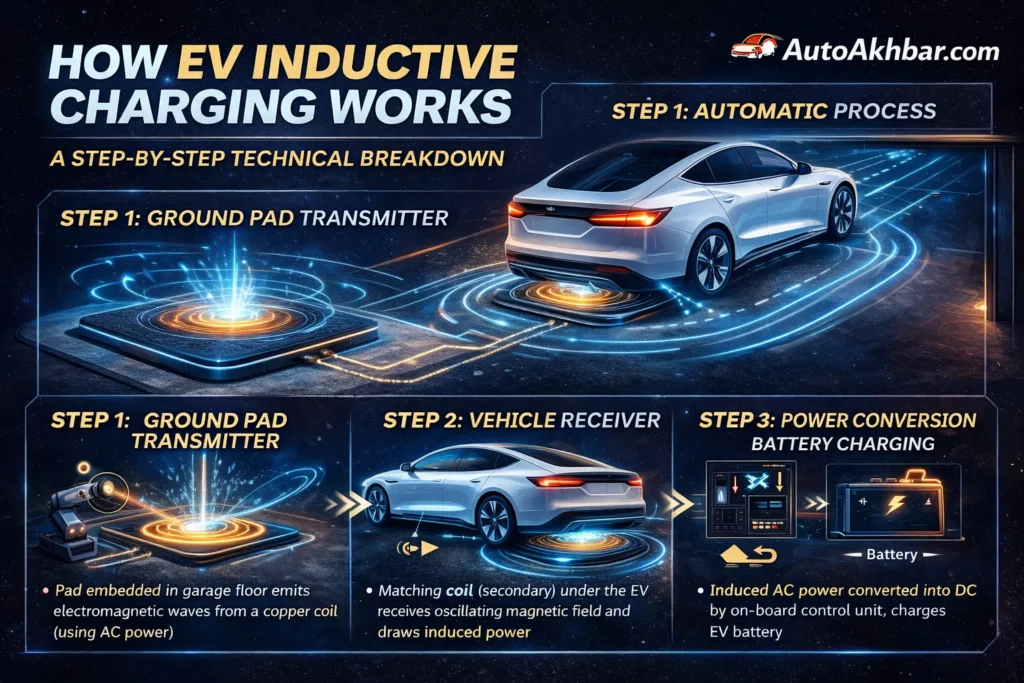
Step 1: The Ground Pad (Transmitter)
A flat pad — roughly the size of a large doormat — is embedded in or placed on your garage floor, parking bay, or charging station. Inside this pad is a primary induction coil, typically a copper coil wound in a flat spiral pattern. When connected to AC power from your home or grid, this coil generates an oscillating electromagnetic field above the pad’s surface.
The coil configuration matters. Most modern systems use a Double D (DD) coil or bipolar coil design, which creates a more intense and directionally focused magnetic field, improving both efficiency and tolerance for slight misalignment.
Step 2: The Vehicle Receiver (Secondary Coil)
Mounted on the underside of the EV is a matching secondary receiver coil. When the car is parked above the ground pad within an acceptable alignment range (typically 10–20 cm of lateral offset), the electromagnetic field from the transmitter coil induces an alternating current in the receiver coil.
This is Faraday’s Law of Electromagnetic Induction in action — the changing magnetic flux through the secondary coil generates voltage.
Step 3: Power Conversion and Battery Charging
The induced AC power in the receiver is then passed through an on-board rectifier and power electronics unit, which converts it to the DC power required to charge the EV’s high-voltage battery pack. A Battery Management System (BMS) manages the charging rate, temperature, and state-of-charge — just as it does during wired charging.
Step 4: Communication and Control
Modern wireless EV chargers don’t just push power blindly. They use a low-bandwidth communication link between the ground pad and the vehicle to negotiate power levels, confirm alignment, detect foreign objects (metal debris, coins, etc.) on the pad, and shut down safely if anomalies are detected. This is handled via protocols such as those defined in SAE J2954, the industry standard for wireless EV charging.
Efficiency and Range
Current best-in-class systems from companies like WiTricity and Mercuso Technology achieve transfer efficiencies of up to 95% — comparable to a standard Level 2 AC wired charger. The practical power range for home systems sits between 3.6 kW and 22 kW, while commercial and fleet systems can push beyond that.
The main efficiency losses occur in the coil-to-coil gap and in the power conversion electronics. The larger the air gap (distance between pad and vehicle), the greater the losses.
Static vs. Dynamic Wireless Charging
There are two major categories of wireless EV charging, and they represent very different visions of the technology’s future:
Static Wireless Charging is what most current consumer and commercial systems offer. The vehicle is parked stationary over a charging pad — in a garage, parking lot, or charging bay. Charging happens while the car is not moving. This is the commercially viable solution today, already deployed by BMW, WiTricity, and several fleet operators globally.
Dynamic Wireless Charging — sometimes called in-road charging or electrified roads — is the more ambitious concept: coils are embedded beneath the road surface, and vehicles receive power while driving. This technology is being piloted in Sweden, Germany, France, Israel, South Korea, and China. Sweden’s Gotland Island had a 2.5-mile inductive trial, and plans exist for a 3,000 km electric motorway network by 2035. In one tested design, systems have delivered up to 200 kW in real time to moving buses — enough to run indefinitely without depleting the battery. This could fundamentally transform the concept of “range anxiety.”
Tesla’s Approach to Wireless EV Charging
Tesla has been characteristically strategic — and deliberate — about wireless charging. For years, the company focused on building out its Supercharger wired network, which remains the gold standard for reliability and speed. But the wireless charging conversation changed significantly in December 2023, when Tesla confirmed it was actively developing a wireless, inductive EV charging platform.
This is consistent with where Tesla’s product roadmap is heading. Consider what Tesla is building: the Cybertruck, the next-generation Roadster, a fleet of autonomous Robotaxis, and a network of Optimus robots. A Tesla ecosystem increasingly built around zero human interaction — with over-the-air updates, Full Self-Driving (FSD), and automatic summon features — makes manual cable plugging an architectural inconsistency.
Wireless charging fits cleanly into Tesla’s vision of a vehicle that parks itself, summons itself, charges itself, and eventually earns you money as a Robotaxi while you sleep.
Tesla’s Integration Advantage
Tesla’s advantage in wireless charging isn’t just engineering — it’s ecosystem integration. Tesla already controls the vehicle hardware, the onboard software, the charging network, and the energy management system (Powerwall, Powerpack). A Tesla wireless charging pad at home could communicate directly with the vehicle via the same API that handles FSD commands, seamlessly integrating with solar power generation and home energy storage.
This level of vertical integration is something no other automaker — and no standalone charging hardware company — can currently replicate.
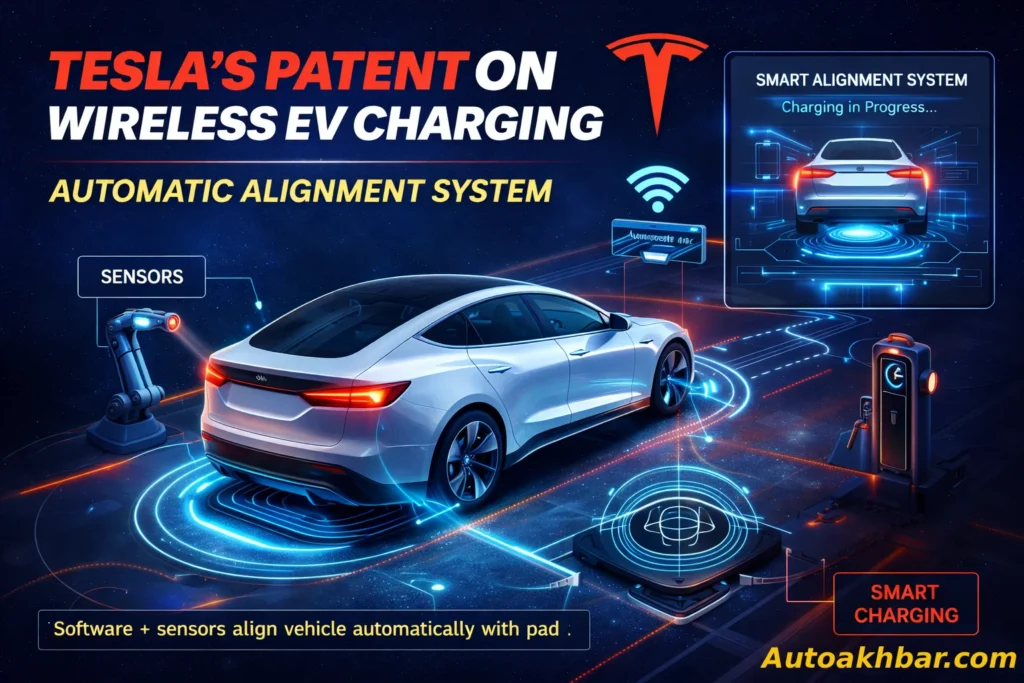
Tesla’s Wireless Charging Patent: What It Actually Means
Tesla’s patent filings related to wireless inductive EV charging reveal several technically interesting approaches. In simple terms, here is what they describe:
Automatic Alignment System: One of the biggest practical problems with wireless charging is precise alignment between the ground pad and the vehicle receiver. Tesla’s patent describes a system where the vehicle automatically adjusts its parking position — using cameras, ultrasonic sensors, and the existing Autopark/Summon infrastructure — to optimally align above the ground pad. The driver parks roughly in the vicinity; the car fine-tunes itself.
Smart Charging via Software: Tesla’s approach involves deep software control of the charging process. The vehicle and pad negotiate in real time — adjusting power levels dynamically based on battery state, grid load, time-of-use pricing, and thermal conditions. This is charging that’s smart, not just wireless.
Real-World Application Possibilities: In a Tesla Robotaxi future, this patent becomes enormously significant. An autonomous vehicle that can navigate to a wireless charging pad, self-align, charge, and then re-enter service — without any human operator involvement — is the logical infrastructure for a truly autonomous fleet. It’s not science fiction; it’s the direct product extension of what Tesla is currently building.
The timeline for consumer-facing Tesla wireless charging products remains unconfirmed. But the technical groundwork is clearly being laid.
Sorry for spoiler, but it looks like the #Robotaxi will adopt a WIRELESS CHARGING system. 👀 pic.twitter.com/rdT300NKzQ
— SETI Park (@seti_park) September 7, 2024
BYD’s Strategy: Flash Charging Over Wireless
If Tesla is betting on wireless and autonomous, BYD is betting on wired and ultra-fast. And right now, BYD’s approach is winning the commercial race.
BYD has invested massively in its Super e-Platform — the world’s first mass-produced full-domain 1000-volt EV architecture. This system enables megawatt-level wired DC charging, allowing a BYD EV to gain approximately 400 km of range in just five minutes — roughly two kilometers per second of charging. That is genuinely competitive with petrol refuelling in terms of time.
BYD’s rollout of Flash Charging stations has been extraordinary in pace: the company activated its 5,000th public flash charging station by early April 2026, just weeks after launching the first one in March 2026. BYD is also planning 3,000 flash charging stations across Europe by end of 2026.
Does BYD have wireless EV charging technology? BYD has not made wireless inductive charging a strategic focus for its current or near-term product line. The company’s position is clear: if you can charge a full battery in five minutes with a wired connection, the ergonomic inconvenience of plugging in becomes a non-argument. BYD’s pragmatic engineering philosophy prioritizes performance and infrastructure scale over the seamlessness that wireless offers.
This creates an interesting market divergence. Tesla is building toward a world where you never touch a cable. BYD is building toward a world where you barely need to — because the entire charging session takes as long as a bathroom break. Both visions can coexist, and both have merit depending on the use case.
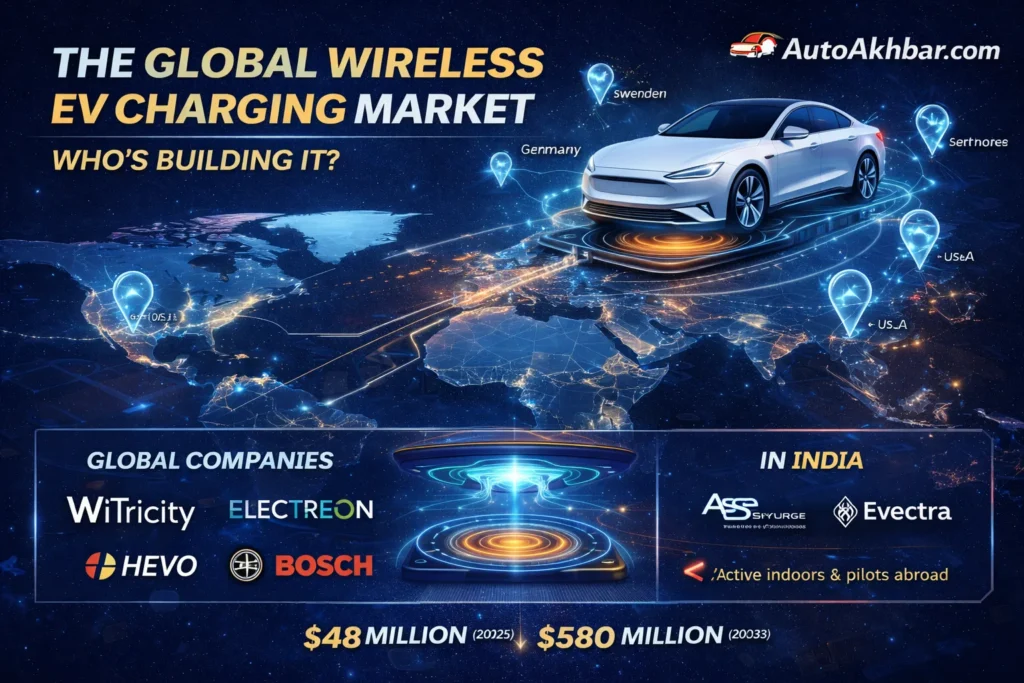
The Global Wireless EV Charging Market: Who’s Building It
The wireless EV charging ecosystem is far more developed than most consumers realize. Here are the key players shaping this market globally:
WiTricity (USA): The leading developer of magnetic resonance wireless charging for EVs. WiTricity’s technology is licensed to multiple automotive OEMs and forms the backbone of much of the SAE J2954 standard. Their systems achieve high efficiency and support a wide range of power levels.
Electreon (Israel/Global): Focused on dynamic wireless charging for roads and commercial vehicle fleets. Electreon recently acquired InductEV (USA), creating what its CEO called a “truly global powerhouse” in wireless EV charging. Their integrated Flow software optimises energy delivery to minimize peak-demand charges.
HEVO (USA): Specializing in wireless charging for urban fleets — buses, delivery vehicles, and taxis. HEVO’s systems are designed for high-utilization commercial environments.
Robert Bosch GmbH (Germany): One of the world’s largest automotive suppliers, Bosch is developing wireless EV charging components for OEM integration — meaning the hardware that goes inside future production EVs.
Continental AG (Germany): Another Tier-1 automotive supplier building wireless charging systems with a focus on safety certification and series production readiness.
Qualcomm (USA): An early pioneer through its Halo wireless EV charging system, Qualcomm helped lay technical groundwork still referenced in modern systems, including the GroundPad solution developed with Renault.
BMW (Germany): Already commercially deployed a wireless charging system for the BMW 530e plug-in hybrid, factory-installed and mounted in the garage. The system charges automatically when parked, completing a full cycle in approximately 3.5 hours at 3.2 kW.
Indian Startups:
- Dash Dynamic (India): Develops inductive charging pads for parking lots, fleet depots, and residential use. Their proprietary Double D coil design improves magnetic field intensity and misalignment tolerance. Dash Dynamic is specifically targeting emerging markets with cable-free, low-maintenance solutions.
- Evectra India: Builds wireless charging systems based on resonant inductive coupling. Their system produces up to 200 kW output with a 300 mm air gap range — making it compatible with a wide range of vehicle clearances — and includes EMF shielding for user and equipment safety.
Pros and Cons of Wireless EV Charging
Advantages
Convenience Above All: The core value proposition is undeniable. Park the car, walk away, come back to a full charge. No connectors to handle, no cables to trip over, no RFID cards to forget.
Reduced Wear on Charging Ports: Physical connectors on both the vehicle and the charger are subject to mechanical wear, corrosion, and damage over time. Eliminating the physical connection also eliminates this failure mode entirely.
Fleet and Commercial Efficiency: For operators running taxi fleets, delivery vehicles, or autonomous vehicles, wireless charging pads reduce operational complexity and enable higher vehicle utilization rates.
Enables True Vehicle Autonomy: An autonomous vehicle that cannot self-charge is only partially autonomous. Wireless charging is a necessary enabler of truly driverless transportation.
Weather Resilience: No exposed electrical connectors means no risk of moisture ingress or contact corrosion in harsh weather — a genuine practical benefit in India’s monsoon conditions or coastal environments.
Disadvantages
Lower Peak Charging Speed: Current wireless home charging systems top out at around 11–22 kW. Wired DC fast chargers routinely deliver 50–350 kW, and BYD’s flash charging pushes into the megawatt range. For daily overnight home charging, this is irrelevant. For highway top-ups, wireless is not yet competitive.
Alignment Sensitivity: Despite advances in DD coil designs and software-guided parking, precise vehicle positioning above the pad still matters for maximum efficiency. Misalignment can reduce efficiency by 10–30% in older systems.
Higher Cost: Wireless EV charging systems require sophisticated electronics in both the pad and the vehicle — the on-board receiver is an expensive addition to vehicle cost. This increases both the purchase price of compatible EVs and the home installation cost of the pad.
Energy Losses: Even at 90–95% efficiency, there is always some energy lost to heat during wireless transfer. At scale and with high-frequency usage, this is a real cost and an environmental consideration.
Limited Vehicle Compatibility: As of 2026, the range of production EVs with factory-fitted wireless charging receivers remains limited. Retrofitting is possible but adds complexity and cost.
Wireless vs. Wired Charging: Speed Comparison
| Charging Type | Typical Power Output | Range Added per Hour | Full Charge Time (60 kWh Battery) |
|---|---|---|---|
| Wireless Home (AC) | 3.6–11 kW | 20–60 km/hr | 6–17 hours |
| Wireless Commercial | 11–22 kW | 60–120 km/hr | 3–6 hours |
| Wired Level 2 AC | 7.4–22 kW | 40–120 km/hr | 3–8 hours |
| Wired DC Fast Charger | 50–150 kW | 250–750 km/hr | 25–75 minutes |
| BYD Flash / Ultra-Fast | 500–1000+ kW | 2 km/second | Under 10 minutes |
The honest conclusion: Wireless charging is not designed to compete with DC fast charging on speed. It is designed to compete with the inconvenience of overnight home charging and fleet depot charging — and on those terms, it wins convincingly.
India Market Analysis: How Ready Is India for Wireless EV Charging?
India’s EV market is moving faster than most global observers credit. The India EV charging station market was valued at $589.1 million in 2025, with projections to reach $1.1 billion by 2034. Government programs like FAME II and state-level EV policies are actively subsidizing charging infrastructure.
However, wireless EV charging in India faces a specific set of challenges:
Infrastructure Readiness: The bulk of India’s current EV charging infrastructure is focused on Level 2 AC chargers and DC fast chargers along highways — the practical priorities for a market still in early EV adoption. Wireless charging is a premium segment, currently cost-prohibitive for most Indian buyers.
Cost Factor: The installed cost of a wireless charging pad system — pad hardware, vehicle receiver, installation — can range from ₹1.5 lakh to ₹5 lakh or more for consumer systems, depending on power level. For the Indian mass market, this remains a significant barrier.
Vehicle Compatibility Gap: Most EVs currently sold in India — Tata Nexon EV, MG ZS EV, Ola S1, and others — do not come equipped with factory wireless charging receivers. Without an OEM mandate or retrofit ecosystem, adoption will be slow.
Power Grid Considerations: Consistent, stable 230V power supply remains a challenge in some Indian residential areas. Wireless charging systems require clean, stable AC input for optimal efficiency.
The Opportunity: India’s startup ecosystem is already active in this space. Dash Dynamic and Evectra India are building India-specific wireless charging solutions targeting parking lots, commercial fleets, and residential complexes in urban centers. Karnataka’s state government has announced plans for 2,500 EV charging stations through public-private partnerships — an infrastructure wave that wireless technology providers can ride.
The timeline for mainstream wireless EV charging in India is realistically 5–8 years for any significant market penetration, likely beginning in premium vehicles and commercial fleet applications before reaching the mass market.
The US and Global Market Perspective
The US market tells a more advanced story. EVgo, ChargePoint, and Electrify America are expanding their networks aggressively, and the integration of wireless technology into commercial and fleet charging is gaining traction.
The US government’s infrastructure push has accelerated EV charging deployment broadly, and while wired fast charging dominates the public network, home wireless charging is increasingly being explored as a premium add-on for premium EVs. The US wireless charging market was valued at $11.91 billion across all segments in 2025, with EV charging as the fastest-growing automotive sub-segment.
Electreon’s acquisition of InductEV has specifically strengthened the US supply chain for wireless charging — and the combined company’s Flow software platform for smart energy management positions them as a serious contender for fleet and transit authority contracts.
WiTricity’s licensing model means that when major OEMs begin integrating wireless charging into production vehicles at scale, they will likely be using WiTricity’s core intellectual property.
Buying Guide: Things to Consider Before Buying an EV Wireless Charger
If you’re seriously considering a wireless EV charging system today, here is the structured framework you need.
1. Vehicle Compatibility
This is the first and most critical check. Does your specific EV model support wireless inductive charging? Does it have a factory-fitted receiver coil, or is a certified aftermarket retrofit available? Without a receiver on the vehicle, the ground pad is useless. Check your vehicle’s technical documentation and contact the OEM directly. Currently, compatible vehicles include certain BMW plug-in hybrids, and select models integrated with WiTricity systems.
2. Installation Requirements
A wireless charging pad installation is not a simple plug-and-play. You will need a qualified electrician to wire the pad to your home’s electrical panel, likely requiring a dedicated 32A circuit for anything above Level 1 charging. For embedded in-floor installations, consider the floor construction, ventilation requirements for the pad electronics, and whether local building codes require permits.
3. Cost
Budget for three components: the ground pad system hardware, the vehicle receiver unit (if not factory-fitted), and installation. Total installed cost for a quality home system ranges from approximately USD 2,000–$5,000 in developed markets and ₹1.5–5 lakh in India. Factor in any utility upgrade costs. Government incentive programs in both the US and India may offset some costs.
4. Charging Efficiency
Verify the declared system efficiency rating. Look for systems certified at 90% efficiency or above. Ask specifically about efficiency at your vehicle’s actual clearance height, since air gap significantly affects performance. Lower efficiency means higher electricity bills over the system’s lifetime.
5. Brand Reliability and Warranty
Choose systems from established players with verifiable OEM partnerships and service networks. WiTricity, Bosch, and Continental are globally reliable. In India, verify that service and warranty support is locally available. Startup hardware from unverified sellers carries warranty and safety risks that outweigh any cost savings.
6. Safety Certifications
This is non-negotiable. Your wireless EV charger must meet relevant safety standards: SAE J2954 (the North American standard for wireless EV charging), IEC 61980 (international standard), and UL certification (for US buyers). Look for Foreign Object Detection (FOD) certification — this ensures the system can detect metal objects on the pad and shut down safely before they heat up. In India, look for BIS (Bureau of Indian Standards) approval as the regulatory framework develops.
Where to Buy a Wireless EV Charger
Given the technical complexity and safety requirements, sourcing matters.
Official OEM Channels: If your EV manufacturer offers an official wireless charging solution (BMW, for instance), always purchase through the official dealership or OEM-certified installer. This ensures warranty compatibility and technical support.
WiTricity Authorized Partners: WiTricity’s licensing network means their technology is available through certified automotive suppliers and installation partners. Their website lists authorized channels.
Electreon and HEVO: Primarily serve commercial fleet and transit applications. Contact them directly for fleet-scale deployments.
India — Dash Dynamic and Evectra India: For India-specific residential and commercial applications, contact these startups directly for demo and installation quotes. Both offer systems designed for Indian grid conditions and vehicle types.
Important: Avoid generic “wireless EV charger” listings on unverified e-commerce platforms. EV wireless charging hardware is not a commodity product — the safety, compatibility, and efficiency claims of unverified sellers cannot be trusted. The consequences of an uncertified high-power inductive charger malfunctioning near your vehicle’s fuel system equivalent (battery pack) are severe.
Specifications Comparison Table
| Parameter | Entry-Level Home Pad | Mid-Range System | Premium/Commercial System |
|---|---|---|---|
| Power Output | 3.6–7.4 kW | 11 kW | 22 kW+ |
| Transfer Efficiency | 85–90% | 90–93% | 93–95%+ |
| Air Gap Tolerance | Up to 10 cm | Up to 20 cm | Up to 35 cm |
| Lateral Misalignment Tolerance | ±5 cm | ±10 cm | ±15 cm |
| Communication Protocol | Proprietary / Bluetooth | SAE J2954 | SAE J2954 / ISO 15118 |
| Foreign Object Detection | Basic | Advanced | Advanced + thermal monitoring |
| Installation Type | Surface-mounted | Surface or recessed | In-floor embedded |
| Certifications | Varies | UL / IEC 61980 | UL / IEC 61980 / BIS (India) |
| Typical Cost (USD) | $1,500–$2,000 | $2,500–$4,000 | $5,000–$15,000+ |
| Best For | Home overnight | Home / small fleet | Fleet / commercial |
Expert Opinion: The Future of Wireless EV Charging
Here’s where I’ll be direct with you. Wireless EV charging is not a gimmick, and it is not the future — it is a parallel present that’s maturing at pace.
The Tesla confirmation of an inductive charging platform in 2023 was the signal the industry needed. When the world’s most influential EV company validates a technology, OEM adoption accelerates across the board. We are now watching that acceleration unfold.
The technology’s efficiency curve is impressive — from 80–85% just five years ago to 93–95% today. The cost curve is following the same downward trajectory as every other semiconductor-driven technology. Within five years, wireless charging receivers will be a standard feature on mid-to-premium EV models globally, in the same way that backup cameras went from luxury option to legal requirement.
The dynamic wireless charging story is the one that genuinely excites me technically. Electrified roads that charge vehicles in motion could render range anxiety obsolete permanently — not by adding more chargers, but by removing the binary distinction between driving and charging. Sweden’s active pilots and the stated goal of 3,000 km of electric roads by 2035 suggest this is no longer speculative.
For India specifically, the opportunity is to not repeat the mistakes of building wired charging infrastructure that becomes obsolete. The smart move for smart city planners and private fleet operators is to integrate wireless charging pad provisions into parking infrastructure being built today — at marginal additional cost — so that as EV adoption accelerates, the infrastructure is ready.
The plug will not disappear overnight. But its days are numbered.
Conclusion
Wireless charging for electric cars is no longer a question of if — it’s a question of when, for whom, and at what cost. The technology works. The efficiency is there. The safety standards are maturing. The market is growing at 36% annually. And the biggest EV company in the world has confirmed it’s building the hardware.
For early adopters and fleet operators, the time to start evaluating wireless EV charging systems is now — particularly for home installation and commercial depot applications where the convenience payoff is immediate.
For the Indian market, the play is patient but proactive: watch the OEM integration announcements, track the BIS certification framework, and plan new parking infrastructure with wireless-compatible provisions.
The road ahead is charging under your wheels whether you see it or not.
📌 Stay Updated: Bookmark AutoAkhbar.com and subscribe to our EV newsletter for weekly coverage of emerging charging technologies, new EV launches in India, and deep-dive technical guides.
💬 Got a question about wireless EV charging? Drop it in the comments below — our editorial team responds to every query.
External Links Reference List
| # | Resource | URL | Purpose |
|---|---|---|---|
| 1 | SAE J2954 Standard (SAE International) | https://www.sae.org/standards/content/j2954/ | Technical standard reference |
| 2 | WiTricity Official | https://witricity.com | Leading wireless EV charging licensor |
| 3 | Electreon Wireless | https://www.electreon.com | Dynamic road charging technology |
| 4 | StartUs Insights — Wireless EV Companies 2026 | https://www.startus-insights.com/innovators-guide/wireless-ev-charging-companies/ | India startup reference |
| 5 | Bolt.Earth — EV Charging Innovations 2026 | https://bolt.earth/blog/top-5-ev-charging-innovations-of-2026-set-to-solve-range-anxiety | Indian EV charging context |
| 6 | IEA Global EV Outlook | https://www.iea.org/reports/global-ev-outlook | Market data |
| 7 | Allied Market Research — Wireless EV Market | https://www.alliedmarketresearch.com/wireless-electric-vehicle-charging-market | Market sizing data |
| 8 | FAME II Scheme — Ministry of Heavy Industries India | https://heavyindustries.gov.in/fame-india | India policy reference |
Frequently Asked Questions Wireless Charger for EV Car
Can I retrofit my existing EV with wireless charging?
In some cases, yes. Companies like Evatran (Plugless Power) have offered aftermarket retrofit kits for specific EV models, including older Nissan Leafs and Chevy Volts. However, retrofits require certified installation, and compatibility depends heavily on your specific vehicle model and year. Always verify with a certified installer before purchasing.
Is wireless EV charging safe near a pacemaker or medical implant?
Inductive charging pads produce electromagnetic fields, which can, in principle, interfere with certain implanted medical devices. Reputable systems include extensive shielding and comply with ICNIRP guidelines on electromagnetic field exposure. If you have an implanted device, consult your cardiologist before using or installing a high-power wireless EV charging system.
Does rain or water affect wireless EV charging?
Well-designed wireless charging pads are rated for outdoor use and are sealed against water ingress. The electromagnetic field is not affected by water in the gap between pad and vehicle. However, debris, snow, or standing water above the pad can reduce efficiency. Systems with Foreign Object Detection will flag anomalies and suspend charging if conditions compromise safety.
What happens if a child or pet walks over the charging pad while it’s active?
Modern certified systems are required to have automatic Living Object Protection (LOP) detection in addition to Foreign Object Detection. These systems use inductive sensing and thermal monitoring to detect the presence of living objects and immediately suspend power transmission. This is a mandatory safety feature in SAE J2954-compliant systems.
How does wireless charging efficiency compare over the lifetime of the system?
Quality wireless charging systems maintain their efficiency ratings over thousands of charge cycles with minimal degradation — the coils themselves have no moving parts and are sealed against environmental exposure. The most likely wear points are the power electronics, which in well-engineered systems are designed for 10+ year service lives. Efficiency degradation over the system’s lifetime is typically less than 2–3%.

Shubham Sharma
Founder & Automotive Content Strategist | AutoAkhbar
Shubham Sharma is the founder of AutoAkhbar, where he focuses on delivering accurate, data-driven automotive news, EV insights, and in-depth car analysis. With expertise in digital marketing and SEO, he specialises in building high-authority automotive content platforms.
He actively tracks global EV trends, emerging technologies, and market shifts to provide readers with reliable and up-to-date insights. His goal is to simplify complex automotive topics and help users make informed decisions.
📍 India | 🚗 EV Trends • Automotive News • SEO Strategy
© 2026 AutoAkhbar.com | All Rights Reserved | For republication queries, contact support@autoakhbar.com