🔋 Intro: Why EV Battery Care Matters More Than Ever
Electric cars are transforming the world — clean, quiet, and smart. Yet, the biggest concern every EV owner has is the battery. Will it last? Will it degrade too soon?
Truth is, a well-maintained EV battery can easily last 15–20 years — far beyond the typical ownership period. But poor habits can silently reduce that lifespan.
At AutoAkhbar, we’ve gathered real-world insights and expert advice to give you five proven ways to extend your EV battery life — the same tips even seasoned EV engineers follow.
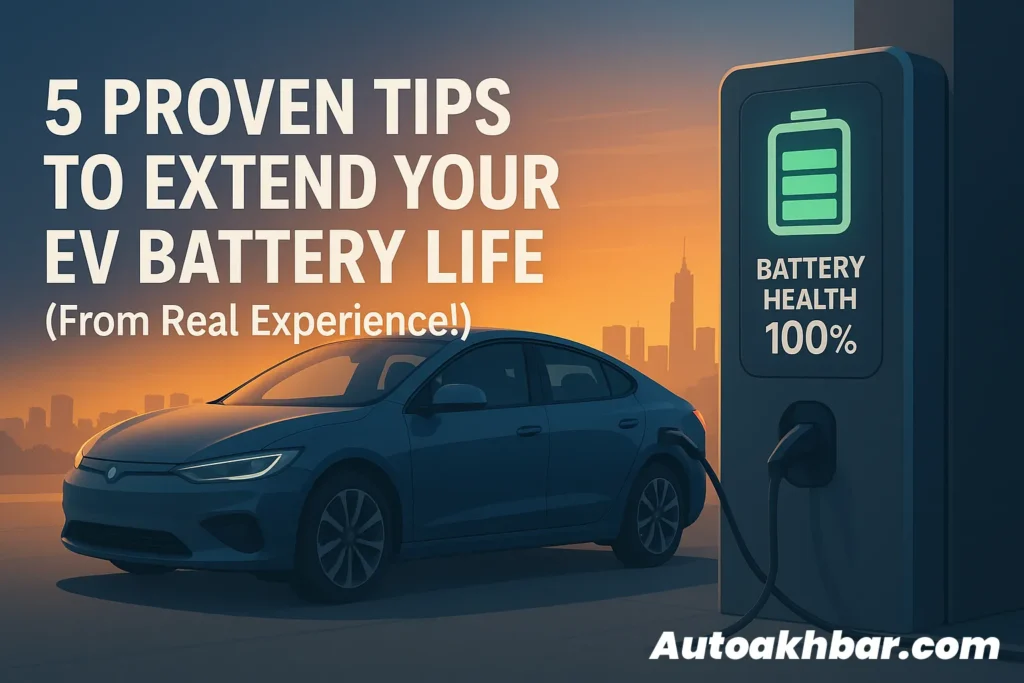
Table of Contents
⚡ Quick Facts: EV Battery Lifespan
| Factor | Good Practice | Why It Matters |
|---|---|---|
| Charging Level | Keep between 20%–80% | Prevents cell stress |
| Charging Speed | Use slow/home charging when possible | Reduces heat damage |
| Temperature | Precondition before charging | Maintains chemistry balance |
| Battery Chemistry | LFP & NMC have different needs | Helps tailor your care |
| Deep Cycles | Occasionally go from 0–100% | Calibrates battery management |
🧩 1. Read Your EV’s Manual — Seriously
Every EV manufacturer includes detailed charging and maintenance recommendations, often hidden in the infotainment system. It’s not just legal fluff — it’s gold.
Your manual clarifies what “ideal charging patterns” mean. For example:
“Charge to 100% at least once a month” ≠ “Charge to 100% every night.”
Understanding the manufacturer’s intent keeps your battery healthy and ensures you follow the chemistry’s real needs — not myths you hear online.

⚙️ 2. Don’t Keep It Fully Charged for Days
Think of a fully charged battery like a balloon stretched to its limit — it’s under tension.
Leaving your EV parked for days at 100% state of charge (SOC) causes chemical stress.
💡 Pro Tip:
Keep your EV between 20%–80% for daily driving. If your commute is short, charge once or twice a week — not every night.
EVs love balance. And if you only drive 10–15 miles a day, topping up constantly just keeps your battery “on edge.” Treat it like you would your smartphone — smart, not obsessive.
⚡ 3. Fast Charging Isn’t Evil — But Be Smart About It
There’s a myth that rapid charging “kills” batteries. Modern EVs prove otherwise.
Even 400kW chargers are managed by your car’s Battery Management System (BMS) — a powerful computer that controls voltage, current, and temperature.
✅ Use ultra-rapid chargers when needed.
✅ Prefer home or slow charging when you can.
Tesla data from thousands of vehicles shows only minor degradation differences between frequent fast-charging users and those who charge slowly. The takeaway: convenience first, panic never.
🌡️ 4. Respect Battery Temperature
EV batteries work best when warm — not hot, not freezing.
Cold weather thickens the battery’s internal chemistry, while heat accelerates wear.
That’s why most EVs come with preconditioning systems to warm or cool the battery before driving or charging.
If your car allows it:
- Precondition 30–60 minutes before charging, especially in cold climates.
- In winter, keep your EV plugged in overnight so the system uses charger power to stay warm.
Skipping preconditioning may not break your battery — but it will slow charging, reduce range, and stress cells over time.
🔁 5. Calibrate Your Battery Once in a While
Your EV’s battery pack contains thousands of individual cells. Over time, their charge readings drift apart.
To realign them, you occasionally need a full cycle — from 0% to 100%.
✅ Do this every 1–2 months for LFP batteries.
✅ Do it once or twice a year for NMC batteries.
This helps the BMS recalibrate its “state of charge” reading and keeps your range estimate accurate. It’s like giving your battery a “health check.”
⚖️ EV vs ICE: The Maintenance Difference
| Factor | ICE (Petrol/Diesel) | EV |
|---|---|---|
| Maintenance | Oil, filters, fluids | Software updates & charging care |
| Lifespan | Engine wear & tear | Battery management dependent |
| Cost of Repairs | Frequent | Minimal |
| Key Habit | Warm engine before pushing | Avoid full charge/empty states |
🌍 AutoAkhbar’s Take
Battery anxiety is real — but often unnecessary.
Today’s EVs are engineered to protect themselves better than any ICE car ever could. If you follow even three of these five tips, your battery will outlast your ownership.
Think of it as smart driving, not cautious driving. You’re not just saving range — you’re saving your future resale value.
FAQ For Extend Your EV Battery Life
How long does an EV battery last?
Most EV batteries are designed for 15–20 years or around 250,000–500,000 miles with proper care.
Is it bad to charge my EV to 100%?
Not always. It’s fine for long trips — but avoid keeping it at 100% for days.
Should I let my EV battery go to 0%?
Occasionally yes, for calibration. But doing it frequently adds stress.
Can I fast-charge daily?
Yes, if needed. Modern EVs have BMS protection to prevent damage.
Do temperature extremes harm EV batteries?
Yes. Always precondition in cold or hot weather for best performance.