Introduction: The Car Tesla Said Would Never Exist
Not long ago, Elon Musk stood in front of investors and called the idea of an affordable Tesla for everyday drivers “pointless.” He said it would be “silly” to build a $25,000 electric car when Tesla was close to deploying fully autonomous robotaxis. The Model 2 — Tesla’s long-promised budget EV — was officially dead.
That was 2024.
Fast forward to early 2026, and something remarkable happened: Tesla delivered 2,500 pilot units of the very same affordable car, now internally codenamed “Project Redwood,” to European fleet operators. Production lines at Gigafactory Texas are running. Mass consumer deliveries are targeting late 2026.
So what changed? Why did Tesla reverse course? And what exactly is this car?
This article breaks it all down — from the full history of the Model 2’s cancellation and comeback, to exactly how it differs from the Model 3, to what you can realistically expect when (and if) it arrives at dealerships.
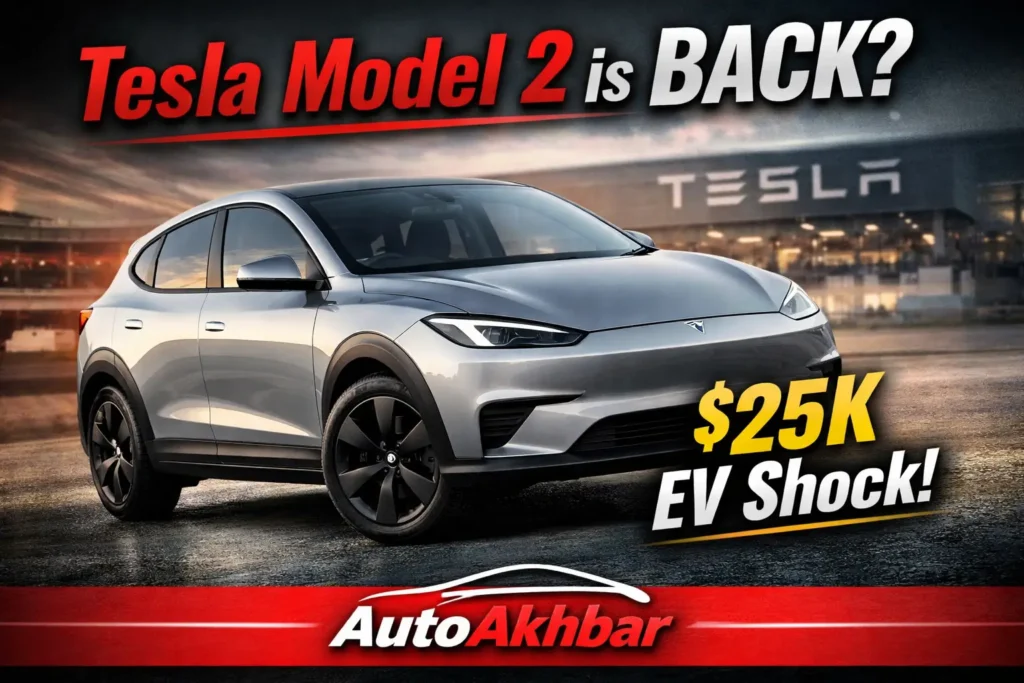
Table of Contents
A Quick Background: What Is the “Tesla Model 2”?
First things first: Tesla has never officially called this car the “Model 2.”
Internally, the project is codenamed Project Redwood, and the platform it sits on is officially referred to as Tesla’s next-generation vehicle platform. The name “Model 2” was coined by automotive media, while the nickname “Model Q” was invented by Deutsche Bank analyst Emmanuel Rosner in a December 2024 research note when he projected a sub-$30,000 Tesla for the first half of 2025.
Despite the lack of an official name, the concept is clear: a compact, affordable Tesla — priced around $25,000 before incentives — designed to open the electric vehicle market to buyers who could never afford a Model 3 or Model Y.
The Rocky Road to This Moment: A Timeline
To understand why this car’s comeback is such a big deal, you need to understand how many times it nearly died.
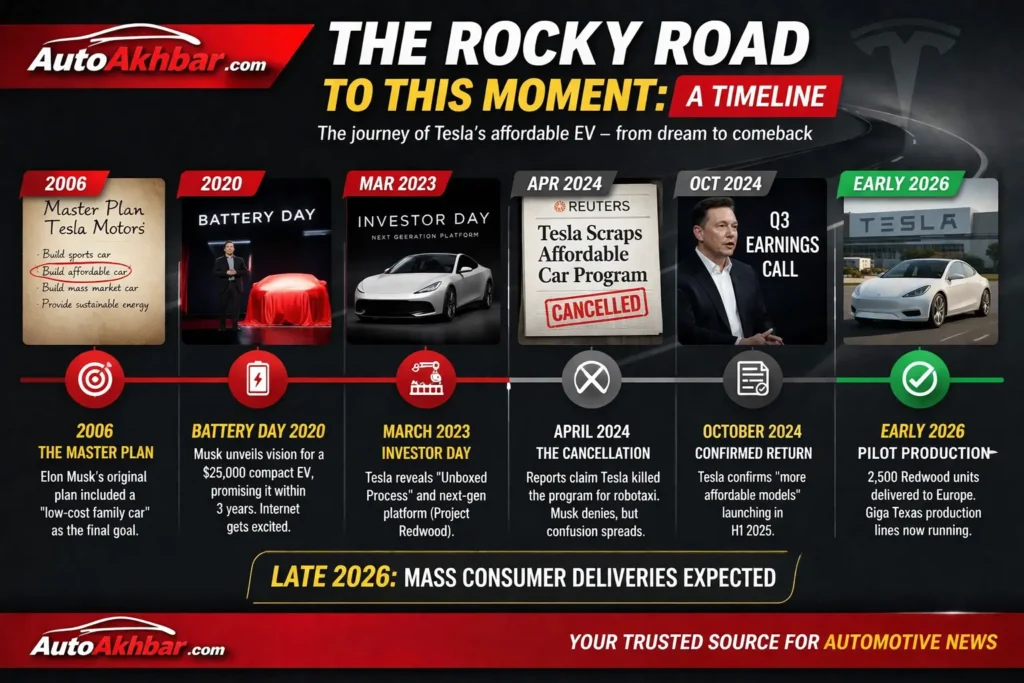
2006 — The Master Plan: Elon Musk’s original Tesla “Master Plan” included a final goal of creating “a low-cost family car.” The Model 2 has always been the endgame.
Battery Day 2020: Musk publicly presented the vision of a compact, fully autonomous, affordable electric car. He promised a $25,000 price point within three years. The internet went wild.
March 2023 — Investor Day: Tesla officially revealed the next-generation vehicle platform (Project Redwood) and introduced the world to the “Unboxed Process” — a radical new manufacturing method designed to cut production costs in half.
April 2024 — The Cancellation: Reuters reported that Tesla had scrapped the affordable car program entirely, shifting resources toward the robotaxi. Tesla denied the report within hours. Musk confirmed on social media that an affordable car was still in development — but the confusion shook investor and consumer confidence.
October 2024 — Q3 Earnings: Tesla’s official shareholder letter stated clearly: “Preparations remain underway for our offering of new vehicles — including more affordable models — which we will begin launching in the first half of 2025.” Musk verbally confirmed this on the earnings call.
Early 2026 — Pilot Production Confirmed: Gigafactory Texas began pilot production of Redwood units in February 2026. In Q1 2026, Tesla delivered 2,500 pilot units to European fleet operators — pre-consumer validation builds, not retail sales, but hard proof the assembly line is real and running.
Late 2026 (Projected): Mass consumer deliveries expected in the United States, with European deliveries from Giga Berlin targeting Q1 2027.
Why Did Tesla Bring It Back? The Real Reasons
1. Deliveries Are Falling — Fast
Tesla peaked at 1.81 million deliveries in 2023. By 2024, that dropped to 1.79 million. In 2025, it fell further to 1.636 million. In Q1 2026, Tesla delivered just 358,000 vehicles — missing analyst expectations again. For a company that built its valuation on perpetual growth, this is a serious problem.
The affordable car is Tesla’s most direct path back to volume.
2. BYD Is Winning the Volume War
Chinese EV giant BYD has officially overtaken Tesla as the world’s leading battery electric vehicle producer by volume. BYD and other Chinese manufacturers like Xiaomi are rapidly scaling their global footprints with aggressively priced EVs. In Europe especially, affordable Chinese hatchbacks have begun eroding market share from legacy automakers — and Tesla is not immune.
Without a car in the $20,000–$30,000 range, Tesla simply cannot compete for the next wave of first-time EV buyers.
3. The Robotaxi Dream Moved Slower Than Musk Hoped
Musk’s core argument for killing the Model 2 was that autonomous vehicles would make personal car ownership obsolete. But Tesla’s robotaxi service in Austin, which launched in June 2025, still operates with only a handful of vehicles in a limited geofence. The fully autonomous future hasn’t arrived on schedule.
One Tesla employee told Reuters that the new vehicle reflects a dual-purpose approach — the car would be “driverless but offer a human-driven option” — which suggests Tesla is acknowledging that real-world autonomy needs more time, and that there’s still a massive market for cars that humans drive themselves.
4. Senior Executives Were Right All Along
When Musk decided to kill the affordable car in 2024, that decision reportedly went against the recommendations of virtually every senior Tesla executive. The internal push to build for the mass market never went away — and eventually, the market data confirmed what those executives had been saying.
What Makes the Model 2 Different From the Model 3?
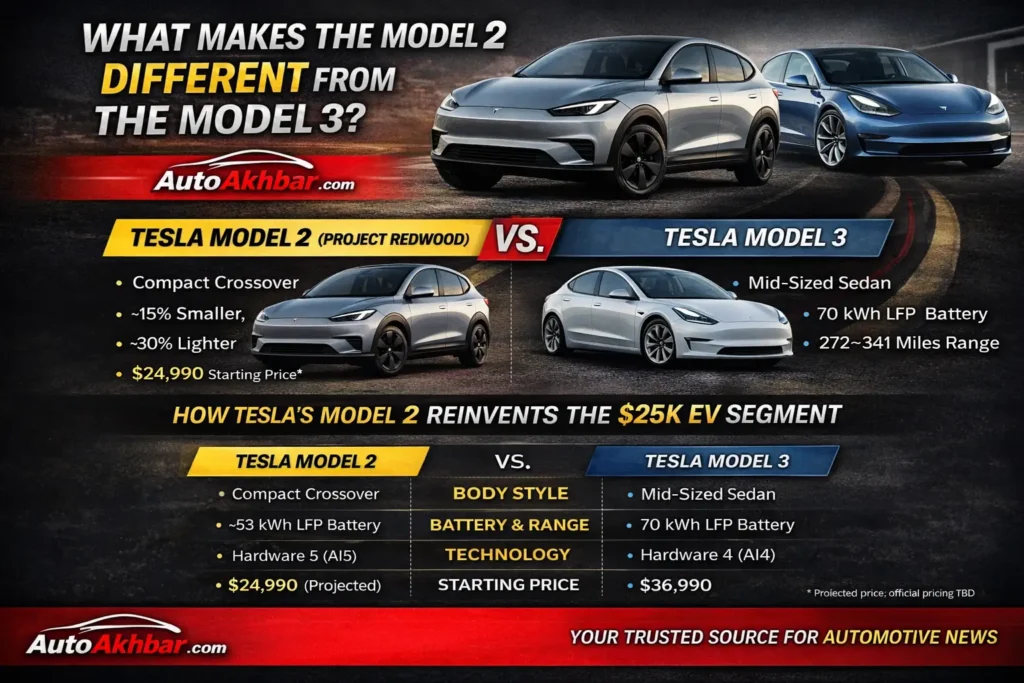
This is where it gets genuinely interesting. The Model 2 is not just a cheaper Model 3. It is built on an entirely different platform, manufactured in an entirely different way, and designed for a fundamentally different buyer.
Size and Form Factor
The Model 2 is expected to be approximately 15% smaller and 30% lighter than the Model 3, with a length of roughly 3,988mm (157 inches). For context, the current Model 3 is 185 inches long — this makes the Model 2 closer in size to a Mini Cooper or a Volkswagen Golf.
In terms of body style, leaked supplier data and spy shots suggest a compact crossover form factor rather than a traditional sedan. It sits slightly higher than the Model 3, with a shorter wheelbase optimized for urban parking and city driving. Think of it as a baby SUV for city streets.
Design Language
While Tesla has not officially revealed final production imagery, supply chain reports and pilot unit observations describe a vehicle with:
- A “Kamm-back” rear design for aerodynamic efficiency
- A minimalist front fascia without a traditional grille (consistent with Tesla’s brand language)
- Slim LED headlights and taillights with what some describe as a “Baby Cybertruck” influence in its lighting signatures
- A drag coefficient aiming below 0.21 Cd — which would make it among the most aerodynamic hatchbacks in its class
- Clean body lines and aero wheel covers to minimize turbulence and maximize range
The overall aesthetic is expected to be unmistakably Tesla — clean, uncluttered, and modern — but in a more practical, city-friendly package.
Battery and Range
Where the Model 3’s entry-level version uses a battery believed to be under 70 kWh, the Model 2 is expected to use a 53 kWh Lithium Iron Phosphate (LFP) battery pack. LFP chemistry is less energy-dense than the nickel-based cells in premium Teslas, but it is significantly cheaper, offers better thermal stability, and has longer cycle life. This is the same type of chemistry used in the entry-level Model 3 sold in China.
Despite the smaller battery, the Model 2’s lighter weight and superior aerodynamics are expected to deliver an estimated range of approximately 250 miles (EPA) / 410 km (WLTP) — competitive for a vehicle in its price class.
Technology and Hardware
Here is where the Model 2 is genuinely impressive: every unit comes equipped with Hardware 5 (AI5) — Tesla’s latest autonomy computing platform, fully compatible with FSD v14.x software. You are getting the same brain as Tesla’s most advanced vehicles, just in a smaller, cheaper body.
Full Self-Driving will remain a subscription add-on (not standard), but base Autopilot — lane-keeping, adaptive cruise control, and emergency braking — is expected to be included at no additional cost.
Additionally, the Model 2 uses a 48-volt low-voltage architecture, following the lead of the Cybertruck. This reduces copper usage in the wiring harness by approximately 15kg — a meaningful cost and weight saving that contributes to the $25,000 price target.
Price — The Number That Changes Everything
The Model 3 RWD currently starts at $36,990 in the US before fees and incentives. The Model 2 is targeting $24,990 before incentives.
After the $7,500 US federal EV tax credit, the effective price drops to approximately $17,500 — less than the average price of a used car in America ($27,250 in Q1 2026, according to Cox Automotive).
That is not just a cheaper Tesla. That is a car that disrupts the used car market.
| Feature | Tesla Model 3 (2026) | Tesla Model 2 (Projected) |
|---|---|---|
| Starting Price | ~$36,990 | ~$24,990 |
| Length | 185 inches (4,694mm) | ~157 inches (3,988mm) |
| Battery | ~70 kWh (LFP base) | ~53 kWh (LFP) |
| Est. Range | 321–363 miles EPA | ~250 miles EPA |
| Autonomy HW | Hardware 5 (AI5) | Hardware 5 (AI5) |
| Body Style | Sedan | Compact Crossover |
| Production | Giga Shanghai / Fremont | Giga Texas / Giga Berlin |
Wireless Charger for EV Car: The Future of EV Charging Is AlreadyHere — And It’s Plug-Free
The Technology That Makes the Price Possible: The Unboxed Process
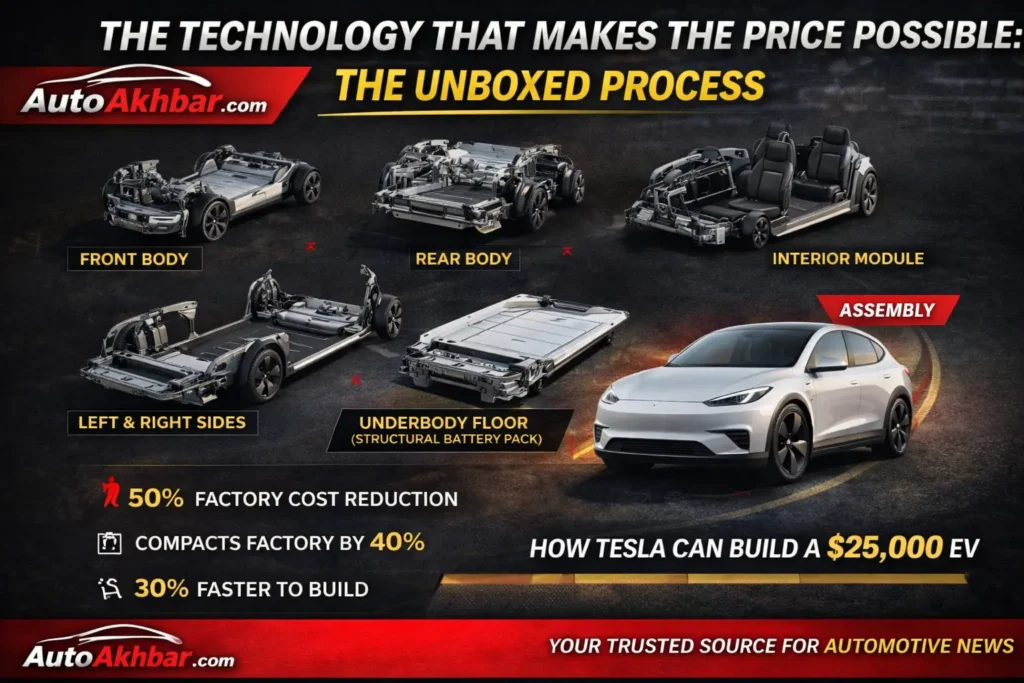
You cannot understand the Model 2 without understanding the Unboxed Process — Tesla’s most radical manufacturing innovation since the Giga Press.
Traditional car manufacturing works like this: a metal shell moves down a long linear track while workers and robots reach inside to install components. It is cramped, slow, and inherently sequential. One bottleneck slows the entire line.
Tesla’s Unboxed Process throws that out. The car is broken into six large sub-assemblies — front body, rear body, left and right sides, underbody floor (which doubles as the structural battery pack), and the interior module — and all of them are built simultaneously in specialized areas of the factory. They only come together for final assembly at the very end, like snapping together large Lego bricks.
The results, according to Tesla and independent analysts:
- ~50% reduction in manufacturing costs compared to the Model 3 platform
- ~40% reduction in factory footprint
- ~30% faster assembly time due to parallel workflows
- $400–$800 saved per vehicle in inspection and correction costs alone, compared to legacy manufacturers
This manufacturing innovation — not cheaper materials — is what makes the $25,000 price point theoretically viable while maintaining healthy profit margins.
Combined with Giga Press castings that replace hundreds of individual parts with single aluminum components, and a structural battery pack that serves as the car’s floor, the Model 2 represents a completely new philosophy of what a car factory should be.
What Official Announcements Tell Us
Tesla has been careful with its language, but the evidence is now substantial:
Tesla Investor Day, March 2023: Elon Musk and engineering team officially unveiled the next-generation vehicle platform and the Unboxed Process. Tesla stated its goal was to cut production costs by more than 50%.
Q3 2024 Shareholder Letter: Tesla officially stated that preparations were underway for “more affordable models” launching in the first half of 2025 — the clearest official confirmation to date.
Reuters Report, April 2026: Four sources confirmed Tesla is actively developing a smaller, cheaper EV based in Shanghai, with plans to expand to the US and Europe. The report noted that production is unlikely to begin at full scale in 2026, but pilot units are running.
Q1 2026 Delivery Data: Tesla disclosed 2,500 “Redwood” pilot units delivered to European fleet operators — not retail sales, but the first time Tesla acknowledged real-world deployment of the vehicle.
Gigafactory Texas Activity: Giga Texas began pilot production of Redwood units using the Unboxed Process in February 2026. Plant operations at Giga Berlin-Brandenburg have also been confirmed in preparation for European production.
Patent Filings: Tesla has filed multiple patents related to the Unboxed manufacturing process, the 48V architecture, and structural battery integration — all technologies central to the Model 2 platform. These filings, while not naming the Model 2 specifically, map directly onto what Project Redwood requires.
Where Will It Be Made?
Production of the Model 2 is spread across multiple gigafactories to serve regional markets efficiently:
- Gigafactory Texas (Austin): Primary US production hub. Pilot lines operational as of February 2026. Mass consumer ramp targeting late 2026.
- Gigafactory Berlin-Brandenburg: European production. Plant preparing for a “second partial approval” for capacity expansion specifically for the next-gen platform. European deliveries projected for Q1 2027.
- Gigafactory Shanghai: Three of four Reuters sources cited Shanghai as the base for additional production, particularly for Asian markets. Chinese production avoids EU import tariffs.
- Gigafactory Mexico (Planned): Originally announced as the primary Model 2 facility, Mexico remains part of the long-term scaling plan, though its status is subject to ongoing trade policy discussions.
Our Verdict: Should You Be Excited — or Skeptical?
After years of delays, false starts, cancellations, and denials, it is completely reasonable to approach the Model 2 with a healthy dose of skepticism. Tesla has missed its own timelines on this car more times than most people can count. The “unboxed” manufacturing process is ambitious and largely unproven at the scale Tesla needs. And Elon Musk’s stated timelines have a well-documented habit of slipping.
But here is what is different now compared to 2022, 2023, or 2024: there are actual cars rolling off actual production lines. The 2,500 pilot units delivered to European fleet operators in Q1 2026 are not renders, patents, or promises. They are physical vehicles that have been driven and validated. The production tooling exists. The gigafactories are running.
The strategic case for this car has never been stronger. Tesla’s sales are declining. BYD is winning. The robotaxi future is taking longer than expected. And there are hundreds of millions of buyers around the world who want a Tesla but simply cannot afford one.
At $17,500 effective after US federal tax credits — cheaper than the average used car in America — the Model 2 does not just compete in the EV market. It threatens to reshape the entire automotive market.
Is it coming? Yes, almost certainly. The only remaining questions are exactly when, at what final price, and whether Tesla can execute the Unboxed Process at scale without the quality issues and production chaos that haunted the Model 3 ramp in 2017.
If they get it right, this is the most important car Tesla has ever made. And for millions of buyers who have been waiting for an affordable electric car worthy of the name, the wait may finally be almost over.
Frequently Asked Questions
What is the Tesla Model 2?
The Tesla Model 2 is the media name for Tesla’s next-generation affordable electric car, internally codenamed Project Redwood. It targets a $25,000 price point before incentives and is designed for everyday buyers who cannot afford the Model 3 or Model Y.
When will the Tesla Model 2 be released?
Mass consumer deliveries in the US are projected for late 2026, with European deliveries from Giga Berlin expected in Q1 2027. Pilot production is already underway at Gigafactory Texas as of early 2026.
How is the Model 2 different from the Model 3?
The Model 2 is approximately 15% smaller, 30% lighter, uses a smaller 53 kWh LFP battery (vs. ~70 kWh in the Model 3 base), has a compact crossover body style rather than a sedan, and starts around $25,000 compared to the Model 3’s $36,990 entry price.
Will the Model 2 have Full Self-Driving?
Every Model 2 comes standard with Hardware 5 (AI5), Tesla’s latest autonomy computer. Full Self-Driving will remain a paid subscription add-on. Base Autopilot is expected to be included at no extra cost.
Has Tesla officially confirmed the Model 2?
Tesla has confirmed development of a next-generation vehicle platform and affordable models, and has acknowledged delivery of 2,500 pilot units in Q1 2026. The name “Model 2” has never been used officially by Tesla — the car is internally known as Project Redwood.
Recommended External Resources
For readers who want to go deeper, here are authoritative sources worth consulting:
- Tesla Investor Relations — Official shareholder letters and earnings call transcripts where Tesla has confirmed affordable model plans
- Electrek — Leading independent EV news outlet covering Project Redwood extensively
- Wikipedia: Tesla next-generation vehicle platform — Comprehensive, cited overview of the technical platform
- Reuters Automotive — Source of original reporting on Tesla’s affordable car development
- US Department of Energy — EV Tax Credits — Official information on the $7,500 federal EV tax credit that could bring the Model 2’s effective price below $18,000
- Tesla Master Plan Part 3 — Tesla’s official long-term vision document, which references the compact vehicle with a 42 million unit lifetime sales target
This article is based on publicly available information as of April 2026, including official Tesla communications, verified press reports, and supply chain data. Specifications are projections based on pilot production data and analyst estimates. Final consumer specifications and pricing have not been officially confirmed by Tesla.
Published by AutoAkhbar.com — Your trusted source for automotive news and analysis.

Shubham Sharma
Founder & Automotive Content Strategist | AutoAkhbar
Shubham Sharma is the founder of AutoAkhbar, where he focuses on delivering accurate, data-driven automotive news, EV insights, and in-depth car analysis. With expertise in digital marketing and SEO, he specialises in building high-authority automotive content platforms.
He actively tracks global EV trends, emerging technologies, and market shifts to provide readers with reliable and up-to-date insights. His goal is to simplify complex automotive topics and help users make informed decisions.
📍 India | 🚗 EV Trends • Automotive News • SEO Strategy