The Juke goes fully electric for the first time in its 15-year history. Here’s a complete breakdown of the technology, battery system, V2G capability, and how it stacks up against the BYD Atto 2.
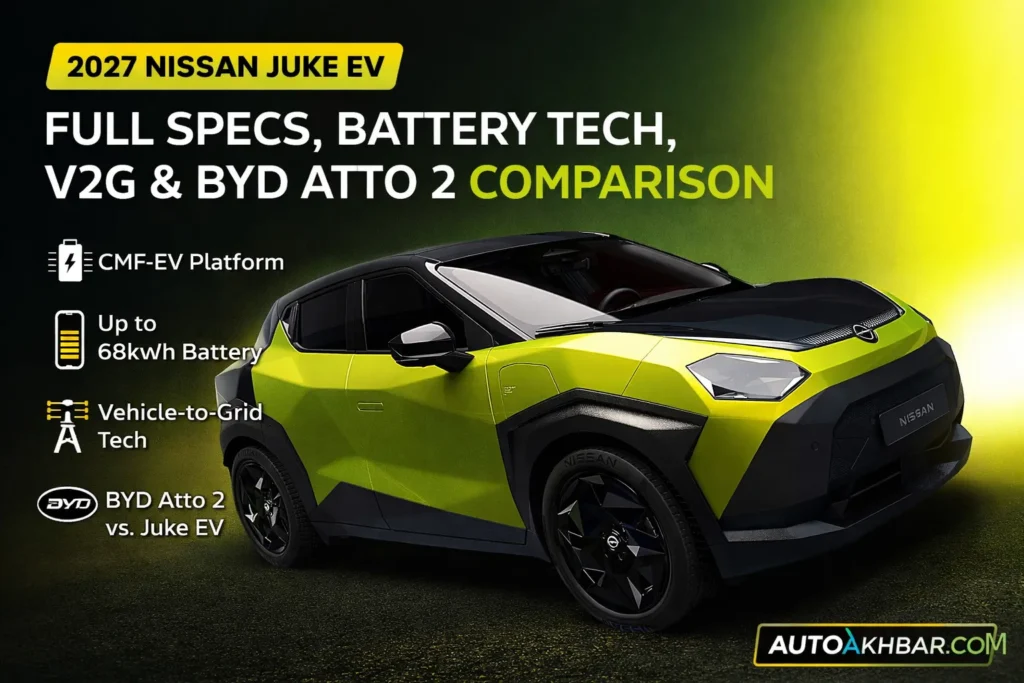
Table of Contents
The Juke Goes Electric
On April 14, 2026, Nissan did something that compact crossover fans have been waiting on for years: it officially unveiled the third-generation Juke — and this time, it’s fully electric. Announced at Nissan’s Vision Event at the company’s global headquarters in Yokohama, Japan, the all-new Juke EV represents one of the most significant pivots in the nameplate’s history.
Since its debut in 2010, the Juke has sold over 1.5 million units across Europe, becoming one of the most recognisable compact crossovers on the continent. It practically invented the quirky-crossover genre. But it always ran on petrol. Until now.
The 2027 Nissan Juke EV is the first-ever fully battery-electric version of the model, and it doesn’t arrive quietly. It comes with an angular, almost origami-like design, a shared platform with the new-generation Leaf, Vehicle-to-Grid charging capability, and a launch window of spring 2027 — exclusively for European markets to begin with.
Quick Context Nissan unveiled the Juke EV as part of its long-term “Mobility Intelligence for Everyday Life” vision, which also includes the new X-Trail Rogue Hybrid e-POWER, the Xterra for the US, and a renewed product portfolio strategy targeting 45 models globally.
This blog is a full deep-dive into the new Juke EV — covering the platform, battery technology, V2G capability, design philosophy, manufacturing details, and a head-to-head comparison with the BYD Atto 2, which is its most direct Chinese competition in the European compact EV crossover space.
CMF-EV Platform Explained
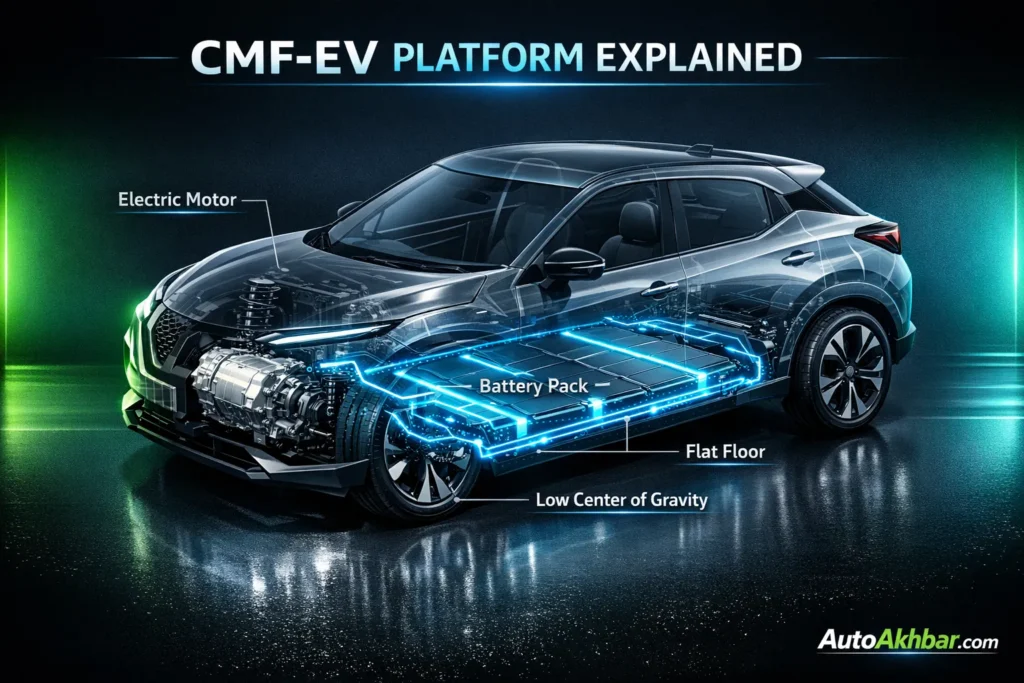
The foundation of the new Juke EV is the CMF-EV platform — also known as AmpR Medium in Renault-Nissan Alliance terminology. This is not a new or untested architecture. It’s a mature, purpose-built electric vehicle platform that already underpins some of the most well-regarded EVs currently on sale in Europe.
Why Tesla Is Bringing Back the Affordable Model 2
What Else Rides on CMF-EV?
If you want a sense of how competent this platform is, consider what it already powers: the Nissan Ariya, the Renault Mégane E-Tech, the Renault Scenic E-Tech, the Alpine A390, and the new third-generation Nissan Leaf. These are all critically well-received vehicles, particularly praised for their ride quality, refinement, and packaging efficiency.
Platform Fact The CMF-EV (also called AmpR Medium) is a fully modular EV-first architecture developed jointly by Renault and Nissan. Unlike adapted ICE platforms, it was designed ground-up for battery electric vehicles, allowing for a flat floor, low centre of gravity, and flexible battery packaging.
For the Juke, Nissan confirmed that the same wheelbase as the Leaf will be retained due to battery packaging requirements. However, the company will adjust overhangs and ride height to match the Juke’s traditional compact crossover proportions and more spirited character. Importantly, Nissan has also stated the Juke EV will get its own specific chassis tuning and steering setup, meaning it will feel notably different to drive than the more comfort-focused Leaf — with reports suggesting a considerably sportier feel befitting the Juke’s personality.
Why CMF-EV is a Big Deal
The platform’s significance goes beyond just being well-proven. CMF-EV enables technologies like bidirectional charging (V2G), fast DC charging at up to 150 kW, and over-the-air software updates. It also allows the Juke to benefit from the R&D investment of the entire Renault-Nissan Alliance — meaning it carries the engineering maturity of multiple production vehicles in its genes before it even reaches a customer driveway.
| Feature | Detail |
|---|---|
| Platform Name | CMF-EV / AmpR Medium (Renault-Nissan Alliance) |
| Platform Type | Purpose-built battery electric (not adapted ICE) |
| Shared With | Nissan Ariya, Leaf (Gen 3), Renault Scenic, Alpine A390 |
| Bidirectional Charging | Yes (V2G capable) |
| Chassis Tuning | Juke-specific (sportier vs Leaf) |
| Production Site | Sunderland Plant, UK |
| Drive Layout | Front-wheel drive (single motor, FWD) |
Battery Pack & Battery Technology
Nissan has not released final, confirmed specifications for the Juke EV just yet — that level of detail will come closer to the spring 2027 launch. However, because the Juke EV shares the CMF-EV platform directly with the third-generation Leaf, industry analysts and automotive publications widely expect the same battery options to carry over.
Expected Battery Options
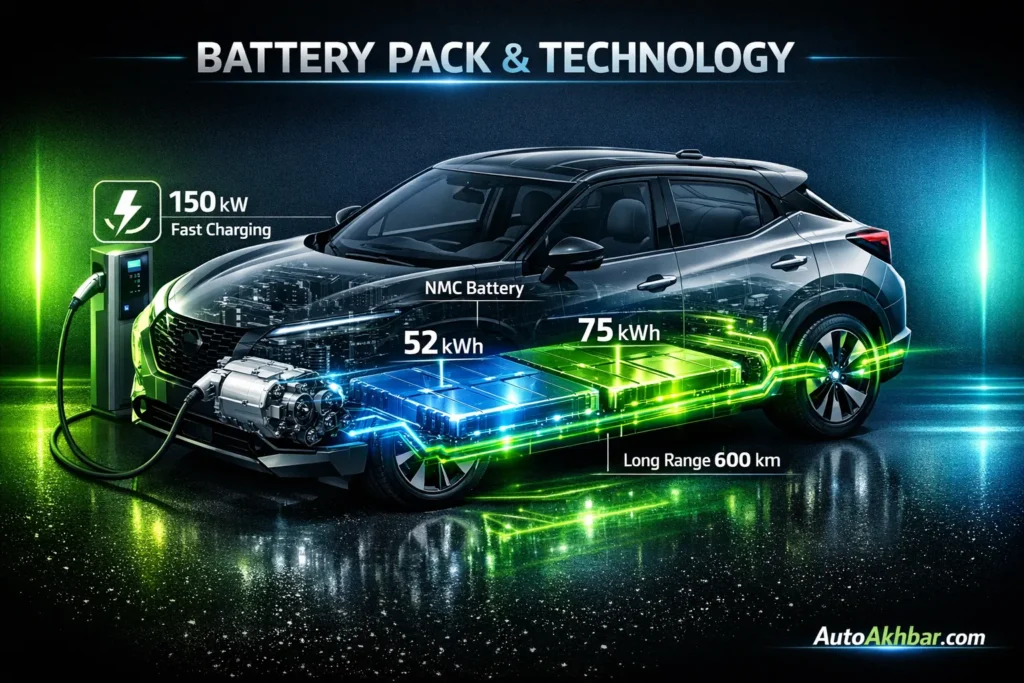
The new Leaf is offered with two battery sizes: a 52 kWh pack and a 75 kWh pack. Based on platform sharing, the Juke EV is expected to offer both of these options too. The 75 kWh battery version of the Leaf achieves a WLTP range of up to 622 km — a figure that would make the Juke EV one of the longest-range compact crossovers in its class if it carries those numbers over with minimal modification.
Expected Battery Specs (Based on CMF-EV / Leaf Reference) Standard pack: ~52 kWh · Long-range pack: ~75 kWh · Chemistry: NMC (Nickel Manganese Cobalt) · Peak DC charging: up to 150 kW · Estimated 10–80% charge: ~35 minutes · Front motor output: ~130 kW (174 hp) or ~160 kW (215 hp) depending on variant
NMC Chemistry: What It Means for You
The Leaf uses NMC (Nickel Manganese Cobalt) battery chemistry, and this is expected to carry over to the Juke EV. NMC cells offer a strong balance of energy density and performance. Compared to LFP (Lithium Iron Phosphate) batteries — which are common in Chinese EVs like the BYD Atto 2 — NMC chemistry delivers higher energy density, meaning more range from the same physical battery size. The trade-off is that NMC cells are somewhat more expensive to produce and require a more sophisticated battery management system.
Charging Speed Advantage
One area where the Juke EV is expected to significantly outperform the BYD Atto 2 is charging speed. The CMF-EV platform supports DC fast charging at up to 150 kW — more than double the 65–82 kW maximum of the entry-level BYD Atto 2 Boost variant. Even the BYD Atto 2’s larger Comfort variant tops out at 155 kW, making the platforms roughly comparable at the top end, but the Juke’s advantage becomes clear when comparing entry-level variants.
| Battery Spec | Juke EV (Expected) |
|---|---|
| Standard Battery | ~52 kWh NMC |
| Long-Range Battery | ~75 kWh NMC |
| Motor Output (Standard) | ~130 kW (174 hp) |
| Motor Output (Long-Range) | ~160 kW (215 hp) |
| Peak DC Charging | Up to 150 kW |
| 10–80% Charge Time | ~35 minutes |
| Estimated WLTP Range (52 kWh) | ~430–460 km |
| Estimated WLTP Range (75 kWh) | ~550–600 km |
| Battery Chemistry | NMC (Nickel Manganese Cobalt) |
It’s worth noting that these are industry estimates based on the platform and the Leaf’s confirmed specs. Official numbers from Nissan will follow ahead of the spring 2027 launch. But even based on conservative estimates, the Juke EV looks set to be a range leader in its class.
Vehicle-to-Grid (V2G) Technology
One of the most forward-thinking features of the 2027 Nissan Juke EV is its confirmed support for Vehicle-to-Grid (V2G) technology. This is a feature that most compact crossovers — even expensive ones — simply don’t offer. It puts the Juke EV in a genuinely small club.
What is V2G?
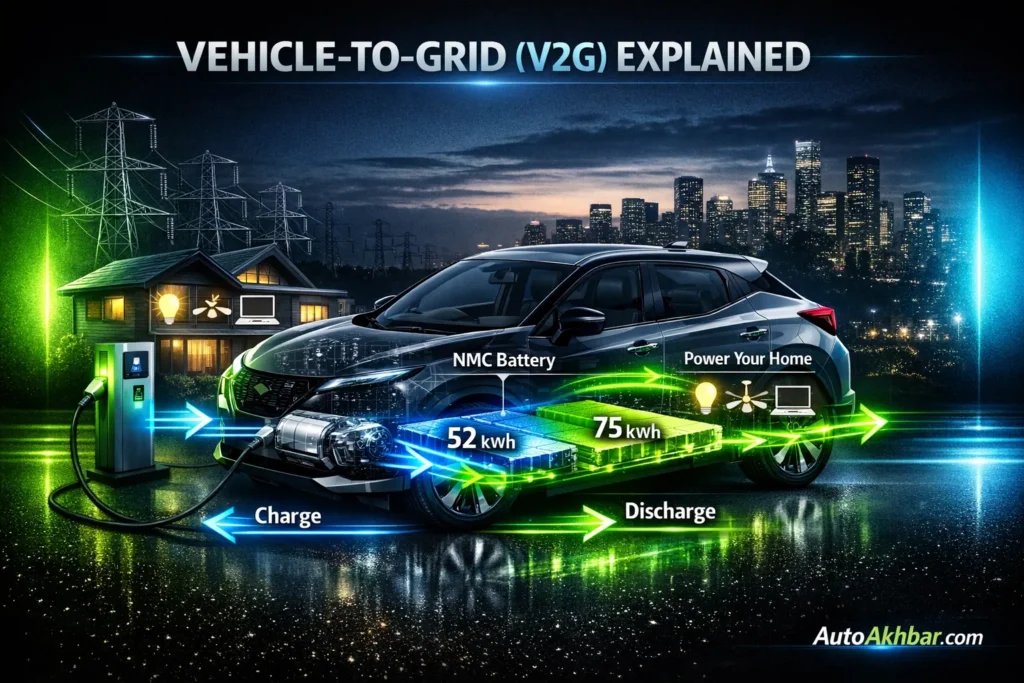
Vehicle-to-Grid technology turns your electric car into a mobile battery pack. Instead of just drawing power from the electricity grid when charging, a V2G-equipped car can also send electricity back to the grid when demand is high. This has real-world benefits: you can charge your car cheaply during off-peak hours (typically late at night), and then sell that electricity back during peak-demand periods — potentially earning money or credits on your energy bill.
On a broader societal level, V2G helps stabilise energy grids that are increasingly stressed by the intermittent nature of renewable energy sources like solar and wind. As more EVs hit the road, V2G-capable fleets effectively become distributed energy storage networks — something electricity companies are extremely keen on supporting.
V2G in Practice Nissan has been pioneering V2G technology since the first-generation Leaf. The new Juke EV joins the third-gen Leaf in offering this capability, making both vehicles part of the company’s broader energy ecosystem vision — not just transport products, but active participants in the energy grid.
Why This Matters for Juke Buyers
In practical terms, a Juke EV with V2G could allow a homeowner to run household appliances off their car’s battery during a power outage, charge other devices during camping or outdoor events, or participate in energy markets through grid export programmes. Several UK energy providers already offer V2G tariffs, and this number is growing rapidly. For buyers in countries with smart-energy incentive programmes — particularly across Northern Europe — V2G compatibility is a meaningful differentiator.
The BYD Atto 2, for comparison, does not support V2G. This is one area where the Juke EV holds a clear technological lead over its Chinese rival, and over most of the segment.
Design: Hyper Punk Inspired Geometry
If the Juke was always the eccentric of the compact crossover class, the EV version doubles down on that identity in extraordinary fashion. The third-generation Juke EV draws direct inspiration from the Nissan Hyper Punk concept, which was unveiled in 2024 to widespread attention for its almost aggressive geometric surfacing.
The production Juke EV is described as a “toned-down version” of that concept, but reviewers who attended the Vision Event in Japan suggest it still cuts an incredibly striking figure. The body features sharp, angular facets with clearly defined edges — a look that has been compared to a flat-shaded 3D model or a piece of origami folded into crossover form. Each panel transition is deliberate and precise, giving the car a presence unlike anything else in the compact EV space.
“JUKE has always stood for bold design and a willingness to challenge convention. With this third generation, we are bringing that spirit into the electric age.”— Clíodhna Lyons, Region Vice President, Product, Brand & Marketing Strategy, Nissan AMIEO
Nissan’s own language around the car is revealing: words like “daring,” “unconventional,” “personality,” and “emotion” appear repeatedly in the official communications. This is clearly a car that Nissan wants to be noticed, photographed, and talked about — a direct counter-strategy to the anonymous, inoffensive crossover design that many rivals (including the BYD Atto 2) have gravitated toward.
Interior photos have not yet been released, but given the platform sharing with the Leaf, buyers can expect a driver-focused, technology-rich cabin with a strong focus on digital integration, a quality materials step-up over the previous Juke, and — given the sportier chassis tuning — likely a slightly more driver-oriented seating position than the more relaxed Leaf.
Nissan just announced a new Juke, Skyline, and Xterra.
by u/Recoil42 in cars
Made in Sunderland, UK
The 2027 Nissan Juke EV will be manufactured at the Nissan Sunderland Plant in the north-east of England — one of the most productive car factories in Europe, and the cornerstone of Nissan’s European manufacturing footprint for over three decades.
Sunderland already builds the new third-generation Leaf, and Nissan has confirmed that the first trial phase of Juke EV production will begin “in the coming weeks” from April 2026. This production ramp timeline suggests that full customer deliveries in spring 2027 are on a solid industrial footing.
Sunderland Plant: Key Facts The Sunderland Plant has produced over 2.5 million Jukes in previous generations. It employs thousands of workers directly, with a supply chain supporting tens of thousands more across the UK. The EV36Zero investment programme has transformed it into a dedicated EV manufacturing hub.
Building the Juke EV in the UK has several important implications. First, it means European customers receive a car built in Europe, which is increasingly important to buyers thinking about supply chain transparency and environmental impact. Second, it helps Nissan comply with European content requirements that affect tariff costs. Third, it signals a long-term commitment to the UK as a manufacturing base — a commitment that carries political and industrial significance in the post-Brexit environment.
Nissan’s broader regional engineering capabilities — including design in London, engineering at Cranfield, and R&D partnerships across the UK and Europe — mean the Juke EV is genuinely a European product from concept to production line.
Nissan Juke EV vs BYD Atto 2
The BYD Atto 2 is currently the most relevant Chinese competitor in the compact electric crossover segment where the Juke EV will compete. Already on sale in the UK and Europe from around £30,850, the Atto 2 has established itself as a rational, well-equipped, and competitively priced option. Let’s see how it sizes up against the incoming Juke EV.
Head-to-Head Comparison
| ⚡ NISSAN JUKE EV | ASPECT | 🔋 BYD ATTO 2 |
|---|---|---|
| Spring 2027 | On Sale | Available Now (UK/EU) |
| ~£30,000 (est.) | Starting Price | £30,850 (Boost) / £34,950 (Comfort) |
| 52 kWh / 75 kWh NMC (expected) Range Leader | Battery | 51.1 kWh / 64.8 kWh LFP |
| ~430–600 km (est.) Edge | WLTP Range | 214–267 miles (344–430 km) |
| Up to 150 kW DC Faster | DC Fast Charge | 82 kW (Boost) / 155 kW (Comfort) |
| CMF-EV (purpose-built EV) EV-Native | Platform | e-Platform 3.0 |
| Yes ✅ Unique Feature | V2G Technology | No ❌ |
| ~174–215 hp (est.) | Motor Power | 174 hp (Boost) / 201 hp (Comfort) |
| Sunderland, UK 🇬🇧 | Manufactured | China 🇨🇳 |
| Heat pump (expected) | Winter Efficiency | Heat pump (standard) |
| Angular, Hyper Punk-inspired Distinctive | Design | Conservative, blends in |
| 15 years of EV heritage (Leaf lineage) | Brand EV Experience | World’s largest EV manufacturer |
Analysis: Who Wins What?
Range and battery size go to the Juke EV — the 75 kWh option gives it a significant advantage over the Atto 2’s largest 64.8 kWh offering, and the NMC chemistry should deliver better cold-weather real-world range performance than LFP cells.
V2G technology is a clear and unambiguous Juke EV win. The Atto 2 doesn’t support it, and in markets where V2G tariffs and smart charging incentives are growing, this could be a financially meaningful differentiator over the ownership period.
Charging speed at the entry level goes strongly to the Juke EV. The Atto 2 Boost’s 82 kW ceiling is noticeably slower than the Juke’s expected 150 kW ceiling — that’s a real-world charging time difference that matters on long journeys.
Availability currently favours the BYD Atto 2 heavily — it’s on sale today, while the Juke EV won’t reach customers until spring 2027. For buyers who need a car now, that’s a significant practical gap.
Design is subjective, but if you want something that genuinely stands out in a supermarket car park, the Juke EV’s Hyper Punk-inspired geometry is in a different visual universe compared to the Atto 2’s conservative crossover silhouette. Multiple reviewers of the Atto 2 have described it as “forgettable to look at” and something that “blends into traffic.”
BYD Atto 2: Where It Still Wins It is available today. Its LFP battery chemistry offers proven longevity and reduces battery degradation anxiety over time. The Comfort variant’s 155 kW charging speed is competitive. And the Atto 2 comes very well equipped at its price point — heated seats, ambient lighting, and 12.8-inch touchscreen are all standard.
Nissan’s Expanding European EV Lineup
The Juke EV doesn’t exist in isolation. It’s part of a much larger push by Nissan to electrify its entire European portfolio. As of 2026, Nissan’s European EV lineup includes the new Micra EV, the third-generation LEAF, the Ariya crossover, and the Townstar electric LCV. The Juke EV will join this family when it launches in spring 2027, and Nissan has also hinted at “a new A-segment EV to come” — suggesting an even more affordable city EV is on the horizon.
Importantly, Nissan is keeping its options open. The existing Juke HEV (hybrid) model will remain on sale alongside the new all-electric version. This reflects the reality of a market still in transition — not all customers are ready for full EVs, and Nissan’s e-POWER hybrid technology in the Qashqai and Juke HEV continues to serve buyers who want an electrified driving experience without the charging infrastructure requirement.
This dual-powertrain strategy is arguably more customer-friendly than a hard EV-only switch. It acknowledges that the compact crossover market spans a wide range of use cases and driving habits, from inner-city commuters who can charge at home every night, to rural drivers who cover long distances and depend on rapid charge network availability.
AI-Defined Vehicle Strategy
The Juke EV doesn’t just come with a new powertrain — it’s also positioned within Nissan’s broader AI-Defined Vehicle (AIDV) strategy. At the Vision Event where the Juke EV was unveiled, Nissan CEO Ivan Espinosa outlined a long-term vision called “Mobility Intelligence for Everyday Life”, which places artificial intelligence at the centre of the company’s future product development.
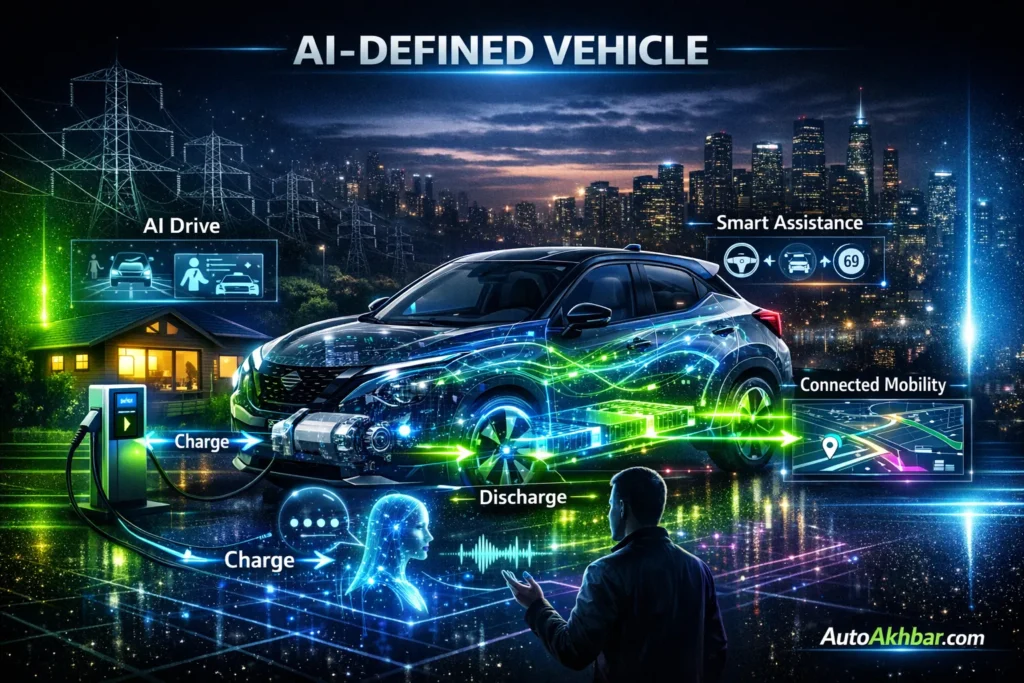
Under this vision, Nissan aims to deploy its AI Drive technology across 90% of its lineup over the long term. This combines advanced driver assistance systems — building on the existing ProPILOT technology — with AI-based vehicle control and safety integration. The company also described an “AI Partner” system that connects intuitively to support everyday activities, integrating the vehicle naturally into daily life beyond just getting from A to B.
“By advancing mobility intelligence, we will deliver products and technologies that are safer, more intuitive and more accessible with outstanding value and a more rewarding overall experience.”— Ivan Espinosa, President and CEO, Nissan Motor Co., Ltd.
While the full extent of AI features in the Juke EV specifically hasn’t been detailed yet, the platform it shares with the Leaf — and the broader investment Nissan is making in AI-enhanced driving systems — suggests buyers can expect meaningful advanced driver assistance, likely including ProPILOT-based highway driving assistance and enhanced connectivity features as standard or available options at launch.
This stands in interesting contrast to the BYD Atto 2, which comes with a capable 12.8-inch touchscreen and a functional ADAS suite but has received some criticism for being slow to adopt truly intuitive AI-driven interfaces. Nissan’s deeper commitment to AI integration across the vehicle’s functions could prove to be a meaningful differentiator in the premium-experience stakes.

Final Verdict
Our Take
What holds back unqualified enthusiasm at this stage is simply timing. We’re talking about a car that won’t reach customers until spring 2027, and full specs — pricing, confirmed battery sizes, interior photos — haven’t been released. The BYD Atto 2 is available today, starting from £30,850, and it’s a capable and well-equipped car despite its visual anonymity.
But if you’re planning ahead — and especially if features like V2G, long range, fast charging, and European manufacturing matter to you — the Juke EV looks like it will be one of the most compelling compact electric crossovers of 2027. The combination of a distinctive, genuinely head-turning design with meaningful technology advantages gives it a clear identity in a crowded segment.
In the words of Nissan’s own executives, Europe is central to this strategy. The Juke EV being built in Sunderland, engineered for European customers, and equipped with grid-integrated charging technology is a statement of intent from a brand that helped pioneer mass-market EV motoring with the original Leaf back in 2010. Now it’s bringing that same spirit to the compact crossover — and if the execution lives up to the reveal, it could be something very special indeed.
Key Takeaways
- First-ever fully electric Nissan Juke, based on the proven CMF-EV / AmpR Medium platform.
- Expected 52 kWh and 75 kWh NMC battery options with up to ~600 km range.
- V2G (Vehicle-to-Grid) support — a class-leading feature the BYD Atto 2 doesn’t offer.
- Built at Nissan’s Sunderland Plant in the UK, alongside the third-gen Leaf.
- Spring 2027 European launch, with pricing expected around £30,000.
- Design inspired by the Hyper Punk concept — angular, geometric, unmistakable.
- Juke HEV (hybrid) will continue alongside the EV, keeping customer choice open.
- Part of Nissan’s AI-Defined Vehicle strategy targeting 90% AI Drive adoption across lineup.
Sources & References
Nissan Global Newsroom — “Nissan sets long-term direction with Vision of Mobility Intelligence for Everyday Life” (April 14, 2026)
Nissan UK Newsroom — “Nissan Unveils All-New, All-Electric JUKE, Advancing Its European Electrification Strategy” (April 14, 2026)
Electric Drives TV, electrive.com, InsideEVs, CarScoops, paultan.org — Juke EV technical analysis (April 14, 2026)
Top Gear, What Car?, Autocar — BYD Atto 2 reviews and specifications
Note: Juke EV battery specs and range figures are estimates based on CMF-EV platform data and Nissan Leaf Gen 3 confirmed specs. Official Nissan specifications will be published ahead of the spring 2027 launch.
People Also Ask
What is the expected range of the Nissan Juke EV?
The 2027 Nissan Juke EV is expected to offer a range of around 430 km to 600 km (WLTP) depending on the battery variant.
Does the Nissan Juke EV support fast charging?
Yes, the Juke EV is expected to support DC fast charging up to 150 kW, allowing a 10–80% charge in around 30–35 minutes.
What is Vehicle-to-Grid (V2G) technology in the Juke EV?
V2G technology allows the car to send electricity back to the grid or power your home, making it more than just a vehicle.
Which platform is used in the Nissan Juke EV?
The Juke EV is based on the CMF-EV platform, a dedicated electric vehicle architecture also used in other Nissan and Renault EVs.
When will the Nissan Juke EV launch?
The Nissan Juke EV is expected to launch in spring 2027, initially in the European market.