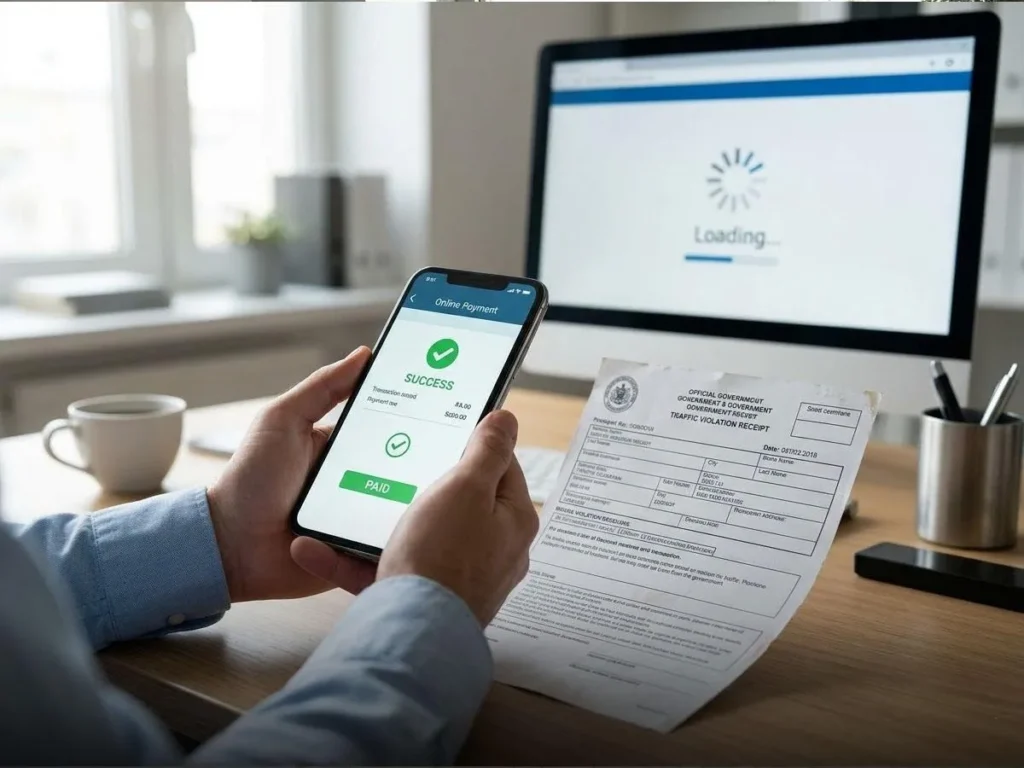
In theory, paying a traffic challan in India has never been easier. The government’s Parivahan portal exists precisely for this purpose, a single online destination where you can check pending fines and clear them from your phone. In practice, many people who have tried it will tell you a different story. One involving spinning loading screens, OTPs that never arrive, and payment confirmations that disappear into the void.
Third-party platforms like Cars24 have stepped in to offer an alternative. So how do the two actually compare when it comes to paying a challan online?
Table of Contents
What Parivahan Gets Right
Parivahan is the official government portal, and that matters. It is the primary source of challan data, pulling records directly from traffic police systems across states. If a challan exists against your vehicle number, it will eventually show up here. The portal also covers a wide range of vehicle services beyond challans, from RC status checks to fitness certificates, making it a useful reference point for anything transport-related.
For users in smaller towns and cities where not all third-party platforms may not have full coverage, Parivahan remains the most reliable source of ground truth information.
Where Parivahan Struggles
Here is where the experience starts to unravel for a lot of users. The portal runs into trouble during peak hours, particularly between 10 AM and 2 PM and again between 6 PM and 10 PM, when server load is highest. During these windows, pages time out, services become inaccessible, and users are met with the now familiar message: “Sorry, please try again.”
Login issues are common, often caused by OTP delays, incorrect credential prompts, or server-side problems that have nothing to do with the user. Poor network conditions on the portal’s end can delay or prevent OTP delivery entirely, leaving users stuck at the very first step with no way to proceed.
Payment failures add another layer of frustration. In some cases, the bank account is debited but the portal shows the transaction as failed or pending, forcing users to contact the helpdesk with transaction IDs and bank statements to get the issue resolved. This process can take 24 to 48 hours or longer before the payment status is updated.
New users often find the portal difficult to navigate, with features like challan checks and vehicle history not being immediately obvious. The interface, built to serve a wide range of government transport services, is not optimised for the simple task of looking up and paying a fine quickly.
What Cars24 Offers Instead
Cars24’s challan payment tool is built around one goal: making the process fast and frictionless. You enter your vehicle registration number, pending challans are fetched from the same Parivahan and state traffic databases, and you pay using UPI, a debit or credit card, or net banking. There is no account creation required, OTP is instant, and the interface is designed for mobile use from the ground up.
Because Cars24 is a private platform with its own infrastructure, it is not subject to the same server load problems that affect Parivahan during peak hours. If you need to pay a challan at 7 PM on a weekday, the chances of the process completing smoothly are meaningfully higher on Cars24 than on the government portal at that same time.
Payment confirmations on Cars24 are instant. There is no ambiguity about whether the transaction went through, which removes the anxiety of not knowing whether you have paid once or accidentally twice.
The Ecosystem Advantage
Beyond the payment experience itself, Cars24 ties challan status into a broader view of your vehicle. If you are using the platform to track your car’s resale value, check its service history, or verify RC details, pending challans appear as part of that overall picture. For someone actively managing a car through Cars24, whether for buying, selling, or routine checks, this context adds genuine utility that a standalone government portal cannot replicate.
This is especially relevant when buying or selling a car. Pending challans affect RC transfer and can reduce a vehicle’s assessed value. Catching and clearing them within the same platform you are using for the transaction is simply a better workflow.
Which One Should You Use?
For most people who just want to check and pay a challan without a fuss, Cars24 is the more reliable day-to-day option. The experience is consistent, the interface is clean, and the payment process does not depend on a government server being cooperative at that particular moment.
That said, Parivahan remains important as the authoritative source. If a challan is not showing up on Cars24 or any third-party platform, checking directly on Parivahan is always worth doing, particularly for challans issued recently or in states with slower database sync times. Parivahan is the official record, and Cars24 is the better way to read and act on it. For the actual payment experience, the choice is fairly clear.