


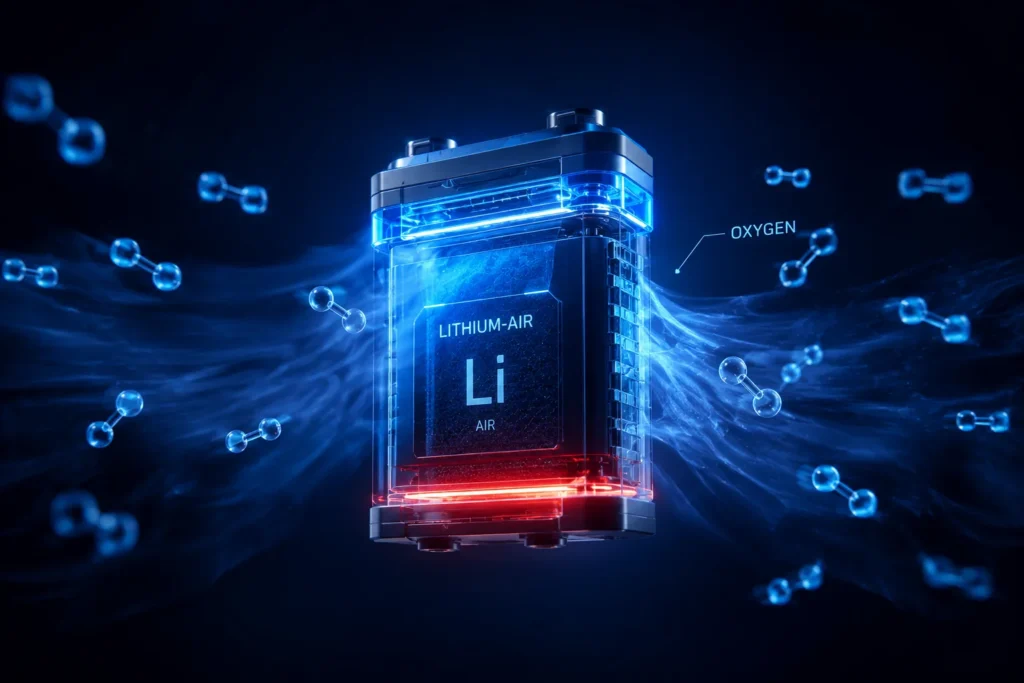
What if the battery in your next electric car could hold as much energy as a full tank of petrol?
That’s not science fiction anymore. In June 2026, CATL — the company that makes batteries for Tesla, BMW, Hyundai, and almost every major EV brand on the planet — officially announced that lithium-air batteries are their next big frontier. And the numbers they’re throwing around are genuinely mind-bending.
We’re talking about a theoretical energy density of 12,000 Wh/kg. For context, petrol sits at roughly 13,000 Wh/kg. Current lithium-ion batteries in today’s EVs? About 250–270 Wh/kg.
If this technology works at scale, it doesn’t just improve EVs — it could make them fundamentally better than petrol cars in every measurable way. Let’s break it down.
Table of Contents
So What Exactly Is a Lithium-Air Battery?
Think of a regular lithium-ion battery — the kind in your phone or today’s EVs. It’s a sealed box. Inside, you’ve got a lithium-based cathode (usually made from heavy metals like nickel, cobalt, or manganese) and an anode. Lithium ions shuttle back and forth between them as the battery charges and discharges. It works well, but the heavy cathode materials add weight and cost.
A lithium-air battery does something radically different: it replaces that heavy cathode entirely with oxygen from the surrounding air.
Yes — the battery literally breathes. That’s why researchers also call it a “breathable battery.” The lithium metal anode reacts with oxygen drawn from the atmosphere to produce electricity. When you charge it, the reaction reverses.
Because you no longer need to carry around heavy cathode metals, the battery is dramatically lighter. And because the cathode “reactant” — air — weighs almost nothing, the theoretical energy density shoots up to levels we’ve never seen in any practical battery system.
“Lithium-air batteries use atmospheric oxygen as the core electrode material. If CATL says this is the future, we’d better listen.” — NewMobility.news, June 2026
The 2026 Announcement: What CATL Actually Said
On June 3, 2026, at the Powering the Nation Forum in China, Wu Kai — CATL’s Chief Scientist and an Academician of the Chinese Academy of Engineering — publicly named lithium-air batteries as the company’s long-term strategic direction for the first time.
This is a big deal because CATL doesn’t make casual announcements. When this company commits to a direction, it typically means serious R&D investment, long-term manufacturing roadmaps, and eventually, real products. The same company predicted and pushed sodium-ion batteries years before anyone took them seriously — and as of 2026, sodium-ion is already in mass production.
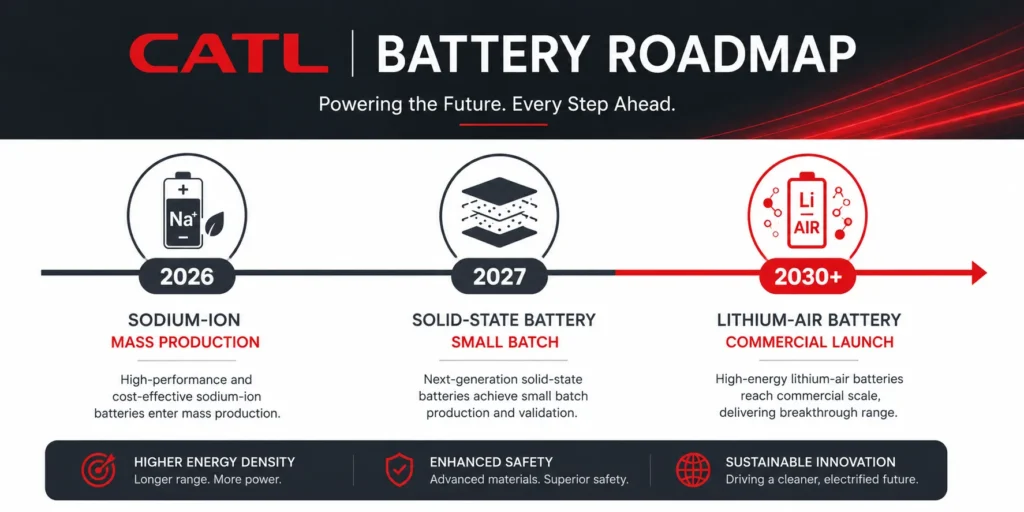
Wu Kai laid out a clear three-stage technology roadmap:
- 🔵 Sodium-ion batteries — Mass production underway in 2026 (already happening)
- ⚪ Solid-state batteries — Small-batch production expected from 2027
- 🔴 Lithium-air batteries — The long-term goal, deployment anticipated after 2030

The Numbers: What Makes This Technology So Exciting
Let’s put the figures into a simple table so you can see why the entire EV world is buzzing about this:
| Battery / Fuel Type | Energy Density | Status |
|---|---|---|
| Petrol (Gasoline) | ~13,000 Wh/kg | Commercial |
| Lithium-Air (Theoretical) | 12,000 Wh/kg | Research Stage |
| Lithium-Air (Lab Prototype, 2025) | 1,200 Wh/kg | Lab / Prototype |
| Solid-State Battery | ~500 Wh/kg | Near Commercial (2027+) |
| Current Best Li-ion (Today’s EVs) | 250–270 Wh/kg | Commercial |

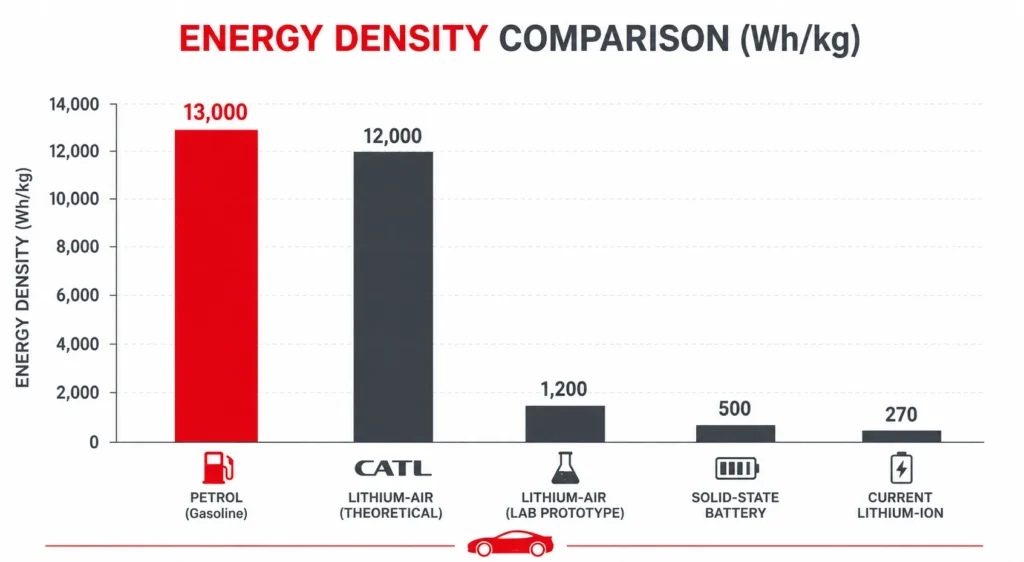
Even at the current lab prototype level of 1,200 Wh/kg — which is still far below the theoretical maximum — this technology is already 4 times better than the best lithium-ion batteries in today’s EVs. And it’s already better than solid-state batteries are expected to be even after commercialisation.
Recent Breakthroughs That Made This Possible
Lithium-air isn’t a new idea — researchers have been chasing it since the 1970s, and IBM famously tried to commercialise it before quietly shelving the project. So what’s different now?
Two critical recent breakthroughs changed the game:
2024 — Stable Cycling in Real Air
A joint research team from the University of Illinois Chicago, Argonne National Laboratory, and California State University, Northridge demonstrated a lithium-air battery capable of over 700 charge-discharge cycles in an air-like environment. Previously, the battery would degrade rapidly when exposed to moisture and CO₂ in real air. This team proved it could be managed.
2025 — The Breakthrough That Convinced CATL
Argonne National Laboratory and the Illinois Institute of Technology developed a prototype that achieved 1,200 Wh/kg at room temperature with over 1,000 charge-discharge cycles. The secret was a hybrid electrolyte approach — combining solid and liquid electrolytes to prevent the decomposition caused by oxygen byproducts. One thousand cycles is widely considered the practical durability threshold for automotive applications. This moved lithium-air from “theoretically interesting” to “worth serious industrial investment.”
When CATL’s chief scientist sees results like this, he announces it as a strategic priority. The pieces are falling into place.
What Are the Challenges? (Being Honest Here)
Let’s be real — this technology is not coming to a showroom near you in 2027. There are genuine engineering hurdles that still need to be solved:
- Moisture and CO₂ sensitivity: Real air contains water vapor and carbon dioxide, which can degrade the lithium metal anode and clog the air cathode. Solutions exist in labs, but scaling them is hard.
- Parasitic reactions: Oxygen byproducts during discharge (mainly lithium peroxide) can block the cathode and reduce efficiency over time. The 2025 hybrid electrolyte breakthrough addressed this, but not entirely.
- Lithium metal anode: Using pure lithium metal is more energy-dense but less stable than the graphite anodes in today’s batteries. Dendrite formation (tiny spikes of lithium that can cause short circuits) remains a concern.
- Charge efficiency: Lithium-air batteries currently have lower round-trip efficiency than lithium-ion — meaning more energy is wasted during charging.
- Manufacturing complexity: The open architecture needed to let air in (while keeping everything else out) adds significant production complexity.
CATL is fully aware of these challenges. That’s precisely why they’re placing this technology in the post-2030 window — not as a near-term product, but as a long-term strategic direction. Their sodium-ion and solid-state batteries will carry them through 2027–2030, while the R&D on lithium-air matures.
CATL’s Master Plan: Why They’re Playing a Very Long Game
CATL’s lithium-air announcement isn’t happening in isolation. The company currently holds a 47% global market share in power batteries (as of April 2026) and sold 121 GWh of energy storage batteries in 2025 alone, ranking #1 worldwide for the fifth year running.
Their strategy is layered: solve the near-term with sodium-ion (cheaper, uses abundant materials), bridge the mid-term with solid-state (safer, higher density), and dominate the long-term with lithium-air (game-changing density). Each technology they’ve committed to has eventually reached production. Their track record suggests lithium-air will be no different — it’ll just take time.
“CATL first proposed sodium-ion in 2020. By 2026, it’s in mass production. Lithium-air gets a similar treatment — but the timeline is longer, the stakes are much higher.” — AutoAkhbar
What Does This Mean for India?
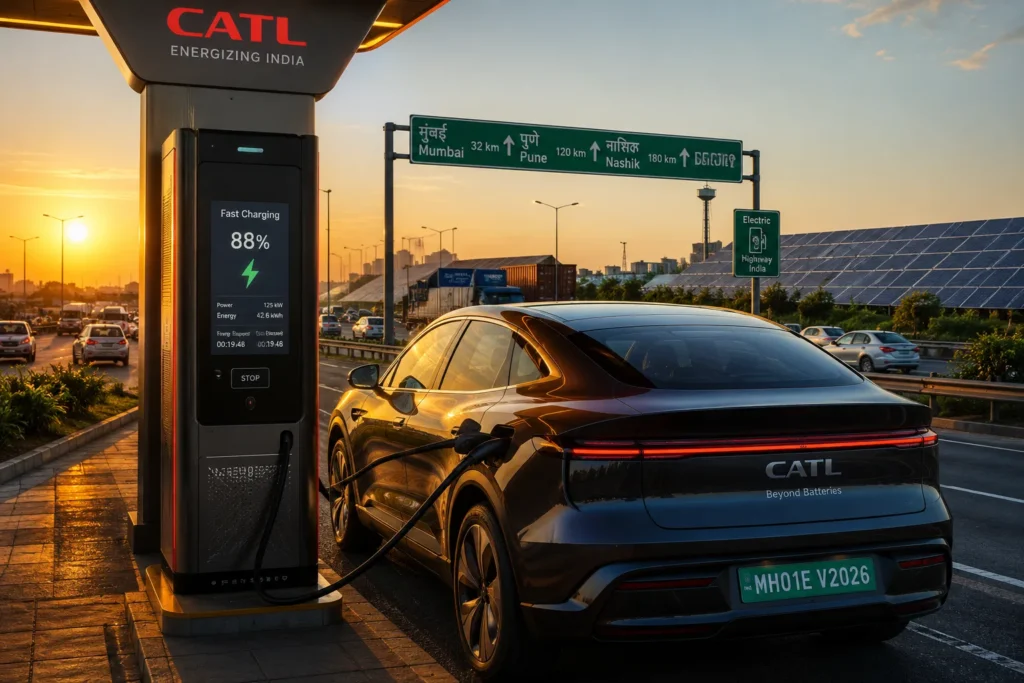
India’s EV revolution is real, but it has a serious problem: range anxiety and battery cost. As of 2026, India’s EV two-wheeler penetration is around 20%, but the passenger car segment has been relatively slow — and a big part of that is the cost and range limitations of current lithium-ion batteries.
India also faces a deeper issue: its EV industry is heavily dependent on imported battery cells, largely from China. A 20–30% increase in cathode material costs could translate to 12–21% increases in total battery costs — a significant hit for a price-sensitive market like India.
Lithium-air batteries, if commercialised, could change multiple things for Indian consumers:
- Range anxiety solved permanently: If even a fraction of the 12,000 Wh/kg potential is unlocked commercially, an EV range of 1,600 km (as projected in current research) would make a single charge outlast multiple full tanks of petrol.
- Lower material dependence: Lithium-air batteries use no cobalt, no manganese, and minimal cathode materials — the supply chain complexity drops dramatically. For India, which struggles with lithium and cobalt supply chains, this is crucial.
- Lighter vehicles: Less battery weight means more efficient vehicles, especially important for the two-wheeler and three-wheeler segments that dominate India’s EV numbers.
- Cost potential: No expensive cathode metals = potentially much cheaper cells at scale. This aligns directly with what the Indian market needs.
India’s EV story is being written right now. Technologies like CATL’s lithium-air research will determine whether Indian consumers get affordable, long-range EVs by 2035 — or whether the country stays dependent on expensive imported cells. Check our full guide to electric cars available in India today to see where the market stands right now.
How Is Lithium-Air Different from Hydrogen Fuel Cells?
A fair question — both technologies involve reactions with ambient gases. But the two are fundamentally different:
- Hydrogen fuel cells use hydrogen gas (which must be stored in high-pressure tanks) and produce electricity through a chemical reaction with oxygen, with water as the byproduct.
- Lithium-air batteries store energy electrochemically in lithium metal, using ambient oxygen only as a cathode reactant during discharge. They’re rechargeable like a regular battery.
Lithium-air batteries don’t need hydrogen infrastructure. They charge from a regular socket (in theory) just like today’s EV batteries. That’s a huge practical advantage for mass adoption — especially in countries like India where building hydrogen infrastructure would take decades and massive investment.
The Competition: Who Else Is Working on This?
CATL’s announcement has put lithium-air into the mainstream spotlight, but several other players have been quietly working on similar ideas:
- IBM Research (Project Battery 500) — Started serious lithium-air research years ago, though progress has been slow and relatively quiet recently.
- Liox Power (MIT spin-off) — Working on lithium-air cells with advanced electrolyte systems.
- Solid Power, QuantumScape — Primarily solid-state focused, but both are researching lithium metal anodes that overlap with lithium-air chemistry.
- Multiple Chinese universities — Following CATL’s announcement, expect a significant surge in Chinese academic and industrial research funding into lithium-air.
What CATL brings is scale, manufacturing expertise, and the ability to commercialise. When CATL calls something a strategic priority, the industry follows.
Timeline: When Will This Reach Production?
Here’s an honest, realistic assessment:
- 2026–2027: Lab research intensifies; CATL increases investment in lithium-air R&D alongside sodium-ion scaling.
- 2027–2028: Solid-state batteries enter small-batch production. Lessons from solid-state (especially on lithium metal anodes) feed directly into lithium-air development.
- 2029–2030: Advanced lithium-air prototypes with improved cycle life and humidity tolerance expected from CATL and research partners.
- Post-2030: First small-scale commercial deployments possible — likely in stationary energy storage before EVs.
- 2035+: Potential for EV integration if manufacturing challenges are solved at scale.
The Argonne/IIT roadmap also specifically projects lithium-air to be “ready for deployment after 2030.” These timelines align remarkably well.
The Bottom Line
CATL’s lithium-air battery announcement in June 2026 is one of the most significant statements in the history of EV battery development. It’s not a product launch — it’s a declaration of direction from the company that controls nearly half the world’s battery market.
The technology is real, the breakthroughs are happening, and the timeline is ambitious but credible. For Indian car buyers and EV enthusiasts, this is the kind of long-term development that could make the electric vehicles of the 2030s genuinely better than anything available today — in range, cost, weight, and supply chain independence.
The EV revolution isn’t over. It’s just getting started. Explore more electric vehicle coverage on AutoAkhbar to stay ahead of every development that matters for Indian buyers.
And when CATL does finally put a lithium-air battery in a car? We’ll be the first to tell you about it.
External Sources for Further Reading:
- CATL sets sights on lithium-air technology — Car News China
- CATL Developing 12,000 Wh/kg Lithium-Air Battery — CleanTechnica
- CATL Aims for 12,000 Wh/kg Breakthrough — Battery-Tech Network
FAQ CATL Lithium Air Battery
What is CATL’s lithium-air battery and why is it a big deal?
CATL’s lithium-air battery is a next-generation EV battery that uses oxygen from the surrounding air as a cathode material instead of heavy metal oxides. Its theoretical energy density of 12,000 Wh/kg is close to petrol — nearly 45 times better than today’s mainstream EV batteries. CATL publicly identified it as a strategic priority for the first time at the 2026 Powering the Nation Forum.
When will CATL lithium-air batteries be available in electric cars?
CATL’s roadmap places lithium-air deployment after 2030. Solid-state batteries will enter small-batch production in 2027, with lithium-air coming after that. Current lab prototypes already achieve 1,200 Wh/kg and 1,000+ charge cycles at room temperature, but commercial-scale manufacturing challenges still need to be solved. Realistic EV integration is expected around 2033–2037.
How is a lithium-air battery different from a regular lithium-ion battery?
A regular lithium-ion battery is a sealed system using heavy metal cathodes (nickel, cobalt, manganese). A lithium-air battery replaces that entire cathode with oxygen drawn from the atmosphere, making it far lighter and dramatically more energy-dense. Think of it as a battery that “breathes” air — similar in concept to how a human lung works during respiration.
What is the energy density of CATL’s lithium-air battery?
The theoretical maximum energy density of lithium-air technology is 12,000 Wh/kg — roughly equal to petrol. Lab prototypes (Argonne/IIT, 2025) have achieved 1,200 Wh/kg with 1,000 charge cycles at room temperature. For comparison, today’s best lithium-ion EV batteries offer 250–270 Wh/kg, and solid-state batteries are expected to reach ~500 Wh/kg.
Will lithium-air batteries benefit Indian EV buyers?
Yes, significantly. Lithium-air batteries use no cobalt or manganese, reducing India’s dependence on expensive imported cathode materials. They could enable EV ranges exceeding 1,600 km, completely eliminating range anxiety. They would also be lighter (important for India’s two-wheeler dominant market) and potentially cheaper at scale — a critical factor for price-sensitive Indian consumers.
What are the main challenges stopping lithium-air batteries from reaching market?
The key challenges are: sensitivity to moisture and CO₂ in real air, degradation from oxygen byproducts (lithium peroxide) in the cathode, instability of the pure lithium metal anode, lower charge efficiency compared to lithium-ion, and complex open-architecture manufacturing. The 2025 Argonne/IIT breakthrough using hybrid electrolytes addressed several of these, but scaling remains the big challenge.
Is CATL the only company working on lithium-air batteries?
No. IBM, MIT spin-offs like Liox Power, and several Chinese and American university research groups have been working on lithium-air technology for years. However, CATL’s announcement brings unmatched manufacturing scale, capital, and commercial execution capability to the space — making their involvement the biggest signal yet that this technology is approaching viable production timelines.