



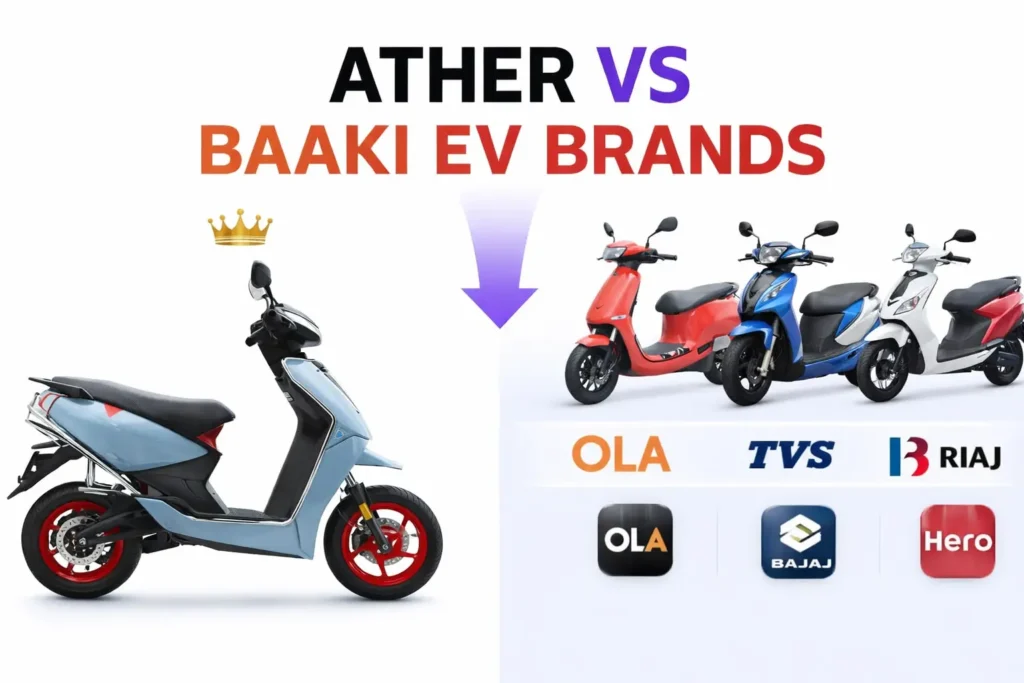
There is a company that created the electric scooter market in India — but could not become number one in the beginning. Not because their product was bad. Quite the opposite: because their product was too good. And now, finally, they have made a stunning comeback to become one of the top three electric scooter companies in the country. Ahead of them stand only TVS and Bajaj — legacy giants with decades of distribution muscle. Among pure startups, this company is the undisputed number one.
This company is widely called the Apple of the Indian electric scooter market. I’m talking about Ather Energy. The story behind this brand — how it started, why it fell behind, and how it staged one of the most remarkable comebacks in Indian startup history — is something every business thinker, investor, and EV enthusiast needs to understand.
2013
Year Founded
55
Prototypes Before Launch
120%
IPO Returns in 9 Months
#3
EV Scooter Brand in India
Table of Contents
The Origin: Two IIT Madras Students Who Wanted to Change Energy
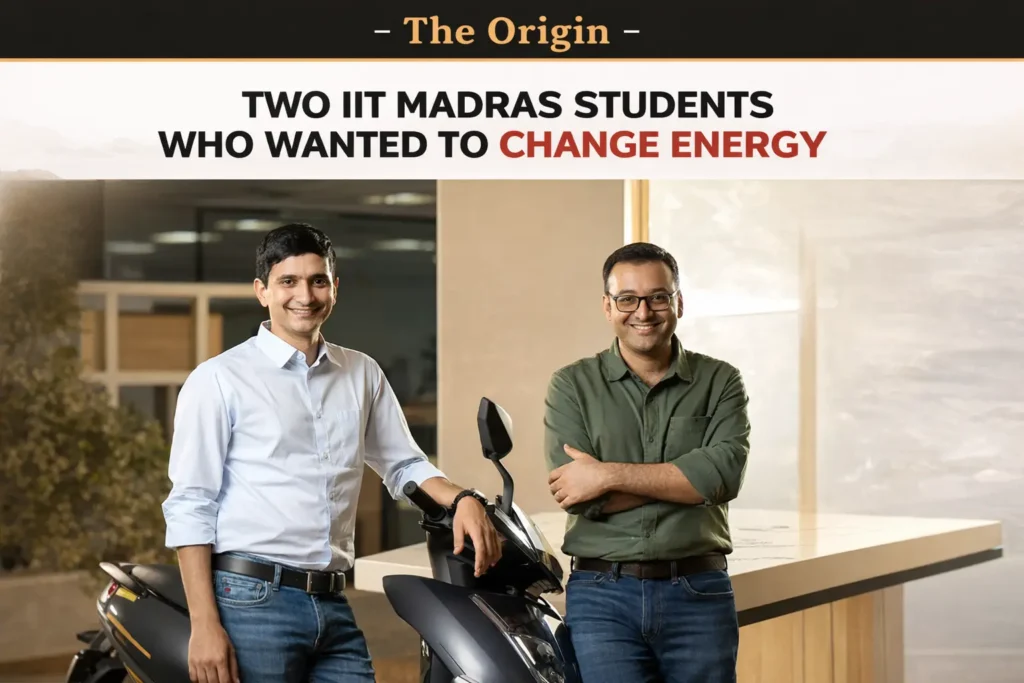
Ather Energy’s story begins at IIT Madras with two students — Tarun Mehta and Swapnil Jain. While most of their peers were preparing for placements, these two were running energy experiments in the college lab. They tried building systems where energy from a lamp could power a fan — small, ambitious ideas aimed at solving real-world energy access problems in rural India.
During one of these experiments, they stumbled upon the electric scooter space. Their initial plan was simple: build better batteries and sell them to scooter manufacturers. But to build a better battery, they needed to understand the actual pain points — so they went out and spoke to real users.
What they heard was not about batteries at all. Users were frustrated with the electric scooters themselves — the speed was terrible, the power was embarrassing on any incline, the battery indicator was unreliable, and the design looked embarrassing enough that friends would mock the owner.
That research moment changed everything. If the scooter itself was the problem, why just fix the battery? Why not build the entire scooter? And that is exactly what they decided to do. In 2013, Ather Energy was born.
Building from Scratch: 5 Years, 55 Prototypes
From day one, Ather made a decision that would define everything: no imports from China. At a time when every other player was simply importing Chinese scooters and slapping an Indian label on them, Tarun and Swapnil said they would design and manufacture in India — entirely.
Their inspiration came from Tesla. They wanted to build something that was visually beautiful, performance-driven, and made the idea of electric mobility aspirational — not a compromise. Their stated goal was not to build the best electric scooter. It was to build the best scooter, period — one that would outperform petrol vehicles.
They walked into the robotics lab at IIT Madras, picked up a Yo Excel scooter, dismantled it component by component, and started understanding how every part worked. In just four months, they had their first naked prototype — no body panels, just wires and components — and it already outperformed every existing electric scooter on the market.
IIT Madras gave them ₹5 lakh as seed funding. When that ran out, they turned to crowdfunding — offering 25 scooters at ₹85,000 each in advance bookings. That caught the attention of an IIT alumnus, Srini V Srinivasan, who handed them ₹25 lakh personally. That money allowed Ather to move out of the lab and into their first real office.
IIT Madras gave them ₹5 lakh as seed funding. When that ran out, they turned to crowdfunding — offering 25 scooters at ₹85,000 each in advance bookings. That caught the attention of an IIT alumnus, Srini V Srinivasan, who handed them ₹25 lakh personally. That money allowed Ather to move out of the lab and into their first real office.
Funding kept coming in. Sachin Bansal and Binny Bansal of Flipkart invested $1 million (₹6 crore). Then Tiger Global put in $12 million (₹72 crore). And in December 2016, the game changed completely when Hero MotoCorp invested ₹205 crore for a 26% stake. That partnership gave Ather not just capital but vendor relationships — something they desperately needed.
2013
Ather Energy founded by Tarun Mehta and Swapnil Jain at IIT Madras
2016
S340 model announced; Hero MotoCorp invests ₹205 crore for 26% stake
2018
First product launched — world’s first electric scooter with touchscreen and Google Maps
2020
TVS and Bajaj enter the EV scooter market with affordable, mass-market models
2021
Ola Electric enters with massive marketing and subsidized pricing
2025
Ather IPO at ₹12,000 crore valuation; market cap hits ₹27,000 crore within 9 months
The Product That Was Ahead of Its Time
When the first Ather scooter finally launched in 2018, it was genuinely revolutionary. It was the world’s first electric scooter with a touchscreen dashboard running Google Maps. Its acceleration was faster than any scooter available — petrol or electric. The build quality was exceptional.
But there was a brutal financial reality underneath. Each scooter cost ₹5 lakh to manufacture, yet had to be sold at ₹1.1–1.25 lakh. Every single unit sold was a significant loss. With R&D heavy, production volumes low, and no scale, the unit economics were catastrophic.
Global consultants were called in. Their verdict was blunt: a 30% cost reduction is the maximum possible for any automobile company. Ather needed 80%. Every expert said it was impossible. Ather had to solve it themselves — and they did, over 61 months of relentless engineering iteration, design changes, and vendor negotiations, ultimately bringing the cost per unit down to profitability levels.
Ola MoveOS 6 Update Features Explained
When the Market Shifted and Ather Got Left Behind
While Ather was grinding on cost reduction and quality, the competitive landscape exploded. TVS and Bajaj entered in 2020 with affordable, mass-market electric scooters and the full force of their national dealer networks. Then in 2021, Ola Electric arrived with aggressive pricing, enormous marketing budgets, and government PLI subsidies that Ather — being too small at the time — did not qualify for.
The brand that invented this category was now invisible to the average Indian buyer. Ola, TVS, and Bajaj had become synonymous with electric scooters. Ather, despite having the best product, had low production capacity, no mass marketing, and a premium price point that limited its addressable market.
It genuinely looked like Ather’s moment had passed. But underneath this apparent stagnation, the team was building five things that would engineer their comeback.

Five Moves That Brought Ather Back
Move 1 — Building a Full Ecosystem, Not Just a Scooter
Ather understood early that selling a vehicle was only part of the game. Post-sale experience would define whether customers returned and recommended the brand. So they built service infrastructure in parallel with sales infrastructure. By the time of their IPO filing in December 2024, Ather had 280 experience centers (sales) and 238 service centers — a ratio of 85 service points for every 100 sales points. That is an extraordinary commitment to after-sales quality.
Move 2 — The Ather Grid: A Proprietary Fast-Charging Network
Ather built its own fast-charging network — the Ather Grid — across major urban corridors, tourist destinations, and city interchange points. But then they did something unexpected: they opened the IP. They formalized the standard as LECCS (Light Electric Combined Charging System), got it approved by the Bureau of Indian Standards (BIS), and made it available to the entire industry.
Today, companies like Hero, V, BT, and Earth are all using this standard. Ather built the EV charging infrastructure for India and then gave it away — creating an ecosystem that benefits the entire industry while cementing Ather’s reputation as the technical leader. You can learn more about India’s EV charging standards at the Bureau of Indian Standards.
Move 3 — Software as a Revenue Stream
Ather recognized that their scooter was not just hardware — it was a software platform. They built Ather Stack, a subscription software layer that offered features, navigation, analytics, and remote diagnostics. Of every customer who buys an Ather scooter, 85% also subscribe to Ather Stack. That is a recurring software revenue stream baked directly into the hardware business — a model borrowed straight from the Silicon Valley playbook and applied to Indian two-wheelers.
Move 4 — The Rizta: India’s Family Scooter Moment
Ather’s earlier models were brilliant but positioned as urban youth scooters — compact, sporty, and solo-riding friendly. But India’s mass market runs on the family scooter: large underseat storage, comfortable for two adults, practical for daily errands. This is the segment that Honda Activa and Bajaj Chetak dominated for decades.
When Ather research confirmed this gap, they launched the Rizta — a family-oriented, larger-format electric scooter starting at ₹1 lakh, making it the most affordable Ather ever. In its first year, Rizta sold over 1 lakh units. Within six months of that, it crossed 2 lakh units. What Honda Activa did for Honda’s mass-market dominance, Rizta has done for Ather’s volume ambitions.
Move 5 — IPO Capital Deployed With Discipline
Ather’s IPO came in May 2025 at a valuation of ₹12,000 crore. Of the ₹3,000 crore raised, only ₹350 crore went to OFS (existing investor exits) — the rest, ₹2,626 crore, came directly into the company. That capital was deployed with surgical focus:
- ₹927 crore — New manufacturing plant to scale capacity from 4 lakh to 14 lakh units annually
- ₹750 crore — R&D investment, continuing the core DNA of the company
- ₹300 crore — Marketing, finally giving the world a chance to hear what Ather had been quietly building
Within nine months of the IPO, Ather’s market cap reached ₹27,000 crore — a 120% return for investors who came in at listing. For more on Ather’s financials and IPO details, refer to their official Ather Energy investor page.
The Numbers That Tell the Real Story
₹35Cr
Revenue in March 2020
₹3,173Cr
TTM Revenue (Latest 12M)
65x
Revenue Growth in 5 Years
–26%
Operating Loss (vs –523% in 2020)
The operating loss trajectory is particularly telling. In 2020, Ather’s operating loss was –523% — meaning a scooter that cost ₹623 to build was being sold for ₹100. By March 2025, that figure had compressed to just –26%. The company has not yet turned profitable, but the direction is unmistakable and the trajectory is steep.
In Q3 of Financial Year 2026, Ather’s overall market share reached 18%. In South India, they hold a 24% market share and still lead the region. In Middle India — Gujarat, Maharashtra, Odisha, Madhya Pradesh — their share doubled in a single year from 8.8% to 17.4%. Gujarat saw them at 25%, Maharashtra at 18.6%, and Rajasthan, Punjab, and Jammu & Kashmir all now fall in the 14–16% market share range.
From 280 experience centers in December 2024 to over 600 centers by the time this was written. The expansion is not gradual — it is a sprint.
Why the Indian EV Market Makes This Story Even Bigger
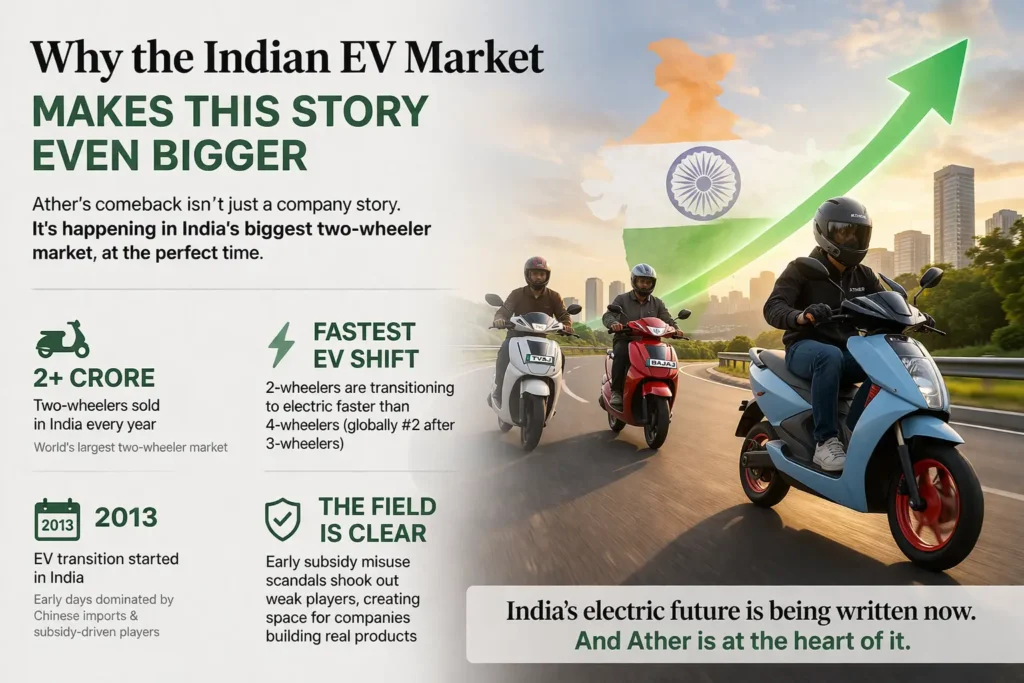
India is the world’s largest two-wheeler market, selling over 2 crore two-wheelers annually. The EV transition in this market is accelerating — and the two-wheeler segment is seeing the second-highest EV transition rate globally, just behind three-wheelers and ahead of four-wheelers.
This transition started in 2013, but early on it was driven by Chinese imports and subsidy farming. When major players like Okaya and Hero Electric were found misusing FAME subsidies, they effectively vanished from the market overnight. That cleared the field for players who had built real products — and nobody had built a more real product than Ather.
As production scales to 14 lakh units annually with the new plant, and as the Rizta continues its mass-market penetration, Ather is positioned to be the defining Indian EV brand of this decade. For a comprehensive view of India’s EV market trends, the VAHAN Dashboard by the Ministry of Road Transport tracks real-time EV registrations across the country.
The R&D Culture That Makes Ather Different
One number stands out above all others in Ather’s DNA. According to their Red Herring Prospectus, Ather spends 15% of revenue on Research & Development — not profit, revenue. For every ₹7 earned, ₹1 goes straight back into R&D.
Of their 3,500 employees, 950 work exclusively in R&D — nearly one in three. Even from their ₹3,000 crore IPO raise, ₹750 crore was earmarked for R&D. This is not a marketing-first company that cuts corners on engineering. This is a research-first company that is finally learning to market itself properly.
That balance — deep technical excellence combined with commercial discipline — is precisely what separates sustainable companies from flashes in the pan. You can explore Ather’s technology roadmap and product specs at their official product page.

Business and Life Lessons from the Ather Story
01
Quality always wins — eventually
If you chase quick money and shortcuts, you may win early but you will not last. If you focus relentlessly on product quality and customer value, the win is slower but it is permanent. Ather fell behind precisely because they refused to compromise — and that same refusal to compromise is what brought them back.
02
A great product in silence is a wasted product
If a peacock dances in the jungle with no one watching, did it dance at all? Ather built a genuinely superior product for years and stayed invisible because they neglected marketing. The lesson is hard but clear: marketing is not optional. It is as important as the product itself.
03
Your customers already know what they need — just listen
Tarun and Swapnil went into research expecting to learn about batteries and came back knowing they needed to build a whole new scooter. No consulting firm, no framework, no strategy deck told them that. A real conversation with real users did. Listen to customers. They always know the answer.
Ather Energy has not yet made a single rupee of net profit. But the trajectory — 65x revenue growth in five years, losses compressing from 523% to 26%, a market share that keeps climbing quarter after quarter — tells the story of a company that was right from the very beginning, just early. And in business, being early and staying alive long enough to be proven right is the hardest thing of all.
India’s electric future is being written right now. And Ather — the pioneer that almost got written off — is writing some of its most important chapters.
An analysis based on publicly available data from Ather Energy’s Red Herring Prospectus, VAHAN registration data, and industry reports.





Pingback: EDF Ev Rule 2026 : What is the 80% Rule for EV?